
Revision summary
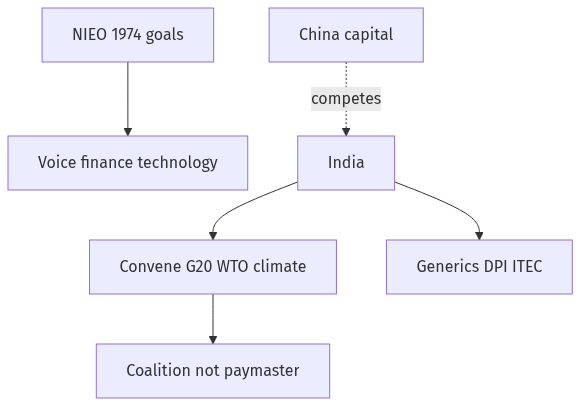
NIEO sought fairer trade, finance, technology and voice for developing countries; it stalled in the late 1970s. India’s potential is to convene the South (G20, Voice of Global South), defend WTO food space, and offer generics and digital public infrastructure. Quad-plus-BRICS seating lets India translate between South and G7. China is the capital competitor; India is not a global paymaster; neighbourhood gaps weaken the claim. Realistic leadership is coalition and agenda-setting toward a less overcentralised order.
Model answer
Copper italics in this answer — like this — are the key facts. Each one is unpacked in the Facts & figures rail.
Introduction
The New International Economic Order (NIEO) of 1974 asked for fairer commodity prices, technology transfer, more voice in the IMF and World Bank, and policy space for development. It stalled against Northern power. The question is what India could do as a leader of the Global South to revive that goal in this century. The potential is as a coalition builder, not as a substitute for Chinese capital or a new Bretton Woods by itself.
Body
What a twenty-first-century NIEO would mean
It would mean reformed IMF quotas, a usable WTO for food and industrial policy (India’s clout in 5(c)), climate finance that is not only a Northern sermon, digital public infrastructure that is not only Silicon Valley’s, and South–South value chains. It would still face Wallerstein’s hierarchy: core money and technology do not move by speech.
India’s potential role
India can convene. The Voice of Global South summits and the G20 presidency put African Union membership and development language on a high table. At the WTO India already speaks a food-and-livelihood dialect many poor members share. Vaccine manufacturing and generic medicines are a material NIEO fragment: health goods at Southern prices. Digital public infrastructure can be offered as a public good rather than as a Chinese smart-city bundle or a purely American platform. ITEC training and peacekeeping remain people-to-people leadership. On climate, India can insist on equity and still run a large renewable programme, which is more credible than a pure rejectionist line.
- India can also translate between the South and the G7: it sits in the Quad and in BRICS, which is the multi-alignment of 8(c) used for economic order, not only for security.
Limits
China claims South leadership with actual banks and BRI contracts. Many African states want Indian trust and Chinese speed. India’s own neighbourhood delivery is uneven, which weakens moral leadership. A new international economic order needs finance. India is not yet that paymaster. If leadership becomes anti-West theatre only, NIEO 2.0 will repeat 1974’s communiqués. If it becomes only a brand for Indian exports, the South will notice.
The potential role is therefore agenda-setting and coalition-making toward a more Southern-sensitive globalisation, the same problem named in other papers as overcentralised globalisation. That is achievable. A full NIEO is not a one-state project.
Flow diagram
Conclusion
India can lead the Global South toward a twenty-first-century NIEO by convening, by defending food and digital policy space, and by offering affordable health and digital public goods. It cannot fund a new world-economy alone. Leadership here is a coalition, or it is a speech.
Quick related
Students also ask
-
Is BRICS the new NIEO?
It is a partial hedge (New Development Bank, some de-dollar talk). It is China-heavy and not a full trade-and-IMF reform.
-
Did India betray NIEO by liberalising in 1991?
It changed domestic strategy. It still uses NIEO-type arguments at the WTO. The mix is the 6(a) transition, not a simple betrayal.
Same topic · past papers
UPSC has asked this before
These previous-year questions sit on the same topic. Open one to practise the earlier ask.
-
2025 · Q8(c) · PSIR GS 2 · 15 marks
Discuss the potential role India can play in initiating a possible phase of trilateral economic engagement among India, China and Nepal
More from this topic
Q8(a) · UPSC Mains 2026 · PSIR GS 2 · 20 marks · Solution
Critically evaluate India-Russia relations in the 21st century. How have both the countries responded to America meddling in their relations in the recent times?
India and the Global South
- India and Russia share a "Special and Privileged Strategic Partnership" driven by defense, energy, and multipolar goals, moving beyond Cold War ties. - Core cooperation rests on defense production (BrahMos), discounted oil imports pushing trade past $50 billion, and joint platforms like BRICS and SCO. - Structural challenges include Russia's heavy reliance on China post-2022, a major trade deficit favoring Moscow, and differing views on the Indo-Pacific. - Both capitals counter Western pressure (like CAATSA and SWIFT restrictions) by asserting strategic autonomy and bypassing dollar-based payment systems. - Moscow implicitly tolerates India's QUAD participation, while New Delhi maintains independent foreign policy choices despite U.S. pressure. - The relationship survives on pragmatic adaptation rather than sentiment, remaining a vital pillar of India's multi-aligned foreign policy framework.
Q7(b) · UPSC Mains 2026 · PSIR GS 2 · 15 marks · Solution
The island of Kachchatheevu remains an intractable issue in India-Sri Lanka relations. Comment
India and the Global South
The Kachchatheevu island issue stems from the 1974 and 1976 Indo-Sri Lankan maritime boundary agreements which ceded the islet to Colombo. While legally settled, it persists as a live domestic political debate involving Tamil Nadu's regional parties and New Delhi. Livelihood concerns of Indian fishermen facing Sri Lankan naval action complicate bilateral ties. Strategic anxieties regarding regional security further elevate the issue in contemporary geopolitics. Resolving it requires a fine balance between cooperative maritime diplomacy and safeguarding domestic fisherfolk interests.
Q6(b) · UPSC Mains 2026 · PSIR GS 2 · 15 marks · Solution
Critically evaluate the important factors of India-Maldives relations on the eve of sixty years of diplomatic ties between the two countries
India and the Global South
• India and the Maldives are marking 60 years of diplomatic ties anchored in