
Revision summary
NonAlignment 2.0 (2012) restated strategic autonomy for a China-first, post-NAM world: partner the U.S., do not join it. Alternative universality means rules others can inhabit without becoming Western or Chinese tributaries. India’s civilisational pluralism, Global South voice, and issue-based coalitions are the claimed site. The aspiration is coherent; capacity in the neighbourhood and in manufacturing is the constraint. The risk is exceptionalism dressed as universality.
Model answer
Copper italics in this answer — like this — are the key facts. Each one is unpacked in the Facts & figures rail.
Introduction
NonAlignment 2.0, the 2012 document associated with Sunil Khilnani, Shivshankar Menon, Nandan Nilekani, Srinath Raghavan and others, was an attempt to write strategic autonomy for a world after NAM’s bipolar script. The claim that it underscored India’s wish to be a site of alternative universality is a theoretical reading: India as a place where a different, still-universal language of order can be spoken — not a satellite of Washington’s liberal internationalism, not a pupil of Beijing’s hierarchy.
Body
What 2.0 said
The text put China as the principal strategic challenge, asked for a harder state and a more capable economy, kept the U.S. as a partner not a patron, and treated the neighbourhood as the first circle. It was realism with an Indian accent: borders, capabilities, and a refusal to subcontract foreign policy. It was not a call to revive the NAM secretariat. It was a call to keep autonomy when alliances were back in fashion.
Alternative universality
Universality in the post-1945 order often meant a North Atlantic story: markets, human rights, and alliances, later sold as global. Alternative universality means India offering principles that others can inhabit without becoming Western — pluralism, sovereignty, development as a right, and a civilisational self that is not Westphalia’s orphan. Ashis Nandy and K. M. Panikkar are older cousins of this thought; Jaishankar’s Voice of Global South is the official dialect. The UN, WTO salvage, and a reformed WHO are institutions where that claim is tested. So is the refusal to treat Ukraine’s morality as the only morality while Gaza and vaccine apartheid sit on the same planet.
This is not ‘anything goes’. Alternative universality still needs rules against conquest, terror and famine. It rejects the idea that those rules are copyrighted in Washington. It also rejects a Chinese universality of hierarchical peace.
Comment
As aspiration, the phrase is fair to NonAlignment 2.0 and to the 2020s desk. As achievement, India is a messy democracy with a China problem, a Pakistan terror problem, and incomplete manufacturing. A site of universality needs public goods: vaccines were a glimpse; neighbourhood delivery is a counter-glimpse. The danger is that ‘alternative’ becomes an alibi for exceptionalism. The promise is that a civilisational state can still speak a language the Global South recognises. Energetic diplomacy is the performance. Capacity is the review.
Flow diagram
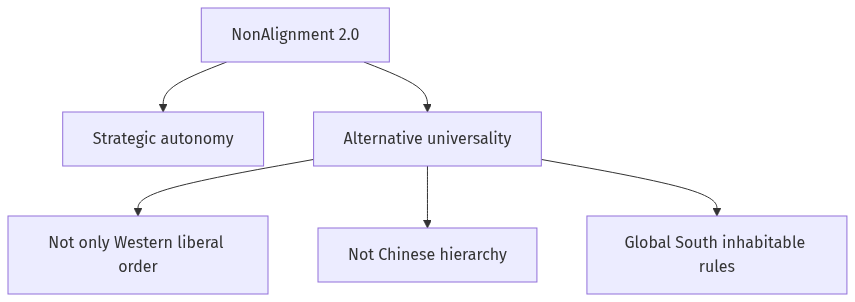
Conclusion
NonAlignment 2.0 kept autonomy and named China. Read generously, it sketched India as a workshop of another universalism — plural, developmental, non-satellite. The sketch is live. The building is not finished.
Quick related
Students also ask
-
The expansionist tendencies of the current Russian regime indicate its intentions for the realization of a Greater Russia on the lines of the Soviet era. Comment.
Next question on this syllabus topic (2024 · Q1(c)). View answer →
-
Is alternative universality anti-human-rights?
It need not be. It argues that rights and development must be jointly universal, not a Northern licence for regime change.
-
Did the 2012 authors speak for the government?
They were insiders and scholars, not a gazette notification. The document’s power was intellectual, later echoed in policy language.
Same topic · past papers
UPSC has asked this before
These previous-year questions sit on the same topic. Open one to practise the earlier ask.
More from this topic
Q7(a) · UPSC Mains 2026 · PSIR GS 2 · 20 marks · Solution
How does illegal cross border migration pose challenges to India's security? Discuss the steps taken by the government in this direction and their effectiveness
Comparative Politics
Illegal cross-border migration undermines India's national security by altering demographic balances, straining economic resources, and exacerbating internal security vulnerabilities. The government has responded through border fencing, technological integration like SMART fencing, institutional mechanisms, and bilateral agreements. However, porous terrain, regional political complexities, and local connivance limit the complete effectiveness of these measures. A holistic approach combining strict border management with socio-economic development and robust legal frameworks is essential for sustainable containment.
Q5(d) · UPSC Mains 2026 · PSIR GS 2 · 10 marks · Solution
Discuss the main features of the land-boundary agreement between India and Bangladesh.
Comparative Politics
• Operationalized via the 100th Constitutional Amendment Act of 2015 to resolve Radcliffe Line anomalies. • Rooted in the unratified 1974 bilateral agreement and the 2011 additional protocol. • Involved the peaceful exchange of 111 Indian enclaves in Bangladesh and 51 Bangladeshi enclaves in India. • Granted affected residents the sovereign right to choose their nationality and place of residence. • Demarcated roughly 6.1 km of previously un-demarcated land boundaries to end administrative confusion. • Secured human rights and welfare access for over 50,000 formerly stateless enclave residents. • Reduced bilateral trust deficits, paving the way for deeper cooperation in security and connectivity.
Q4(c) · UPSC Mains 2026 · PSIR GS 2 · 15 marks · Solution
What is UNCLOS? Explain its salient features
Comparative Politics
UNCLOS, established in 1982, serves as the constitution of the oceans, codifying customary international law regarding maritime jurisdictions. Its salient features include distinct maritime zones ranging from territorial waters to the high seas, balancing coastal state sovereignty with freedom of navigation. It establishes compulsory dispute settlement mechanisms through institutions like ITLOS. The convention also mandates environmental protection and sustainable management of marine resources. For India, UNCLOS provides a rules-based order in the Indo-Pacific while respecting navigational rights. It remains central to addressing contemporary maritime security and resource challenges.