
Revision summary
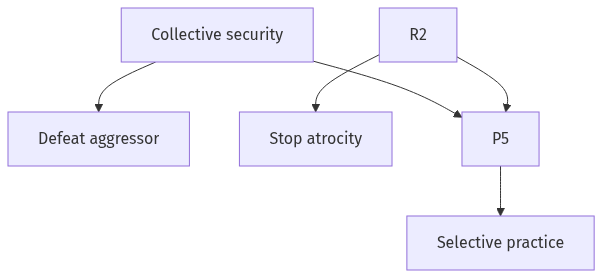
Collective security is all-against-the-aggressor under League and UN Chapter VII logic. R2P (ICISS 2001, World Summit 2005) treats sovereignty as responsibility to prevent mass atrocity. Goals differ: interstate peace versus protection of populations; methods differ: central war versus a ladder to last-resort force. NATO Article 5 is collective defence, not UN collective security. Libya, Syria and P5 vetoes show neither doctrine is uniform in practice.
Model answer
Copper italics in this answer — like this — are the key facts. Each one is unpacked in the Facts & figures rail.
Introduction
Collective security is the old hope that peace is indivisible: aggression against one is aggression against all. Responsibility to Protect (R2P) is a post-1990s claim that sovereignty includes a duty to protect populations from mass atrocity, and that the international community may act if the state fails. They rhyme. They are not the same instrument, and neither is uniform in scope, goals or methods.
Body
Collective security
The League of Nations failed the test in Manchuria and Abyssinia. The UN Charter tried again: Article 2(4) bans force; Chapter VII lets the Security Council name threats and authorise measures, including force. Korea (1950) and the 1991 Gulf War are the textbook ‘successes’, each with a Cold War or post-Cold War asterisk. Collective security’s goal is interstate peace and the defeat of a named aggressor. Its method is centralised authorisation, ideally universal. Its scope is legally the whole membership, politically whatever the P5 will allow. NATO Article 5 is collective defence, a club guarantee, not UN collective security — a distinction examiners mark.
R2P
After Rwanda and Srebrenica, the ICISS (2001) and the 2005 World Summit paragraphs 138–139 named three pillars: the state’s responsibility, international assistance, and timely response including, in last resort, Chapter VII force. The goal is protection of populations from genocide, war crimes, ethnic cleansing and crimes against humanity — not regime change as a stated end, and not every human-rights violation. The method is a ladder: diplomacy, sanctions, arms embargoes, then force. The scope is narrower than ‘all aggression’ and wider than interstate war: it looks inside borders.
Not uniform
Libya 2011 used R2P language and a no-fly resolution; the campaign’s drift toward removing Gaddafi poisoned the well. Syria showed vetoes and corpse counts. Myanmar, Gaza, Sudan and Ukraine display four different mixes of law, interest and paralysis. Collective security against Russia in 2022 was a General Assembly majority and Western sanctions, not a Chapter VII army — because a P5 member was the aggressor. R2P is selectively invoked when it fits a coalition; Global South states remember Kosovo, Iraq and Libya as warnings. Hedley Bull would say order and justice collide. Mohammed Ayoob’s subaltern realism says weak states fear R2P as a door for the strong.
Uniformity would need a disinterested council and equal sovereignty in practice. Neither exists. The doctrines remain useful as standards of criticism. They are poor as predictions.
Flow diagram
Conclusion
Collective security targets the aggressor state for the sake of interstate peace. R2P targets atrocity inside a state for the sake of people. Goals, scope and methods differ, and P5 politics make both uneven. That unevenness is the doctrine’s living history, not an accident.
Quick related
Students also ask
-
Discuss the relevance of the normative ethos of the Non-Aligned Movement in magnifying India's soft power in pursuit of her national interest
Next question on this syllabus topic (2023 · Q2(a)). View answer →
-
Did R2P legalise regime change?
The 2005 text did not. Libya 2011 was read by many states as a bait-and-switch, which is why later Council action froze.
-
Is Ukraine an R2P case?
It is first a classic aggression and self-defence case under Article 51. Atrocity language appears, but the legal spine is interstate force, blocked in the Council by a P5 party to the war.
Same topic · past papers
UPSC has asked this before
These previous-year questions sit on the same topic. Open one to practise the earlier ask.
-
2026 · Q1(c) · PSIR GS 2 · 10 marks
Discuss various methods of Balance of Power.
More from this topic
Q6(c) · UPSC Mains 2026 · PSIR GS 2 · 15 marks · Solution
"The mother of all deals" is a transformative milestone in Indo-EU trade relations. Elaborate on the new Security and Defence partnership
Key concepts in International Relations
• India-EU ties have shifted from basic dialogue to pragmatic geoeconomic and security alignment. • The revitalized trade architecture tackles market access hurdles and builds supply chain resilience. • Both sides are diversifying critical raw materials and transferring advanced technologies. • A new Security and Defence partnership institutionalizes cooperation on maritime security and cyber defense. • Defense ties are moving from a buyer-seller model to co-development and co-production. • Enhanced naval exercises and information-sharing secure sea lines of communication in the Indo-Pacific. • This partnership reinforces India's strategic autonomy and supports a multipolar global order.
Q3(a) · UPSC Mains 2026 · PSIR GS 2 · 20 marks · Solution
NATO, the oldest surviving collective security system, is facing the challenge of transactional coercion from its own biggest member. What future does NATO have amidst such developments?
Key concepts in International Relations
• Founded in 1949 as a collective defense pact, NATO now faces internal pressure from US transactional coercion alongside resurgent external threats. • Severe power asymmetry allows Washington to leverage security guarantees for narrow economic and political concessions, straining Article 5. • Chronic disputes over the 2 percent GDP defense spending target expose deep fault lines in alliance burden-sharing. • Despite internal frictions, NATO shows resilience through the accession of Finland and Sweden and expanded mandates in cyber and hybrid warfare. • Strategic outreach to Indo-Pacific AP4 nations aligns transatlantic security with broader global containment frameworks. • The alliance's future depends on balancing European demands for strategic autonomy with the irreplaceable US nuclear umbrella. • NATO will likely persist because Europe currently lacks any viable alternative security architecture to handle geopolitical revanchism.
Q1(c) · UPSC Mains 2026 · PSIR GS 2 · 10 marks · Solution
Discuss various methods of Balance of Power.
Key concepts in International Relations
Balance of Power is a core realist concept designed to prevent any single state from dominating the global system.