
Revision summary
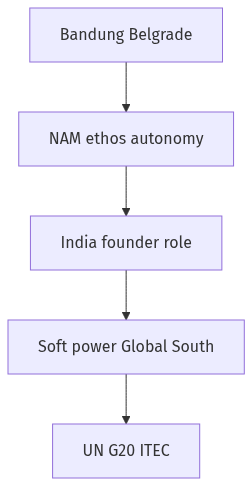
NAM’s ethos is non-membership of Cold War blocs, sovereignty, and anti-colonial solidarity. Belgrade 1961 organised a movement, not an army. India’s founder role still reads as diplomatic autonomy in much of Africa and Asia. Nye’s soft power here is legitimacy and voice, carried by training, vaccines, UN work, and Global South summits. The ethos is strained by a large membership and by India’s later multi-alignment, but it has not been discarded.
Model answer
Copper italics in this answer — like this — are the key facts. Each one is unpacked in the Facts & figures rail.
Introduction
The Non-Aligned Movement was organised as a diplomatic identity, not as a military bloc. Its ethos is independent judgment, anti-colonial solidarity, and peaceful coexistence. India used that ethos from Belgrade onward, and still uses it as a source of soft power among developing States.
Body
Ethos of NAM
- Bandung in 1955 and Belgrade in 1961 set the core: no membership of Cold War military alliances, respect for sovereignty, and opposition to colonialism and racial domination.
- Jawaharlal Nehru, Josip Broz Tito, Gamal Abdel Nasser, Kwame Nkrumah, and Sukarno treated non-alignment as the right to decide each issue, not as equidistance as a formula.
- Panchsheel and the UN Charter language of peaceful coexistence supplied the moral vocabulary.
- The ethos was South–South consultation, economic self-reliance talk, and nuclear-disarmament pressure on both camps.
- It was never a command structure. Consensus and a rotating chair were the method, which later made the movement large and slow, a point taken up in 3(a).
India inside that ethos
- India was a founder and a regular chair and host. It linked NAM to the Commonwealth, the UN, and later to the G77 without becoming a treaty ally of either superpower.
- During the Cold War this gave India voice among Afro-Asian States even when the 1971 Treaty with the USSR looked, to critics, like a tilt.
- After the Cold War, India did not dissolve NAM. It kept the forum while adding other clubs.
Soft power
- Joseph Nye’s soft power is attraction through culture, values, and perceived legitimacy of policy, not through force or payment alone.
- NAM ethos supplies India with a story of autonomy that many African, Asian, and Latin American governments still recognise.
- Vaccine supplies, ITEC training, disaster relief, and the Voice of Global South Summit rest on that recognition more than on NAM communiqués.
- At the United Nations, India can speak as a large democracy that was not a NATO or Warsaw Pact member, which still matters in votes and in peacekeeping politics.
- G20 presidency in 2023, including the African Union’s seating, used the same South-facing language.
Limits
- Soft power is reduced when neighbours contest India’s regional role, or when NAM itself is divided on Ukraine, Myanmar, or Palestine.
- Multi-alignment with the Quad and with Russia is a later practice. It does not erase the NAM vocabulary; it sits beside it.
- Ethos without delivery of development finance is a thin resource next to China’s capital.
Flow diagram
Conclusion
NAM’s ethos is independent choice, anti-colonial solidarity, and peaceful coexistence without a military headquarters. India draws soft power from being seen as an originator of that ethos, provided policy still looks autonomous and useful to the Global South.
Quick related
Students also ask
-
National Interest is an essentially contested concept. Comment.
Next question on this syllabus topic (2022 · Q1(e)). View answer →
-
Is NAM the same as neutrality?
No. Neutrality is a legal status in war. Non-alignment was a claim to decide issues without joining a Cold War alliance.
-
Does Quad membership end NAM ethos?
Quad is not a NATO treaty. India presents it as issue-based cooperation. Many NAM States still judge India by autonomy and development voice, not by one forum.
Same topic · past papers
UPSC has asked this before
These previous-year questions sit on the same topic. Open one to practise the earlier ask.
-
2022 · Q1(e) · PSIR GS 2 · 10 marks
National Interest is an essentially contested concept. Comment.
More from this topic
Q6(c) · UPSC Mains 2026 · PSIR GS 2 · 15 marks · Solution
"The mother of all deals" is a transformative milestone in Indo-EU trade relations. Elaborate on the new Security and Defence partnership
Key concepts in International Relations
• India-EU ties have shifted from basic dialogue to pragmatic geoeconomic and security alignment. • The revitalized trade architecture tackles market access hurdles and builds supply chain resilience. • Both sides are diversifying critical raw materials and transferring advanced technologies. • A new Security and Defence partnership institutionalizes cooperation on maritime security and cyber defense. • Defense ties are moving from a buyer-seller model to co-development and co-production. • Enhanced naval exercises and information-sharing secure sea lines of communication in the Indo-Pacific. • This partnership reinforces India's strategic autonomy and supports a multipolar global order.
Q3(a) · UPSC Mains 2026 · PSIR GS 2 · 20 marks · Solution
NATO, the oldest surviving collective security system, is facing the challenge of transactional coercion from its own biggest member. What future does NATO have amidst such developments?
Key concepts in International Relations
• Founded in 1949 as a collective defense pact, NATO now faces internal pressure from US transactional coercion alongside resurgent external threats. • Severe power asymmetry allows Washington to leverage security guarantees for narrow economic and political concessions, straining Article 5. • Chronic disputes over the 2 percent GDP defense spending target expose deep fault lines in alliance burden-sharing. • Despite internal frictions, NATO shows resilience through the accession of Finland and Sweden and expanded mandates in cyber and hybrid warfare. • Strategic outreach to Indo-Pacific AP4 nations aligns transatlantic security with broader global containment frameworks. • The alliance's future depends on balancing European demands for strategic autonomy with the irreplaceable US nuclear umbrella. • NATO will likely persist because Europe currently lacks any viable alternative security architecture to handle geopolitical revanchism.
Q1(c) · UPSC Mains 2026 · PSIR GS 2 · 10 marks · Solution
Discuss various methods of Balance of Power.
Key concepts in International Relations
Balance of Power is a core realist concept designed to prevent any single state from dominating the global system.