
Revision summary
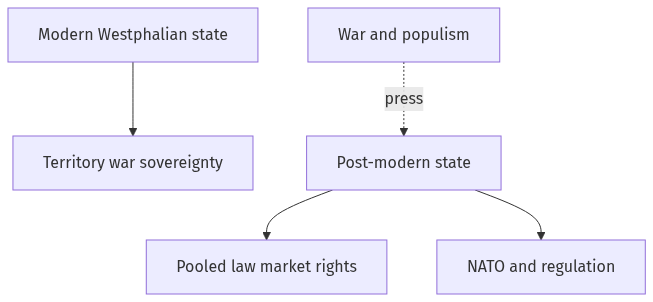
The post-modern state, especially in the EU core, pools sovereignty, lives by regulation and rights, and has often subcontracted hard security to NATO. Advanced capitalist features include post-industrial production, welfare-regulatory capacity and networked authority with firms and courts. Cooper’s post-modern zone is an IR shorthand, not the end of the state. Brexit, borders and rearmament show reversibility. The type is a phase of the capitalist core, not a universal stage of history.
Model answer
Copper italics in this answer — like this — are the key facts. Each one is unpacked in the Facts & figures rail.
Introduction
The modern state in the Westphalian picture is territorial, sovereign and war-capable, with a clear inside and outside. The post-modern state, a term used in European international thought for advanced capitalist polities especially in the European Union, is a state that has pooled parts of that sovereignty, thickened regulation, and shifted legitimacy toward rights, markets and identity rather than toward mass conscription and border conquest. The question asks for distinctive features and for analysis, not for a claim that the state has vanished.
Body
Distinctive features
First, pooled and legalised sovereignty. EU members apply directly effective European law, share a single market, and in the eurozone share a currency without a full federal treasury. Borders inside Schengen are thin for people even when they remain real for migration politics. Second, the regulatory and welfare state: risk is managed through agencies, social insurance and consumer law more than through imperial tariffs. Third, post-industrial capitalism: finance, services and global production chains, which Wallerstein would still place in the core of the world-economy, reduce the old national factory as the sole material base. Fourth, identity and rights politics: gender, race, sexuality and multicultural claims become first-order, alongside class. Fifth, networked security: NATO and U.S. guarantees have allowed many West European states to under-provide national armies relative to a classical modern state, a bargain now under stress after Russia’s war. Sixth, porous authority: firms, ratings agencies, Brussels, and courts share the stage with the cabinet, which is the domestic face of the transnational actors problem.
Robert Cooper’s typology of pre-modern, modern and post-modern zones is the usual IR shortcut: the EU as a post-modern security community internally, still meeting a modern Russia and a pre-modern belt of state failure at the edges.
Analysis
These features are real in Western Europe, Canada, Japan and parts of the Anglosphere, and uneven in the United States, which is advanced capitalist but still a hard military sovereign. The post-modern state is not weak in surveillance or in tax capacity. It is weak in the classical sense of autonomous war-making when it has subcontracted security to an alliance.
Analysis must also note reversibility. Brexit showed that pooling can be politically rejected. Border fences, industrial policy and tariff talk in the 2020s show the modern territorial state returning inside post-modern economies. Gramsci would ask whether the historic bloc of embedded liberalism still produces consent. When consent thins, the post-modern state looks like a market without a nation, and populist parties demand a modern border again.
So the distinctive features are legal pooling, regulation, post-industrial core production, rights-based legitimacy and alliance security. They describe a historical phase of the capitalist core, not a destiny for every state.
Flow diagram
Conclusion
In advanced capitalist economies the post-modern state is territorial still, but it shares law, money and market rules, and it has lived under alliance security. Those features are distinctive. They are under pressure from war, migration politics and industrial policy, which pull the modern state back into view.
Quick related
Students also ask
-
Is the United States a post-modern state?
It is advanced capitalist and highly legalised, but it remains a centralised military sovereign. It fits the type less well than EU members.
-
Does post-modern mean post-national?
Not fully. Nations remain the electoral base. What is post-modern is the sharing of instruments that used to define exclusive sovereignty.
Same topic · past papers
UPSC has asked this before
These previous-year questions sit on the same topic. Open one to practise the earlier ask.
-
2026 · Q4(c) · PSIR GS 2 · 15 marks
What is UNCLOS? Explain its salient features -
2026 · Q5(d) · PSIR GS 2 · 10 marks
Discuss the main features of the land-boundary agreement between India and Bangladesh. -
2023 · Q5(a) · PSIR GS 2 · 10 marks
Explain the major features of India's Foreign Policy in the 21st century.
More from this topic
Q2(a) · UPSC Mains 2026 · PSIR GS 2 · 20 marks · Solution
Discuss the factors responsible for the changing nature of states in contemporary industrial societies and explain its impact
State in comparative perspective
• Contemporary industrial states have shifted from post-war Keynesian welfare models to market-driven, porous entities. • Globalized capital mobility and transnational supply chains weaken traditional domestic economic and fiscal sovereignty. • Neoliberal governance has transformed the state from a welfare provider into a "workfare" and regulatory authority. • Compliance with international bodies like the WTO and IMF further constrains national legislative autonomy. • Technocratic policy-making insulates key economic decisions from democratic pressures, causing a growing "democratic deficit." • Citizen alienation from reduced welfare has triggered political polarization and populist backlashes across democracies. • Despite losing absolute autonomy, the state remains vital for managing systemic risks and maintaining social cohesion.
Q8(b) · UPSC Mains 2025 · PSIR GS 2 · 15 marks · Solution
Discuss some of the key drivers of India's new interests in Africa which might help in developing long-term comparative advantage over China
State in comparative perspective
India’s Africa push is driven by diaspora, ITEC, peacekeeping, pharma, digital public goods, minerals and Global South diplomacy. China competes on BRI-scale infrastructure and credit; India cannot win that race on money. Long-term advantage is plausible in skills, affordable tech, political comfort and a less threatening profile. Delivery failures and domestic racism can still waste the advantage. Pick trust and human capital, not a stadium-for-stadium contest.