
Revision summary
India’s Africa push is driven by diaspora, ITEC, peacekeeping, pharma, digital public goods, minerals and Global South diplomacy. China competes on BRI-scale infrastructure and credit; India cannot win that race on money. Long-term advantage is plausible in skills, affordable tech, political comfort and a less threatening profile. Delivery failures and domestic racism can still waste the advantage. Pick trust and human capital, not a stadium-for-stadium contest.
Model answer
Copper italics in this answer — like this — are the key facts. Each one is unpacked in the Facts & figures rail.
Introduction
India’s new African interests are not a discovery of the continent. They are a thicker, more strategic return: votes, minerals, markets, energy, and a Global South story that cannot be only Asian. China is the scale competitor — Belt and Road, contractors, and credit. The question asks for drivers that might yield a long-term comparative advantage, not a fantasy of out-spending Beijing next year.
Body
Drivers
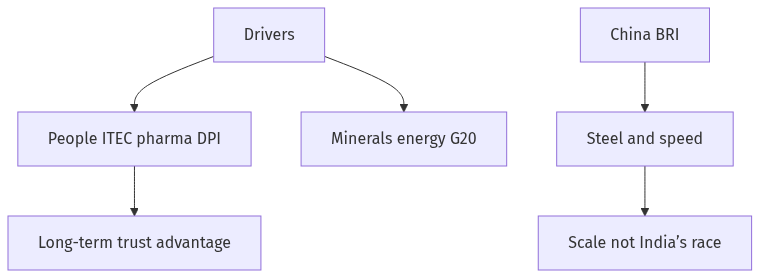
Diaspora and history — from Gandhi’s Natal to traders in East Africa — give a human network China must buy. ITEC and education still train officers and doctors who later sit in cabinets. UN peacekeeping is an Indian comparative practice. Generic pharma and vaccine manufacturing (including the COVID years) hit a need China does not own. Digital public infrastructure — identity, payments, open networks — is a 2020s export that fits African leapfrogging better than some heavy BRI monuments. Critical minerals and energy (oil, solar partnerships) are the hard-economy driver. African Union in the G20 and India–Africa Forum Summits are the diplomatic driver: voice, not only projects. Defence training and maritime awareness in the western Indian Ocean complete the security ring.
Versus China
- China wins speed and steel: ports, rails, stadiums, and a willingness to ignore governance sermons. It also accumulates debt-and-image problems that African publics now debate. India cannot copy the chequebook. It can copy presence of people: students, SMEs, English-language professional classes, and a democracy that, however noisy, is intelligible to African plural societies. Advantage, if it comes, will be in human capital, affordable tech, pharma, and political comfort, plus a less threatening naval profile than either China or old extra-regional powers.
Long-term, not brochure
Comparative advantage is not automatic. Indian delivery is slow; projects stall; racism toward Africans in Indian cities wrecks the brand; and some African states want Chinese speed anyway. A serious policy would finish lines of credit, stay in mining with environmental care, and keep peacekeeping. The G20 AU seat is a joint win, not an Indian trophy. Advantage over China is plausible in trust and skill intensity. It is implausible in bulk infrastructure. Honesty is part of the 15-mark answer: do not claim a race India is not funding.
Flow diagram
Conclusion
India’s African drivers are people, training, pharma, digital public goods, minerals and a South–South voice. Those can beat China in trust over a generation. They will not beat China in concrete next quarter. Policy should pick the race it can win.
Quick related
Students also ask
-
What are the distinctive features of the post-modern state in the advanced capitalist economies? Analyse.
Next question on this syllabus topic (2024 · Q2(b)). View answer →
-
Is ‘not China’ enough of a policy?
No. African states want options, not an anti-China sermon. India’s offer must be usable projects and training, not only a warning about debt.
-
Does peacekeeping still matter?
Yes as reputation and as knowledge of African security elites. It is not a mineral strategy by itself.
Same topic · past papers
UPSC has asked this before
These previous-year questions sit on the same topic. Open one to practise the earlier ask.
-
2023 · Q8(c) · PSIR GS 2 · 15 marks
Discuss the major drivers of India's interests in Africa -
2022 · Q7(a) · PSIR GS 2 · 20 marks
What are the main drivers of India-Japan Strategic and Global Partnership? -
2021 · Q8(c) · PSIR GS 2 · 15 marks
Identify the drivers of India's new interest in Africa
More from this topic
Q2(a) · UPSC Mains 2026 · PSIR GS 2 · 20 marks · Solution
Discuss the factors responsible for the changing nature of states in contemporary industrial societies and explain its impact
State in comparative perspective
• Contemporary industrial states have shifted from post-war Keynesian welfare models to market-driven, porous entities. • Globalized capital mobility and transnational supply chains weaken traditional domestic economic and fiscal sovereignty. • Neoliberal governance has transformed the state from a welfare provider into a "workfare" and regulatory authority. • Compliance with international bodies like the WTO and IMF further constrains national legislative autonomy. • Technocratic policy-making insulates key economic decisions from democratic pressures, causing a growing "democratic deficit." • Citizen alienation from reduced welfare has triggered political polarization and populist backlashes across democracies. • Despite losing absolute autonomy, the state remains vital for managing systemic risks and maintaining social cohesion.
Q2(b) · UPSC Mains 2024 · PSIR GS 2 · 15 marks · Solution
What are the distinctive features of the post-modern state in the advanced capitalist economies? Analyse.
State in comparative perspective
The post-modern state, especially in the EU core, pools sovereignty, lives by regulation and rights, and has often subcontracted hard security to NATO. Advanced capitalist features include post-industrial production, welfare-regulatory capacity and networked authority with firms and courts. Cooper’s post-modern zone is an IR shorthand, not the end of the state. Brexit, borders and rearmament show reversibility. The type is a phase of the capitalist core, not a universal stage of history.