
Revision summary
The India–U.S. partnership includes the nuclear deal, 2+2s, foundational pacts and the Quad. It is already thick on maritime and China-overlapping interests. A formal alliance would demand camp discipline India will not accept and a LAC guarantee Washington will not cleanly give. Interests diverge on Russia, trade and Pakistan; a partnership can be elastic, a treaty cannot. Agree with the statement; keep 2+2 and Quad habits so a political swing in Washington does not empty the file.
Model answer
Copper italics in this answer — like this — are the key facts. Each one is unpacked in the Facts & figures rail.
Introduction
- India and the United States now share a strategic partnership: the civil nuclear bargain, 2+2 ministerial meetings, logistics and communications pacts, intelligence-adjacent arrangements, and the Quad. The statement that they have become so strong that they need not become formal allies is right. An alliance treaty would add a legal chain without adding the cooperation they already choose.
Body
How strong the partnership is
The relationship moved from sanctions after 1998 to a de facto technology and maritime partnership. Foundational agreements allow refuelling, secure communications and geospatial sharing. Defence industry talk, student mobility, and a shared Indo-Pacific vocabulary (5(d)) are thicker than any Cold War non-aligned distance. On China, interests overlap even when language differs. This is already alliance-like in parts of the military-technical stack.
Why not a formal ally
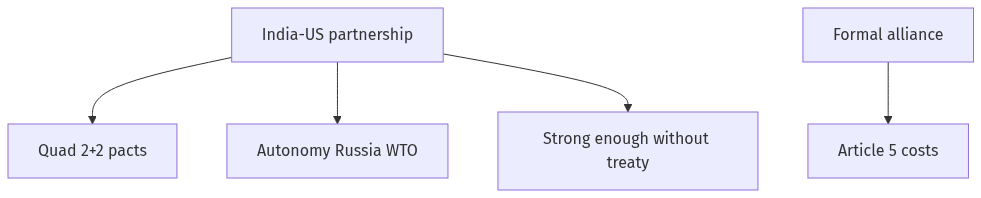
Formal allies take Article 5-type obligations. India will not promise to fight the United States’ wars, and Washington will not write an unambiguous guarantee for the LAC that binds Congress on India’s terms. Strategic autonomy — Russia oil and platforms, Iran energy memory, WTO fights, and a Global South voice — would look like breach of camp discipline. U.S. domestic politics (human rights, tariffs, immigration) would enter Indian elections as treaty politics. For the United States, a non-allied India is still useful: it looks less like containment cosplay to ASEAN.
Morgenthau would say an alliance should match defined interests. Here interests overlap on China and the sea and diverge on Russia, trade and Pakistan. A partnership can be issue-based. A treaty cannot be as elastic.
Comment
- Agree: they need not become formal allies. The partnership is strong because it is not a camp. Residual friction — export controls, CAATSA-type sanctions threats, data and farm trade, and U.S. comments on Indian domestic politics — is easier to manage without a treaty that turns every friction into a loyalty test. The risk of the statement is complacency: without some institutional density, a change of U.S. administration can still thin the partnership. The Quad and 2+2s are that density. They are not NATO, and they should not try to be.
Flow diagram
Conclusion
India and the United States have built a strategic partnership that already does much of an alliance’s work on China and the Indo-Pacific. A formal alliance would cost autonomy and would not clarify the LAC. They need not become allies. They do need to keep the partnership’s habits, because strength here is practised, not sworn.
Quick related
Students also ask
-
What are the crucial functions of empirical political theory in Comparative Politics?
Next question on this syllabus topic (2023 · Q1(a)). View answer →
-
Is the Quad a secret alliance?
No. It has no mutual-defence clause. Calling it an alliance is a Chinese polemic and an Indian fear, not a treaty fact.
-
Could CAATSA still hit India?
U.S. sanctions law on Russian arms is a residual friction that an alliance would make more, not less, awkward.
Same topic · past papers
UPSC has asked this before
These previous-year questions sit on the same topic. Open one to practise the earlier ask.
More from this topic
Q7(a) · UPSC Mains 2026 · PSIR GS 2 · 20 marks · Solution
How does illegal cross border migration pose challenges to India's security? Discuss the steps taken by the government in this direction and their effectiveness
Comparative Politics
Illegal cross-border migration undermines India's national security by altering demographic balances, straining economic resources, and exacerbating internal security vulnerabilities. The government has responded through border fencing, technological integration like SMART fencing, institutional mechanisms, and bilateral agreements. However, porous terrain, regional political complexities, and local connivance limit the complete effectiveness of these measures. A holistic approach combining strict border management with socio-economic development and robust legal frameworks is essential for sustainable containment.
Q5(d) · UPSC Mains 2026 · PSIR GS 2 · 10 marks · Solution
Discuss the main features of the land-boundary agreement between India and Bangladesh.
Comparative Politics
• Operationalized via the 100th Constitutional Amendment Act of 2015 to resolve Radcliffe Line anomalies. • Rooted in the unratified 1974 bilateral agreement and the 2011 additional protocol. • Involved the peaceful exchange of 111 Indian enclaves in Bangladesh and 51 Bangladeshi enclaves in India. • Granted affected residents the sovereign right to choose their nationality and place of residence. • Demarcated roughly 6.1 km of previously un-demarcated land boundaries to end administrative confusion. • Secured human rights and welfare access for over 50,000 formerly stateless enclave residents. • Reduced bilateral trust deficits, paving the way for deeper cooperation in security and connectivity.
Q4(c) · UPSC Mains 2026 · PSIR GS 2 · 15 marks · Solution
What is UNCLOS? Explain its salient features
Comparative Politics
UNCLOS, established in 1982, serves as the constitution of the oceans, codifying customary international law regarding maritime jurisdictions. Its salient features include distinct maritime zones ranging from territorial waters to the high seas, balancing coastal state sovereignty with freedom of navigation. It establishes compulsory dispute settlement mechanisms through institutions like ITLOS. The convention also mandates environmental protection and sustainable management of marine resources. For India, UNCLOS provides a rules-based order in the Indo-Pacific while respecting navigational rights. It remains central to addressing contemporary maritime security and resource challenges.