
Revision summary
Asia-Pacific centred East Asian production, APEC and U.S. Pacific alliances, with India at the edge. Indo-Pacific is a maritime theatre from the Indian Ocean to the western Pacific. Rationale: energy and trade sea lanes, China’s naval and port reach, India’s Act East, Abe’s FOIP language and the Quad. U.S. official strategy made the label bureaucratic. The term keeps ASEAN centrality in Indian usage while re-ranking Delhi as a hinge power.
Model answer
Copper italics in this answer — like this — are the key facts. Each one is unpacked in the Facts & figures rail.
Introduction
Asia-Pacific named a rim of East and Southeast Asia plus the Americas, organised around APEC, U.S. hubs-and-spokes alliances, and China-centred production. Indo-Pacific names a wider maritime system from the eastern African littoral through the Indian Ocean to the western Pacific. The new term is not a fashion. It is a strategy label for a changed map.
Body
What was incomplete in ‘Asia-Pacific’
The older term under-weighted the Indian Ocean, energy routes through the Malacca strait, and India as a resident power. It fitted a world in which Japan, the Asian Tigers and then China were the growth story, and in which Washington’s alliances ran through Tokyo, Seoul and Canberra without needing Delhi. ASEAN sat at the centre of that vocabulary. The vocabulary did not disappear. It was too small for Chinese naval reach, for African and Gulf energy, and for India’s Act East.
Rationale for Indo-Pacific
- First, geography of trade and energy: a large share of world oil and goods moves on waters India can affect. Second, China’s maritime rise — South China Sea pressure, dual-use ports in the Indian Ocean, and the Belt and Road at sea — made a purely Pacific frame look like a half-board. Third, India’s willingness to be named as a net security partner, not only as a NAM spectator. Fourth, Japanese language under Shinzo Abe (confluence of the two seas; later Free and Open Indo-Pacific) gave allies a phrase. Fifth, the Quad — Australia, India, Japan, the United States — needed a theatre name that included the Indian Ocean. Sixth, the United States officially shifted documents and commands toward an Indo-Pacific strategy, making the term bureaucratic fact.
The strategy is inclusive in Indian official speech (ASEAN centrality, IPOI) and more oppositional in some U.S. versions (a China-challenge frame). That ambiguity is part of the term’s success: several states can inhabit it.
What the rename does
It relocates India from the edge of Asia-Pacific charts to a hinge. It justifies minilateral naval practice and quality infrastructure as public goods. It does not dissolve ASEAN or APEC. It re-ranks who must be in the room when sea lanes and China are discussed. For PSIR, the rationale is strategic geography plus a coalition, not a poetic preference for two oceans.
Flow diagram
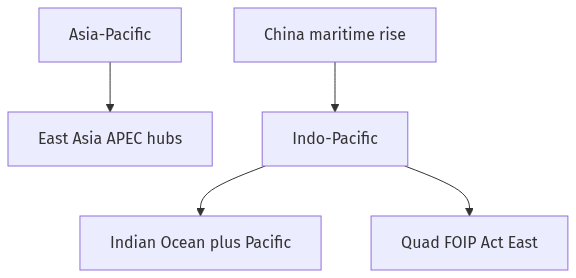
Conclusion
Asia-Pacific described an East Asian economic rim and U.S. Pacific alliances. Indo-Pacific adds the Indian Ocean and India because China, energy routes and the Quad made the older map too narrow. The new term is a strategy, not a synonym.
Quick related
Students also ask
-
"India and USA have become such strong strategic partners that they need not become formal allies." Comment.
Next question on this syllabus topic (2024 · Q7(c)). View answer →
-
Did India invent the term?
No. Australian, Japanese and U.S. usage mattered. India adopted and Indianised it through SAGAR and IPOI.
-
Is Indo-Pacific only anti-China?
Some capitals use it that way. India’s stated version is a free, open and inclusive order in which China is a geographic fact, not a named enemy in every paragraph.
Same topic · past papers
UPSC has asked this before
These previous-year questions sit on the same topic. Open one to practise the earlier ask.
More from this topic
Q7(a) · UPSC Mains 2026 · PSIR GS 2 · 20 marks · Solution
How does illegal cross border migration pose challenges to India's security? Discuss the steps taken by the government in this direction and their effectiveness
Comparative Politics
Illegal cross-border migration undermines India's national security by altering demographic balances, straining economic resources, and exacerbating internal security vulnerabilities. The government has responded through border fencing, technological integration like SMART fencing, institutional mechanisms, and bilateral agreements. However, porous terrain, regional political complexities, and local connivance limit the complete effectiveness of these measures. A holistic approach combining strict border management with socio-economic development and robust legal frameworks is essential for sustainable containment.
Q5(d) · UPSC Mains 2026 · PSIR GS 2 · 10 marks · Solution
Discuss the main features of the land-boundary agreement between India and Bangladesh.
Comparative Politics
• Operationalized via the 100th Constitutional Amendment Act of 2015 to resolve Radcliffe Line anomalies. • Rooted in the unratified 1974 bilateral agreement and the 2011 additional protocol. • Involved the peaceful exchange of 111 Indian enclaves in Bangladesh and 51 Bangladeshi enclaves in India. • Granted affected residents the sovereign right to choose their nationality and place of residence. • Demarcated roughly 6.1 km of previously un-demarcated land boundaries to end administrative confusion. • Secured human rights and welfare access for over 50,000 formerly stateless enclave residents. • Reduced bilateral trust deficits, paving the way for deeper cooperation in security and connectivity.
Q4(c) · UPSC Mains 2026 · PSIR GS 2 · 15 marks · Solution
What is UNCLOS? Explain its salient features
Comparative Politics
UNCLOS, established in 1982, serves as the constitution of the oceans, codifying customary international law regarding maritime jurisdictions. Its salient features include distinct maritime zones ranging from territorial waters to the high seas, balancing coastal state sovereignty with freedom of navigation. It establishes compulsory dispute settlement mechanisms through institutions like ITLOS. The convention also mandates environmental protection and sustainable management of marine resources. For India, UNCLOS provides a rules-based order in the Indo-Pacific while respecting navigational rights. It remains central to addressing contemporary maritime security and resource challenges.