
Revision summary
FOIP for India is an open maritime order, not a Chinese lake or a U.S. private canal. Core partners: Japan, the United States, Australia, France and ASEAN; Quad is the sharpest minilateral. Connectivity — SAGAR, IPOI, IMEC, Chabahar, INSTC, digital public goods — is the other half of ‘assurance’. The strategy is sound; neighbourhood leakage and thin shipyard capacity make it incomplete. A portfolio of partners, not one ally, is the actual policy.
Model answer
Copper italics in this answer — like this — are the key facts. Each one is unpacked in the Facts & figures rail.
Introduction
A free and open Indo-Pacific (FOIP) is, for India, a maritime order in which sea lanes, data and rules are not a Chinese lake or an American private canal. The question’s wording is accurate: Delhi keeps strongest ties with partners who assure that order and who connect India to the rest of the world. Analysis must name the partners and test the assurance.
Body
Partners who assure FOIP
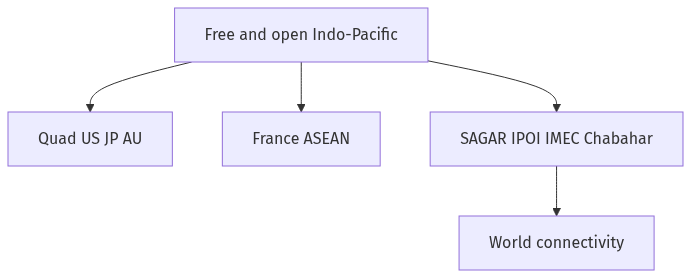
Japan authored much of the FOIP language and funds quality infrastructure. The United States brings navy, intelligence and deterrence that India will not duplicate soon. Australia is an Indian Ocean resident power in the Quad. France is the extra-Quad European with Reunion, a jet and submarine relationship, and a dislike of spheres. ASEAN is the legitimacy core: without it, FOIP looks like containment cosplay. United Kingdom, South Korea and Vietnam sit in the second ring. These ties are not identical: the U.S. wants more alignment; ASEAN wants less naming of China; France wants European strategic autonomy that still sells Rafales.
Connectivity as the other half
Assurance without connectivity is a patrol. India’s SAGAR (Security and Growth for All in the Region), IPOI, Chabahar into Afghanistan–Central Asia, IMEC after the G20, and the older INSTC are attempts to guarantee greater access than the Malacca-and-China route. Digital public infrastructure exports, ITEC training, and semiconductor friendships with Japan and the U.S. are connectivity of another kind. The EU talks (Q6(c)) belong here once tariffs push Europe to find non-U.S. markets.
Analysis
The strategy is sound and incomplete. It is sound because India’s trade and energy move on water, and because a unipolar Asia is a trap. It is incomplete because the neighbourhood — Myanmar, Bangladesh, Sri Lanka — can still host Chinese logistics; because IMEC is a drawing until rails and politics exist; and because India still under-builds ships and ports relative to the rhetoric. Partners assure FOIP only if India is a capable hinge, not a speech. Quad exercises are real. So is ASEAN’s refusal to be a member of anyone’s diamond.
- Thus India maintains strong ties with FOIP partners as a portfolio: America for deterrence, Japan for capital, ASEAN for political cover, Europe for technology and hedge against Trump tariffs. No single partner guarantees the ocean. The portfolio is the policy.
Flow diagram
Conclusion
FOIP partners are those who keep the Indo-Pacific from becoming a closed sphere and who thicken India’s routes to the world. The portfolio is right. Delivery still depends on Indian capacity and on ASEAN’s consent.
Quick related
Students also ask
-
India continues to invoke its time-tested policy of strategic autonomy vis-à-vis both the United States of America and Russia by rejecting US' offer of mediation on Kashmir issue and by refusing to criticize Russia in its ongoing war against Ukraine. Comment
Next question on this syllabus topic (2025 · Q7(a)). View answer →
-
Is FOIP just the Quad?
The Quad is the deterrent-leaning core. FOIP as India tells it must include ASEAN and often France, or it loses the ‘open’ claim.
-
Does India include China in the Indo-Pacific?
As a geographic fact, yes. As a rule-maker of a closed sphere, no. That distinction is the policy.
Same topic · past papers
UPSC has asked this before
These previous-year questions sit on the same topic. Open one to practise the earlier ask.
-
2024 · Q5(d) · PSIR GS 2 · 10 marks
Discuss the rationale behind replacing the "Asia-Pacific" strategy with the new term "Indo-Pacific" strategy.
More from this topic
Q7(a) · UPSC Mains 2025 · PSIR GS 2 · 20 marks · Solution
India continues to invoke its time-tested policy of strategic autonomy vis-à-vis both the United States of America and Russia by rejecting US' offer of mediation on Kashmir issue and by refusing to criticize Russia in its ongoing war against Ukraine. Comment
Indian Foreign Policy
Strategic autonomy means India will not outsource core security choices to a patron. Kashmir is treated as bilateral; U.S. mediation offers are refused, especially after terror shocks such as Pahalgam. On Ukraine, India avoids Western condemnation blocs while buying oil and keeping Russian platforms, without endorsing conquest. The two refusals share a doctrine but not the same moral file. This is NonAlignment 2.0 practice: partners, not instructors.
Q8(a) · UPSC Mains 2024 · PSIR GS 2 · 20 marks · Solution
Critically examine the continuity and change in India's Palestine policy in the wake of the ongoing Israel-Hamas War.
Indian Foreign Policy
Baseline India policy was anti-colonial support for Palestine, two states, and UN voting with the South. From the 1990s–2010s India de-hyphenated and built defence and technology ties with Israel. After October 2023 India condemned Hamas’s terror quickly and kept humanitarian and two-state language as the war widened. Continuity is the diplomatic formula; change is partner hierarchy and the terror frame. Critical need: keep both sentences, because dropping either one breaks either the South or India’s own terrorism diplomacy.
Q8(a) · UPSC Mains 2023 · PSIR GS 2 · 20 marks · Solution
What are the external determinants of the Foreign Policy of a State?
Indian Foreign Policy
External determinants are systemic power, geography, economic dependence, and international institutions. Waltz and Mearsheimer emphasise anarchy and great-power threat; Keohane adds regimes and interdependence. Cox adds the hegemonic structure of ideas and production. India’s live external set includes China, Pakistan, Myanmar 2021, Afghanistan 2021, and sanctions maps. Governments still choose among constrained options, which is why multi-alignment is a policy, not a geography.