
Revision summary
Globalisation meant deep cross-border production and GATT/WTO-style rules that treated efficiency as first. Deglobalisation names tariffs, sanctions, pandemic reshoring and U.S.–China tech security. The WTO’s weakness and regional rewrites such as USMCA show politics back in trade. Trade and data still move; regionalisation is not 1930s autarky. Comment: hyper-globalisation is being displaced; a closed world is not the completed fact.
Model answer
Copper italics in this answer — like this — are the key facts. Each one is unpacked in the Facts & figures rail.
Introduction
Globalisation after the 1990s meant deeper cross-border flows of goods, capital, data and production, under rules associated with the World Trade Organization and with the spirit of GATT. The claim that deglobalisation is displacing globalisation says those flows are now shrinking or being re-routed by politics. The comment should agree in part. A thicker border is real. A closed world is not yet the fact.
Body
What globalisation was
It was not only more trade. It was production networks, container shipping, multinational firms, and a legal bet that most-favoured-nation treatment and bound tariffs would keep politics off the dock. Wallerstein would say it was the latest deepening of a long world-economy. Liberal institutionalists would say it was regimes lowering transaction costs. For two decades after 1995 that description fitted the data better than a 1930s picture.
What deglobalisation names
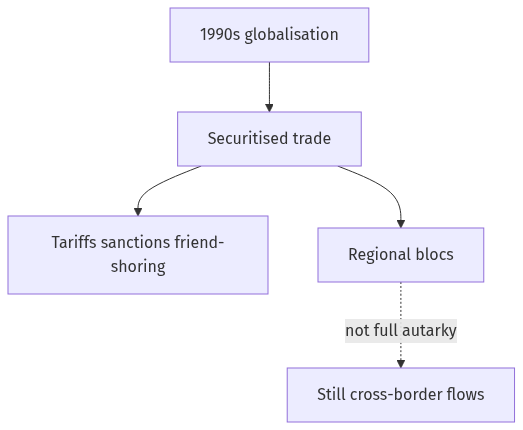
COVID-19 exposed single-point supply failure. The United States–China strategic contest turned semiconductors, telecom and critical minerals into security goods. Tariffs returned as ordinary tools, including under the Trump administration and in later industrial policy on both sides of the Pacific. Sanctions after Russia’s invasion of Ukraine weaponised finance, energy and technology. The WTO dispute system, treated in 4(b), no longer polices the largest players. Firms speak of friend-shoring, China-plus-one, and national industrial policy. NAFTA’s replacement by the United States-Mexico-Canada Agreement, treated in 2(c), is a regional rewrite of openness, not an expansion of global multilateralism.
This is displacement in the sense that efficiency is no longer the first rule. Security, labour politics and great-power rivalry now sit in the trade ministry.
Comment
Displacement is not a full reversal. Trade-to-output ratios have wobbled rather than collapsed to 1970. Digital services, ideas and capital still move. Regional blocs — the European Union, USMCA, RCEP — are re-globalisation at a smaller scale, or regionalisation, not autarky. India still seeks markets and supply-chain roles even while it defends food stocks and digital policy space at the WTO.
The accurate comment is that hyper-globalisation of the 1990s–2000s is being displaced by managed, securitised interdependence. Deglobalisation as a slogan overstates autarky. As a description of the death of naive openness, it is fair.
Flow diagram
Conclusion
Tariffs, sanctions, pandemic shocks and strategic industry policy have pushed against the old globalisation. They have not ended cross-border production. Deglobalisation is displacing the unpolitical version of globalisation. It is not replacing it with a world of closed states.
Quick related
Students also ask
-
What were the limitations of NAFTA? How did its replacement by the United States-Mexico-Canada Agreement counter them? Explain.
Next question on this syllabus topic (2024 · Q2(c)). View answer →
-
Is deglobalisation the same as protectionism?
Protectionism is one tool. Deglobalisation also includes export controls, investment screening and industrial subsidies.
-
Did COVID cause it?
The pandemic accelerated it. The U.S.–China contest and the WTO appellate crisis were already in motion.
Same topic · past papers
UPSC has asked this before
These previous-year questions sit on the same topic. Open one to practise the earlier ask.
-
2021 · Q3(b) · PSIR GS 2 · 15 marks
What is globalisation? Why is there an intense debate about globalisation and its consequences? -
2023 · Q4(a) · PSIR GS 2 · 20 marks
Critically examine the impact of Globalisation on the developing countries of the world -
2022 · Q1(b) · PSIR GS 2 · 10 marks
What are the main challenges faced by the developing countries in the era of globalisation? -
2022 · Q6(a) · PSIR GS 2 · 20 marks
Discuss the relevance of the demand for New International Economic Order (NIEO) in the present era of globalisation
More from this topic
Q7(a) · UPSC Mains 2026 · PSIR GS 2 · 20 marks · Solution
How does illegal cross border migration pose challenges to India's security? Discuss the steps taken by the government in this direction and their effectiveness
Comparative Politics
Illegal cross-border migration undermines India's national security by altering demographic balances, straining economic resources, and exacerbating internal security vulnerabilities. The government has responded through border fencing, technological integration like SMART fencing, institutional mechanisms, and bilateral agreements. However, porous terrain, regional political complexities, and local connivance limit the complete effectiveness of these measures. A holistic approach combining strict border management with socio-economic development and robust legal frameworks is essential for sustainable containment.
Q5(d) · UPSC Mains 2026 · PSIR GS 2 · 10 marks · Solution
Discuss the main features of the land-boundary agreement between India and Bangladesh.
Comparative Politics
• Operationalized via the 100th Constitutional Amendment Act of 2015 to resolve Radcliffe Line anomalies. • Rooted in the unratified 1974 bilateral agreement and the 2011 additional protocol. • Involved the peaceful exchange of 111 Indian enclaves in Bangladesh and 51 Bangladeshi enclaves in India. • Granted affected residents the sovereign right to choose their nationality and place of residence. • Demarcated roughly 6.1 km of previously un-demarcated land boundaries to end administrative confusion. • Secured human rights and welfare access for over 50,000 formerly stateless enclave residents. • Reduced bilateral trust deficits, paving the way for deeper cooperation in security and connectivity.
Q4(c) · UPSC Mains 2026 · PSIR GS 2 · 15 marks · Solution
What is UNCLOS? Explain its salient features
Comparative Politics
UNCLOS, established in 1982, serves as the constitution of the oceans, codifying customary international law regarding maritime jurisdictions. Its salient features include distinct maritime zones ranging from territorial waters to the high seas, balancing coastal state sovereignty with freedom of navigation. It establishes compulsory dispute settlement mechanisms through institutions like ITLOS. The convention also mandates environmental protection and sustainable management of marine resources. For India, UNCLOS provides a rules-based order in the Indo-Pacific while respecting navigational rights. It remains central to addressing contemporary maritime security and resource challenges.