
Revision summary
Globalisation is deeper cross-border economic and legal integration, marked by the WTO era. Some developing countries gained manufacturing and services growth. Others faced financial crises, TRIPS costs, and commodity dependence. Wallerstein and Cox stress hierarchy; Keohane stresses what regimes can still do for weaker States. India’s post-1991 path is partial opening plus defence of policy space, not a single verdict for all of the South.
Model answer
Copper italics in this answer — like this — are the key facts. Each one is unpacked in the Facts & figures rail.
Introduction
Globalisation is the thickening of cross-border flows of goods, capital, people, data, and rules. For developing countries the impact is mixed: growth and technology for some, vulnerability and rule-taking for many. A critical examination must use both the growth record and the hierarchy of the world economy.
Body
Channels of impact
- Trade opening after the Uruguay Round and the WTO (1995) cut some tariffs and locked in intellectual property, services, and investment-related rules.
- Capital account opening brought foreign direct investment and also sudden stops, as in the 1997 East Asian crisis.
- Global production chains moved manufacturing to China, Vietnam, Bangladesh, and parts of India, raising exports and wage employment in those niches.
- Ideas, media, and standards travelled with firms and with international financial institutions.
Gains
- East Asian and then Chinese industrialisation cut global extreme poverty on a large scale.
- India after 1991 gained in services, pharmaceuticals, and later digital exports, while remaining a cautious capital-account reformer.
- Access to medicines, telecom, and higher education expanded for urban middle classes.
- Keohane’s regimes argument is that rules can protect weaker traders from pure bilateral power, when the rules are actually enforced.
Costs and hierarchy
- Immanuel Wallerstein’s core–periphery map still describes commodity exporters that take price shocks.
- TRIPS raised the cost of some medicines and seeds until flexibilities and later COVID-era fights, including the incomplete 2022 vaccine decision.
- Footloose capital and tax competition limit the developmental State that had built Korea and Taiwan in an earlier, less legalised WTO world.
- Robert Cox treats globalisation as a hegemonic order of production and ideas, not as a neutral technology. Structural adjustment often cut public services first.
- Joseph Stiglitz and UNCTAD work document inequality within countries even where average GDP rose.
- Environment and labour standards were weakly globalised compared with finance, which is the human-security link from 3(c).
Differentiation
- Developing countries are not one case. China became a manufacturing core. Many African oil and mineral exporters remained price-takers.
- India’s story is partial integration with policy space claims at the WTO on food stocks and e-commerce.
- Critical examination therefore rejects both “globalisation as gift” and “globalisation as only loot.” It is a structured process with winners, losers, and room for State strategy.
Flow diagram
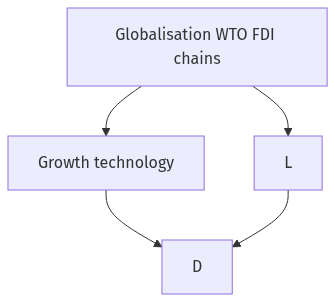
Conclusion
Globalisation has raised trade and technology access for developing countries that could enter production chains, and it has locked others into commodity and debt vulnerability. The impact depends on domestic capability and on who writes the rules, which is why Cox and the WTO fights belong in the same answer.
Quick related
Students also ask
-
What are the main challenges faced by the developing countries in the era of globalisation?
Next question on this syllabus topic (2022 · Q1(b)). View answer →
-
Did globalisation end the developmental State?
It constrained some industrial-policy tools. East Asia and later China still used State direction. WTO rules made some older tools harder, not impossible.
-
Is the impact mainly cultural?
Culture travels, but the core critical issues for this question are trade, finance, technology, and rule-making power.
Same topic · past papers
UPSC has asked this before
These previous-year questions sit on the same topic. Open one to practise the earlier ask.
-
2026 · Q2(a) · PSIR GS 2 · 20 marks
Discuss the factors responsible for the changing nature of states in contemporary industrial societies and explain its impact -
2021 · Q3(a) · PSIR GS 2 · 20 marks
Explain the impact of electoral systems and cleavages in shaping party systems with reference to developing countries -
2021 · Q5(e) · PSIR GS 2 · 10 marks
How does the recent takeover of Afghanistan by Taliban impact India's strategic interests?
More from this topic
Q4(a) · UPSC Mains 2022 · PSIR GS 2 · 20 marks · Solution
Identify and evaluate the reasons for deadlock in the WTO negotiations on fisheries between the developing and developed countries
Globalisation
Doha mandated cuts in harmful fisheries subsidies. IUU and overfished-stock bans are the easier slice; overcapacity is the deadlock. Developing Members want S&DT for small-scale and food-security fleets. Developed Members fear loopholes for large emerging distant-water fleets. MC12’s partial treaty parked the hardest pillar rather than ending the conflict.
Q1(b) · UPSC Mains 2022 · PSIR GS 2 · 10 marks · Solution
What are the main challenges faced by the developing countries in the era of globalisation?
Globalisation
Globalisation opens markets and tightens external rules. Wallerstein’s hierarchy and Prebisch’s trade concern still describe many late developers. Capital flight, TRIPS, and farm subsidies in the North cut policy space. Inequality, informality, and climate costs are domestic faces of the same pressure. Regional and South–South bargains are the usual reply, not autarky.