
Revision summary
August 2021 ended India’s Republic-era development partnership as it stood. Foothold now is aid, a technical presence, and counter-terror diplomacy. Chabahar remains the land-sea work-around to Pakistan. Recognition of the Taliban is still withheld. Success is measured by access and by security, not by a return to 2019 politics.
Model answer
Copper italics in this answer — like this — are the key facts. Each one is unpacked in the Facts & figures rail.
Introduction
The Taliban entered Kabul in August 2021 as US and allied forces left. India’s embassy closed. Foothold now means humanitarian access, political contact without full legal recognition, connectivity options, and limits on anti-India terrorism. It does not mean the pre-2021 development-and-democracy partnership restored as it was.
Body
What was lost
- India had built the Afghan parliament building, the Salma Dam, power lines, and training for civilians and some security personnel under the Republic.
- Direct air and political access collapsed. Pakistan’s geography again sat across the land route.
What foothold can still mean
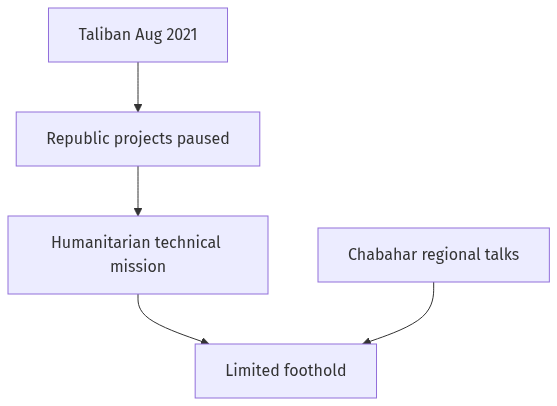
- Humanitarian food, medicine, and earthquake or winter aid keep an Indian name among Afghans and a channel to de facto authorities.
- A technical mission in Kabul, opened after 2021, is a thin diplomatic presence short of ambassadorial recognition of the Taliban government.
- Intelligence and regional tables with Russia, Iran, and Central Asian States aim at ISKP and at any use of Afghan soil against India.
- Chabahar and the INSTC idea remain a way to reach Afghanistan and Central Asia without Pakistan, if Iran sanctions and Afghan security allow cargo.
Constraints
- The Taliban’s ideology, treatment of women, and intra-Afghan war limit any values partnership.
- Pakistan’s influence is real though not total. China talks economic access. India is not first in either queue.
- Full recognition would clash with India’s own line on terrorism and with Western sanctions maps. Non-recognition without contact would mean zero foothold.
Policy mix
- Pragmatism: talk to the authority that holds Kabul. Culture and past investment: stay on the Afghan people’s side with aid.
- Do not outsource the file only to the Quad or only to Russia. It is a regional security file first.
Flow diagram
Conclusion
India retains a foothold after August 2021 through aid, a limited mission, regional security talks, and the Chabahar option. It cannot restore the Republic-era political project. The test is whether Afghan soil is used against India and whether a civilian channel survives.
Quick related
Students also ask
-
Discuss the significance of "West Asia Quad" in the light of India's 'Look West' policy
Next question on this syllabus topic (2023 · Q8(b)). View answer →
-
Does a technical mission equal recognition?
No. Recognition is a legal-political act toward a government. A mission can be a contact point for aid and visas without that act.
-
Can India ignore the Taliban?
Ignoring them cedes the ground to Pakistan, China, and others. Contact without endorsement is the remaining middle.
Same topic · past papers
UPSC has asked this before
These previous-year questions sit on the same topic. Open one to practise the earlier ask.
-
2021 · Q5(e) · PSIR GS 2 · 10 marks
How does the recent takeover of Afghanistan by Taliban impact India's strategic interests?
More from this topic
Q8(b) · UPSC Mains 2026 · PSIR GS 2 · 15 marks · Solution
India has recognised that West Asia is not a single contest, but a tangle of rivalries, bargains and anxieties. Comment
Recent developments in Indian Foreign policy
This 15-mark model answer for UPSC CSE Mains examines India's evolved diplomacy in West Asia, transitioning from a monolithic view to navigating complex regional rivalries, strategic bargains, and security anxieties. It highlights India's de-hyphenated engagement with Israel, Iran, and the Arab Gulf, robust energy diplomacy, diaspora protection, and minilateral frameworks like I2U2. The conclusion anchors this pragmatic realism within India's strategic autonomy and Act West policy.
Q5(b) · UPSC Mains 2026 · PSIR GS 2 · 10 marks · Solution
What strategic options can India exercise as a response to the tensions between Pakistan and Afghanistan?
Recent developments in Indian Foreign policy
India faces a complex security landscape due to Durand Line tensions and cross-border terrorism between Pakistan and Afghanistan. Strategic options include proactive diplomatic engagement with the Taliban regime to secure developmental investments, intelligence-sharing and capacity-building with regional partners like Iran and Central Asian Republics, and maintaining a strict posture on counter-terrorism. By leveraging multilateral platforms such as the Shanghai Cooperation Organisation and reinforcing soft-power outreach through humanitarian aid, New Delhi can safeguard its core security interests. Simultaneously, India must balance its defensive posture with strategic autonomy, ensuring regional stability without direct military entanglement in the Pashtun belt.
Q5(c) · UPSC Mains 2025 · PSIR GS 2 · 10 marks · Solution
For India, a multipolar world order would also mean a multipolar Asia. Comment.
Recent developments in Indian Foreign policy
A multipolar world is several great-power centres; it is hollow for India if Asia is Sino-centric. India’s threats, trade and waters are Asian, so Asian power-sharing is the real test of the slogan. Japan, ASEAN centrality, Korea, Australia and India beside China and the U.S. are the intended map. Quad and FOIP are instruments of pluralism, not a finished concert. The claim is right as strategy and still aspirational as fact.