
Revision summary
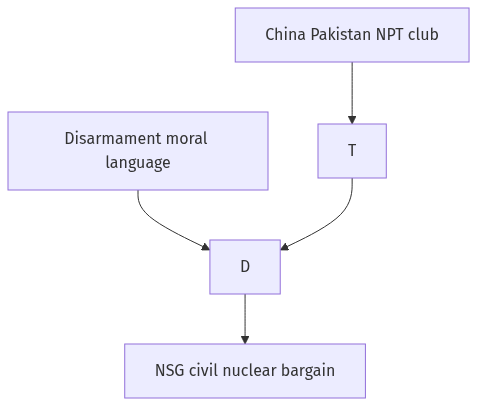
Moral and anti-colonial language made India a critic of nuclear inequality and a late tester. China and Pakistan, plus a closed NPT, made weapons a pragmatic choice by 1998. Credible minimum deterrence and no first use carry the cultural claim into doctrine. The 2008 civil nuclear path was pragmatic normalisation, not NPT accession as a non-weapon State. Defensive-realist security, not offensive hegemony, is the better fit for the declared doctrine.
Model answer
Copper italics in this answer — like this — are the key facts. Each one is unpacked in the Facts & figures rail.
Introduction
India’s nuclear story runs from moral opposition to great-power weapons, through the 1974 peaceful explosion, to the 1998 tests and a declared doctrine of credible minimum deterrence and no first use. Cultural beliefs supplied the language of restraint. Pragmatic foreign policy supplied the arsenal, the doctrine, and the later search for civil nuclear commerce.
Body
Cultural and moral beliefs
- Anti-colonial thought and Buddhist and Gandhian non-violence gave Indian public language a suspicion of nuclear weapons as civilisational failure.
- Jawaharlal Nehru backed civilian atomic science and world nuclear disarmament at the same time. Homi Bhabha’s programme was scientific modernism inside that moral frame.
- The Rajiv Gandhi Action Plan of 1988 still spoke a disarmament idiom at the UN.
- After 1998, official doctrine kept no first use and minimum deterrence, which is a cultural-political choice not required by Mearsheimer’s offensive-realist logic of maximum capability.
Pragmatic drivers
- China’s 1964 test and the 1962 war created a security reason that moral language could not erase.
- Pakistan’s programme and later declared weapons made a dyad that Indian planners could not ignore.
- The NPT (1968) as a closed club pushed India toward an outsider path: 1974 “peaceful nuclear explosion,” then 1998 weapon tests after the extended NPT and CTBT pressures.
- Pragmatism after 1998 meant a doctrine, a command structure, a moratorium on further tests, and the 2008 civil nuclear opening with the United States and the NSG waiver.
- Export controls, IAEA safeguards on civilian reactors, and missile development (Agni series) are the practical State, not the ashram.
How the mix works
- Culture explains why India delayed, why it rejected the NPT as unequal, and why NFU was advertised as responsible stewardship.
- Pragmatism explains why India tested, why it built a triad path, and why it bargained for nuclear commerce without joining the NPT as a non-weapon State.
- Defensive-realist reading: nuclear weapons are for survival and for stopping blackmail, not for conquest. That fits NFU better than offensive realism.
- Diplomacy toward the Global South still uses disarmament talk even while India is a weapon State outside the NPT.
Tensions
- No first use is a political promise. Future doctrine debates, missile defence, and tactical-weapon talk can strain it.
- Moral exceptionalism is weaker when India also seeks great-power status with a nuclear portfolio.
Flow diagram
Conclusion
- Indian nuclear policy is a mix: a cultural claim to restraint and equal global rules, and a pragmatic arsenal built against China and Pakistan and then normalised through the NSG-era bargain. Neither half alone explains 1974, 1998, and NFU together.
Quick related
Students also ask
-
What steps has India taken to regain its foothold in Afghanistan since the Taliban has taken over the country in August 2021?
Next question on this syllabus topic (2023 · Q7(b)). View answer →
-
Did Gandhi’s thought forbid a bomb?
Gandhian ethics opposed industrial killing. The Indian State did not treat that as an operational ban after the China and Pakistan shocks. The residue is restraint language and NFU, not zero weapons.
-
Is NFU compatible with pragmatism?
Yes, if the aim is deterrence of nuclear use and of extreme conventional defeat, not nuclear war-fighting. Critics say NFU can be revised in a crisis, which is why it is a policy, not a physics constraint.
Same topic · past papers
UPSC has asked this before
These previous-year questions sit on the same topic. Open one to practise the earlier ask.
-
2026 · Q1(a) · PSIR GS 2 · 10 marks
Criticism of the institutional approach in comparative political analysis has come up in successive waves. Comment. -
2025 · Q1(a) · PSIR GS 2 · 10 marks
Discuss the psychological approach to the study of comparative politics. -
2024 · Q1(a) · PSIR GS 2 · 10 marks
Discuss the interpretive approach to the study of comparative politics. -
2024 · Q1(d) · PSIR GS 2 · 10 marks
Explain the various facets of the idealist approach to the study of international relations. Comment on its contemporary relevance. -
2023 · Q2(b) · PSIR GS 2 · 15 marks
In what ways does the functionalist approach in International relations help in maintaining peace and order in global politics?
More from this topic
Q8(b) · UPSC Mains 2026 · PSIR GS 2 · 15 marks · Solution
India has recognised that West Asia is not a single contest, but a tangle of rivalries, bargains and anxieties. Comment
Recent developments in Indian Foreign policy
This 15-mark model answer for UPSC CSE Mains examines India's evolved diplomacy in West Asia, transitioning from a monolithic view to navigating complex regional rivalries, strategic bargains, and security anxieties. It highlights India's de-hyphenated engagement with Israel, Iran, and the Arab Gulf, robust energy diplomacy, diaspora protection, and minilateral frameworks like I2U2. The conclusion anchors this pragmatic realism within India's strategic autonomy and Act West policy.
Q5(b) · UPSC Mains 2026 · PSIR GS 2 · 10 marks · Solution
What strategic options can India exercise as a response to the tensions between Pakistan and Afghanistan?
Recent developments in Indian Foreign policy
India faces a complex security landscape due to Durand Line tensions and cross-border terrorism between Pakistan and Afghanistan. Strategic options include proactive diplomatic engagement with the Taliban regime to secure developmental investments, intelligence-sharing and capacity-building with regional partners like Iran and Central Asian Republics, and maintaining a strict posture on counter-terrorism. By leveraging multilateral platforms such as the Shanghai Cooperation Organisation and reinforcing soft-power outreach through humanitarian aid, New Delhi can safeguard its core security interests. Simultaneously, India must balance its defensive posture with strategic autonomy, ensuring regional stability without direct military entanglement in the Pashtun belt.
Q5(c) · UPSC Mains 2025 · PSIR GS 2 · 10 marks · Solution
For India, a multipolar world order would also mean a multipolar Asia. Comment.
Recent developments in Indian Foreign policy
A multipolar world is several great-power centres; it is hollow for India if Asia is Sino-centric. India’s threats, trade and waters are Asian, so Asian power-sharing is the real test of the slogan. Japan, ASEAN centrality, Korea, Australia and India beside China and the U.S. are the intended map. Quad and FOIP are instruments of pluralism, not a finished concert. The claim is right as strategy and still aspirational as fact.