
Revision summary
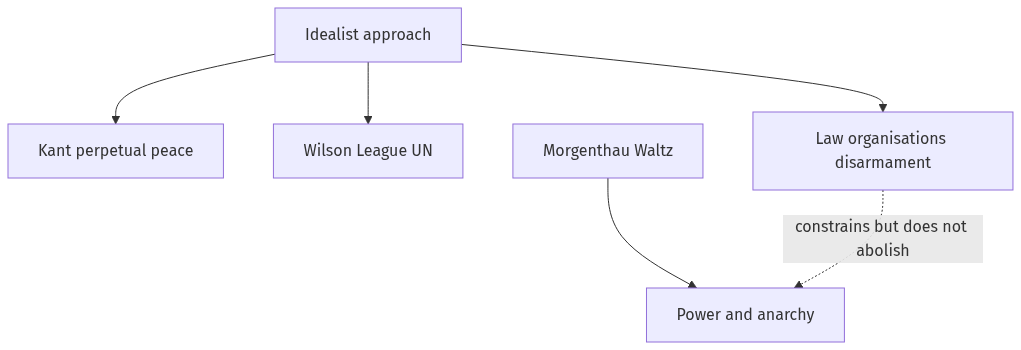
Idealism in IR treats law, morality, public opinion and organisations as real forces, not only military power. Kant’s perpetual peace and Wilson’s League/UN lineage are the core facets, with collective security and disarmament as programmes. It is not naive pacifism; it seeks to change incentives through institutions. Morgenthau and Waltz remain the main critique: interest, anarchy and self-help. Contemporary relevance is institutional and normative — UN, NPT, courts — not a claim that power politics has ended.
Model answer
Copper italics in this answer — like this — are the key facts. Each one is unpacked in the Facts & figures rail.
Introduction
The idealist approach to international relations holds that world politics can be steered by law, morality, public opinion and institutions, not only by relative military power. It is older than the word ‘idealism’. Immanuel Kant and Woodrow Wilson remain the syllabus names. Its facets still organise the United Nations, arms control and human rights. Realists say those facets are decoration. The comment must judge contemporary relevance, not nostalgia.
Body
Facets of the approach
First, human nature and progress. Classical idealism, unlike Morgenthau’s account of interest defined as power, treats education, commerce and republican government as forces that can reduce war. Kant’s Toward Perpetual Peace linked republican constitutions, a federation of free states, and cosmopolitan hospitality. Second, international law as a real constraint, not a slogan: treaties, arbitration, and later the International Court of Justice and the International Criminal Court. Third, international organisation: the League of Nations after Wilson’s Fourteen Points, then the United Nations Charter’s ban on aggressive force. Fourth, collective security rather than shifting alliances. Fifth, disarmament and open diplomacy as moral-political programmes. Sixth, in later liberal form, economic interdependence and democratic peace as empirical cousins of the older moral claim.
Idealism is not the claim that states are already good. It is the claim that institutions and norms can change incentives and that foreign policy should be judged by justice as well as by survival. Wilson tried to replace the old diplomacy of spheres with national self-determination and a league. The 1930s punished that hope. The 1945 Charter tried again with a Security Council that admitted power through the veto.
Realist objection
Morgenthau argued that politics among nations is a struggle for power and that moral crusades produce hypocrisy. Waltz argued that anarchy forces self-help regardless of the goodness of leaders. The League failed in Manchuria and Abyssinia. The United Nations fails when a permanent member is the aggressor, as in Ukraine. Those facts are the realist brief.
Contemporary relevance
Idealism remains relevant as the working language of order. Climate agreements, the Nuclear Non-Proliferation Treaty, refugee law, and the everyday work of the World Health Organization and the World Trade Organization are unintelligible if one counts only tanks. NATO itself claims a community of democracies, which is an idealist wrapping on a realist alliance. The International Criminal Court’s warrants, however uneven, show that atrocity is still named as crime.
Relevance is partial. Great-power war, tariff nationalism, and the stalling of disarmament (question 1(e)) show that Kantian peace is not the structure of 2024. Idealism is relevant as a standard and as a set of institutions, not as a prediction that power politics has ended. A PSIR answer that discards it cannot explain why states still sign charters. An answer that treats it as sufficient cannot explain Ukraine, Gaza, or nuclear modernisation.
Flow diagram
Conclusion
The idealist approach joins Kantian peace, Wilsonian organisation, international law and the hope of progress. It is still the grammar of the UN and of much arms-control talk. It is not a complete theory of the 2020s. Its contemporary relevance is as constraint and aspiration inside a still-anarchic system.
Quick related
Students also ask
-
In what ways does the functionalist approach in International relations help in maintaining peace and order in global politics?
Next question on this syllabus topic (2023 · Q2(b)). View answer →
-
Is liberal institutionalism the same as classical idealism?
It is a later, more rational-choice cousin. Keohane keeps anarchy and adds regimes. Classical idealism spoke more of morality and progress.
-
Did idealism die in 1939?
As a prediction of peace, it failed. As a programme of institutions, it was rebuilt in 1945 and still structures diplomacy.
Same topic · past papers
UPSC has asked this before
These previous-year questions sit on the same topic. Open one to practise the earlier ask.
-
2026 · Q2(a) · PSIR GS 2 · 20 marks
Discuss the factors responsible for the changing nature of states in contemporary industrial societies and explain its impact
More from this topic
Q3(c) · UPSC Mains 2026 · PSIR GS 2 · 15 marks · Solution
Does power transition theory reflect the dynamics of US-China relations?
Approaches to the Study of International Relations
Power transition theory, formulated by A.F. Organski, posits that hegemonic wars occur when a dissatisfied challenger approaches parity with the dominant power. In the context of US-China relations, the theory explains the structural anxieties, trade wars, and technological decoupling observed today. China's rapid economic and military rise fits the challenger profile, while its contestation of the US-led liberal international order signals systemic dissatisfaction. However, the theory's deterministic focus on war overlooks complex economic interdependence, nuclear deterrence, and institutional absorption. While power transition highlights the security dilemma at play, contemporary Sino-US dynamics are shaped equally by deterrence and globalization, making conflict neither inevitable nor strictly linear.
Q1(a) · UPSC Mains 2025 · PSIR GS 2 · 10 marks · Solution
Discuss the psychological approach to the study of comparative politics.
Approaches to the Study of International Relations
The psychological approach studies personality, attitudes, civic culture and cognition in comparative politics. Lasswell, Adorno, Almond and Verba, Easton and later political psychology are the main lineage. It explains voting, protest, obedience and leadership better than a constitution or a class map alone. Surveys, experiments and psychobiography are typical methods. It is a layer, not a substitute for institutions and political economy.
Q1(b) · UPSC Mains 2024 · PSIR GS 2 · 10 marks · Solution
Explain the central tenets of the World-Systems Theory.
Approaches to the Study of International Relations
Wallerstein’s unit is the capitalist world-economy since the long sixteenth century, not the isolated nation-state. Core, semi-periphery and periphery form a durable three-tier division of labour. Unequal exchange and strong/weak states move surplus toward the core. The theory rejects modernisation’s national ladder and differs from Waltz’s interstate anarchy as first cause. Limits include economic determinism and underplaying state autonomy and culture; mobility exists but hierarchy persists.