
Revision summary
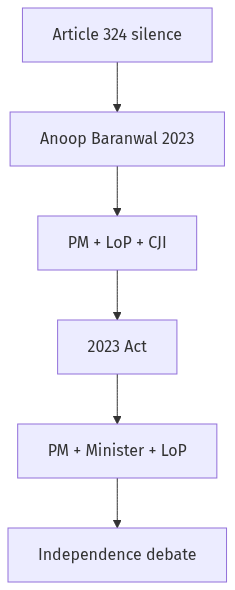
Article 324 left CEC and EC appointments to the President subject to a law Parliament long failed to make, so the Union executive decided in practice. Anoop Baranwal (2023) filled the gap with a committee of the Prime Minister, the Leader of the Opposition, and the Chief Justice of India. The 2023 Act replaced the CJI with a Union Cabinet Minister, giving the executive two of three votes. The debate is about referee independence, separation of powers, and whether opposition participation is equal or ornamental. Procedure cannot guarantee a fair election, but a one-team selection committee makes impartiality harder to perform and to believe.
Model answer
Copper italics in this answer — like this — are the key facts. Each one is unpacked in the Facts & figures rail.
Introduction
The Election Commission of India is a constitutional referee of the democratic game. How its referees are chosen is therefore a constitutional question, not a staffing footnote. Article 324 leaves appointment of the Chief Election Commissioner and other Election Commissioners to the President, subject to a parliamentary law that did not exist for decades. The 2023 judicial and legislative sequence filled that silence in two opposed ways.
Body
The constitutional gap and Anoop Baranwal
Article 324(2) says the CEC and ECs shall be appointed by the President, provided that their appointment shall be subject to the provisions of any law made by Parliament. Until 2023 there was no such law. In practice the Union executive decided. In Anoop Baranwal v. Union of India (March 2023) a five-judge Bench held that this vacuum risked executive dominance over a body that must check the same executive at election time. Drawing on the Vineet Narain spirit of filling gaps to protect integrity, the Court put in place an interim collegium: the Prime Minister, the Leader of the Opposition in the Lok Sabha (or the leader of the largest opposition party), and the Chief Justice of India.
- The analysis is institutional: independence is who hires and fires. The judgment treated a free election’s referee as too important to be the government’s nominee alone.
The 2023 Act
The 2023 statute’s selection committee is the Prime Minister, a Union Cabinet Minister, and the Leader of the Opposition. The CJI is out; the Union has two of three votes. Critics call this executive primacy with an opposition spectator. The government says the Constitution never placed the CJI in executive appointments, and that a law now exists as Article 324 contemplated.
Aspects of the debate
The clash is independence versus electoral mandate, and bipartisanship versus a 2–1 majority. Procedure is not everything, but a referee chosen by one team spends the match proving impartiality. The Act closed the legal vacuum and reopened the legitimacy vacuum Baranwal had tried to fill.
Flow diagram
Conclusion
- The appointment debate has three layers: a constitutional silence, a judicial interim of PM–LoP–CJI, and a statute that returns a Union majority on the panel. Independence of the ECI is the democratic good at stake. The aspect that matters most is whether the opposition’s voice is real or ornamental when the referee of elections is named.
Quick related
Students also ask
-
Explain the structure and functions of the National Commission for Women.
Next question on this syllabus topic (2024 · Q6(b)). View answer →
-
Did the Court amend the Constitution in Baranwal?
It issued a judicial direction to fill a legislative vacuum until Parliament acted, in the name of protecting free and fair elections as a constitutional good.
-
Is the 2023 Act unconstitutional merely because the CJI is absent?
That is the live legal and political question. Constitutionally Parliament may legislate on appointments; whether this design meets independence is what the Court is being asked to test.
Same topic · past papers
UPSC has asked this before
These previous-year questions sit on the same topic. Open one to practise the earlier ask.
-
2025 · Q8(a) · PSIR GS 1 · 20 marks
The decision to conduct Population Census-2027 has reopened the debate on consultation in India. Discuss its various aspects -
2021 · Q8(a) · PSIR GS 1 · 20 marks
"The success of electoral democracy can partly be attributed to the status and role of the Election Commission of India." Explain
More from this topic
Q5(e) · UPSC Mains 2025 · PSIR GS 1 · 10 marks · Solution
How far has been the National Human Rights Commission successful in achieving its objectives? Comment
Statutory Institutions/Commissions
The NHRC is a statutory body under the 1993 Act, meant to watch public violations of human rights in the spirit of the Paris Principles. It has succeeded in recording custodial abuse, bonded labour, and other violations, and in issuing guidelines that travel with court doctrine. Its power is mainly recommendatory, and it often depends on the police it investigates. Vacancies, the 2019 composition changes, and weak reach over armed-forces and conflict-area cases are serious limits. It is a necessary lamp in Indian rights politics, not a substitute for courts, elections, or a reformed criminal state.
Q6(b) · UPSC Mains 2024 · PSIR GS 1 · 15 marks · Solution
Explain the structure and functions of the National Commission for Women.
Statutory Institutions/Commissions
The National Commission for Women is a statutory body under the 1990 Act, constituted in 1992. Structure: a Chairperson, five members, and a Member-Secretary, with SC/ST representation among members, appointed by the Central Government. Functions include examining legal safeguards, investigating complaints, studying and promoting women’s rights, inspecting custodial institutions, advising on development planning, and supporting litigation. For inquiries it can use specified civil-court powers to summon and record evidence. It cannot replace courts or social movements; its limits are executive appointment and non-binding recommendations.
Q6(b) · UPSC Mains 2023 · PSIR GS 1 · 15 marks · Solution
How does NITI Aayog as a 'policy think tank with shared vision' visualize the reorganization of planning in India? Justify your answer
Statutory Institutions/Commissions
NITI Aayog replaced the Planning Commission in 2015 as a Union policy think tank chaired by the Prime Minister. Shared vision is institutionalised in a Governing Council of Chief Ministers, not in approval of State Plans. Planning is recast as a fifteen-year vision, seven-year strategy, and three-year action agenda, plus competitive indices. Allocative Plan grants ended; the Finance Commission and ministries now move money. The reorganisation is justified as cooperative-federal honesty, and limited if States lose a bargaining forum over resources.