
Revision summary
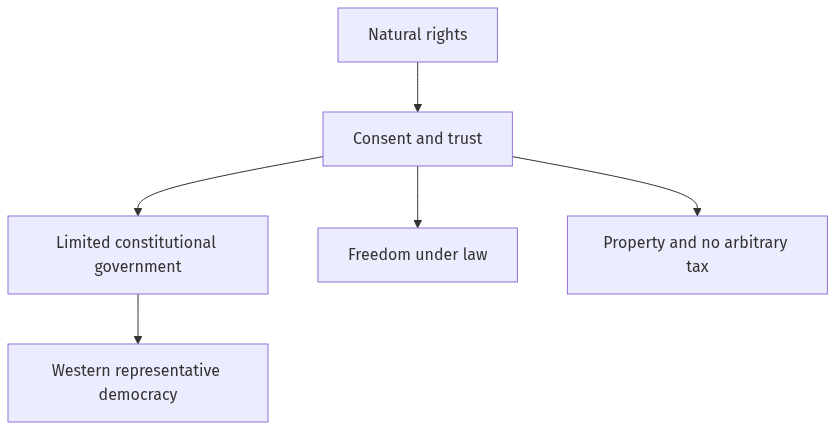
Locke’s constitutionalism treats government as a trust created by consent to protect life, liberty, and estate under standing law. Freedom is independence from arbitrary will, including a right of revolution when the trust is broken. Property arises from labour and is a principal end of political society; taxation without consent violates the trust. These ideas shaped 1688, the American founding, and liberal bills of rights, even as Macpherson and Marx criticised their proprietary core. Later Western democracy widened the person who holds those rights without dropping the Lockean grammar of limited government.
Model answer
Copper italics in this answer — like this — are the key facts. Each one is unpacked in the Facts & figures rail.
Introduction
John Locke’s Two Treatises of Government gave Western democracy its most durable grammar: persons are free and equal by nature; government is a trust; property and conscience are not the prince’s gift. Constitutionalism, freedom, and property are not three ornaments on a liberal tree. They are one argument, and modern representative democracy grew from that argument even where it later outgrew Locke’s exclusions.
Body
Constitutionalism
Against Sir Robert Filmer’s patriarchal kingship, Locke located political power in consent. In the state of nature people have natural law, but they lack an impartial judge. They therefore form a political society and set up a legislature as supreme in the ordinary sense, yet bound by the ends of the trust: preservation of life, liberty, and estate. Government is limited. It must rule by promulgated standing laws, not by extemporary decree. Separation of legislative and executive power follows, because the same hands should not make the law and hold the sword without check.
If the trust is betrayed — if power becomes arbitrary, or if the legislature is destroyed — the people may resume their original right. This right of revolution is the sharp edge of constitutionalism. Jefferson wrote it into 1776. English Whigs had already used 1688 as the practical lesson. Constitutional democracy is this idea institutionalised: periodic consent, higher law, and removable rulers.
Freedom
Lockean freedom is not the licence of Hobbes’s right to everything. It is freedom from another’s arbitrary will, under a law that one has a part in authorising. Religious toleration, argued in the Letter Concerning Toleration, extends the same logic to conscience, even if Locke notoriously excluded atheists and was harsh toward Catholics in his context. Civil liberty is law that applies equally, not the absence of all constraint. Montesquieu and later American founders took this as the meaning of a free government.
Property and Western democracy
Property begins in the person. Labour mixed with unowned nature creates a claim, limited by spoilage and by leaving enough and as good for others. Money, by consent, allows accumulation beyond spoilage. Government exists largely to secure this property, and taxation without representation is a breach of the trust. That clause armed the American cry against Britain. It also armed a proprietary franchise in early Western democracies: those with estate were those with a stake.
C. B. Macpherson called Locke a possessive individualist; Marx saw bourgeois right. Both critiques bite: women were not full contractors, and colonial appropriation shadows the chapter on land. Western democracy still took the architecture — rights prior to the state, limited government, consent of the taxed — and slowly widened the person. Rawls remains in that family. The base is Lockean even where the social state is not.
Flow diagram
Conclusion
Locke joined constitutionalism, freedom under law, and property as a trust that rulers may not devour. Western democracy — 1688, 1776, 1789 in its liberal strain, and later bills of rights — speaks that language. The task of later democracy has been to keep the grammar while widening who counts as a free proprietor of his or her person.
Quick related
Students also ask
-
Hannah Arendt analysed a few categories of vita activa. Explain
Next question on this syllabus topic (2025 · Q4(b)). View answer →
-
Is Locke the father of democracy or of capitalism?
He is a father of constitutional liberal government and of a property-centred civil society. Universal suffrage democracy is a later extension of his person, not a clause he wrote.
-
How does constitutionalism differ from mere majority rule?
The majority in Locke is bound by the ends of the trust and by natural law. A majority that confiscates without right is still a breach, which is why later democracies add judicial review and bills of rights.
Same topic · past papers
UPSC has asked this before
These previous-year questions sit on the same topic. Open one to practise the earlier ask.
-
2026 · Q3(c) · PSIR GS 1 · 15 marks
Discuss Gandhi's approach to property in relation to trusteeship
More from this topic
Q8(b) · UPSC Mains 2026 · PSIR GS 1 · 15 marks · Solution
Critically comment on the shifts in the functioning of the Indian Parliament in the last two decades
Indian Nationalism
This 15-mark answer analyses the transformation of the Indian Parliament over the past two decades, moving from a deliberative forum to an arena of executive assertion. It highlights declining debate hours, bypassing of Department-Related Standing Committees (DRSCs), and the rise of ordinance-making and bypassing of bicameral consensus through Money Bills. The critique incorporates Morris-Jones and Pratap Bhanu Mehta's insights on the hollowing out of institutions. The conclusion argues for systemic institutional reforms to restore Parliament's core constitutional role as a deliberative check on executive power.
Q7(a) · UPSC Mains 2025 · PSIR GS 1 · 20 marks · Solution
Enunciate the impediments to women's participation in local governance in the process of political decentralisation
Indian Nationalism
The 73rd and 74th Amendments reserved local seats for women, which is a structural opening, not yet equal participation. Sarpanch-pati proxy rule, unpaid care, and a male bureaucracy remain the everyday patriarchal impediments. Caste and class decide which women can act; Dalit women office-holders face additional violence and veto. Thin devolution of money and staff makes many local offices ceremonial, so participation has no policy content. Parties and seat rotation often transfer the reserved ticket to a household rather than building a woman’s public career.
Q7(b) · UPSC Mains 2025 · PSIR GS 1 · 20 marks · Solution
Caste remains a vital axis for political mobilisation in India. How would the caste census address the aspirations of people? Discuss
Indian Nationalism
Caste remains a mobilisation axis because it still structures dignity, land, and access to the state, as Kothari, Mandal, and bahujan politics show. Parties already count jatis; the demand is that the official Census should too, beyond SC and ST. Aspirations include fairer reservation design, targeting of welfare, and recognition after the unpublished 2011 SECC caste data. Risks include reification of identity and a pure percentage war that forgets class, gender, and Ambedkar’s horizon of annihilation. A democratic census would publish usable aggregates while protecting persons and keeping constitutional individual rights at the centre.