
Revision summary
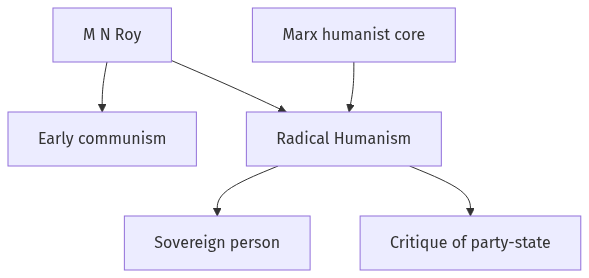
Roy began as an international communist organiser and a critic of colonial capitalism in Marxist terms. His later Radical Humanism treated reason and the sovereign individual as the test of any revolutionary politics. He recovered Marx’s humanistic concern with alienation against mechanical materialism and against a permanent party-state. The political programme was radical democracy and planned reconstruction that does not administer away individuality. The statement is true: Roy highlighted humanistic Marxism by using it to judge, and finally to leave, orthodox communist practice.
Model answer
Copper italics in this answer — like this — are the key facts. Each one is unpacked in the Facts & figures rail.
Introduction
Manabendra Nath Roy began as a founder of communist organisation in Mexico and India and as a delegate who debated Lenin on the colonial question. His later thought, named Radical Humanism or New Humanism, argued that Marxism’s truth was its humanist core: the free person as the end of politics. The statement that his political thought highlighted the humanistic aspects of Marxism is accurate and needs to be specified.
Body
From communism to the person
Roy’s early work accepted historical materialism, anti-imperialism, and organised class struggle. Experience of Comintern discipline, the failure of mechanical forecasts, and the record of the Soviet state pushed him to ask what had been lost. In Reason, Romanticism and Revolution and in the Radical Humanist movement after the 1940s, he treated reason and the sovereign individual as the measure of any party or plan.
Humanistic Marxism, for Roy, meant recovering Marx’s concern with alienation and species-being rather than a closed dialectics of matter. Ethics is not a bourgeois luxury. A revolution that produces a new Leviathan has failed. This is close to later Western Marxism’s humanist wing and distant from Lenin’s smash-and-wield state as a permanent form.
Political consequences
Roy rejected both colonial liberalism that left the person formally free and hungry, and a vanguard that claimed to incarnate history. He wanted a radical democracy of local organised publics, scientific education, and economic reconstruction that does not swallow individuality. That last clause answers Gandhi’s fear of the modern state, without accepting Gandhi’s civilisational rejection of industry. It also answers Nehru’s planning state: plans need a humanist criterion, not only growth.
Critics said Roy underestimated class organisation and caste, which Ambedkar placed at the centre. Others said Radical Humanism became a small intellectual current. The theoretical contribution remains. Roy read Marxism as a project of human emancipation and judged communist practice by whether the person was enlarged or administered.
Discussion
To discuss the statement is to agree that Roy highlighted Marxism’s humanistic aspects, and to add that he did so by breaking with orthodox party Marxism. The humanism is not a soft extra. It is a test of power, hegemony, and the state. In that sense Roy belongs with the question on Marxism as a theory of action: action is required, but not action that erases the actor.
Flow diagram
Conclusion
M. N. Roy’s thought took Marxism’s emancipatory aim and made the free, reasoning person its criterion. Radical Humanism criticised mechanical materialism, Comintern tutelage, and a state that outlives its justification. The discussion therefore affirms the given statement and locates Roy as a humanist critic inside, and then beyond, orthodox Marxism.
Quick related
Students also ask
-
Did Roy remain a Marxist?
He remained a materialist critic of exploitation and a believer in organised reconstruction. He ceased to be an orthodox party Marxist when the person became the sovereign criterion.
-
How does Roy differ from Gandhi on the person?
Both fear a crushing state. Gandhi’s person is moral self-rule often tied to village civilisation. Roy’s person is a reasoning, scientific citizen of a modern radical democracy.
Same topic · past papers
UPSC has asked this before
These previous-year questions sit on the same topic. Open one to practise the earlier ask.
-
2024 · Q2(b) · PSIR GS 1 · 15 marks
Marxism is a political theory of action demanding strict compliance with its core principles. Comment. -
2021 · Q4(a) · PSIR GS 1 · 20 marks
Do you think that the Buddhist traditions have lent greater ethical foundation to the ancient Indian political thought? Give your arguments