
Revision summary
Locke treats government as a trust to protect life, liberty, and estate under standing law. When the trust is destroyed by arbitrary rule, the government is dissolved and power returns to the community. Revolution is this resumption of original right, not every private act of force against a lawful magistrate. The argument rejects Filmer and answers Hobbes by making a last appeal against tyranny. 1688 and the American Declaration used this grammar of consent and the right to alter destructive government.
Model answer
Copper italics in this answer — like this — are the key facts. Each one is unpacked in the Facts & figures rail.
Introduction
John Locke in the Two Treatises of Government treats government as a trust created by consent to protect life, liberty, and estate. Revolution is not a taste for disorder. It is the residual right of the people when that trust is dissolved by arbitrary power.
Body
The trust and its breach
In the state of nature people have natural law but lack an impartial judge. They form political society and set a legislature that must rule by standing law. The executive is a fiduciary power. If the prince or the legislature acts contrary to the trust — by arbitrary taxation, by destroying the legislature, by placing the people under a foreign power, or by a long train of abuses — government is dissolved. Power returns to the community.
Locke insists that this is not a licence for every discontent. Private force against a lawful magistrate is not the same as the people acting when the constitution is already broken. The appeal is to heaven only when no earthly judge remains. Filmer’s patriarchal kingship is rejected because no one is born the property of a ruler.
Political meaning
The argument armed 1688 and later Jefferson’s 1776 claim that a people may alter a government destructive of rights. It also limits revolution: the end is the restoration of law and property, not a war of all against all. Hobbes feared that right; Locke made it the last check on tyranny. Later constitutional democracy regularises the same idea as elections, higher law, and removable rulers.
Flow diagram
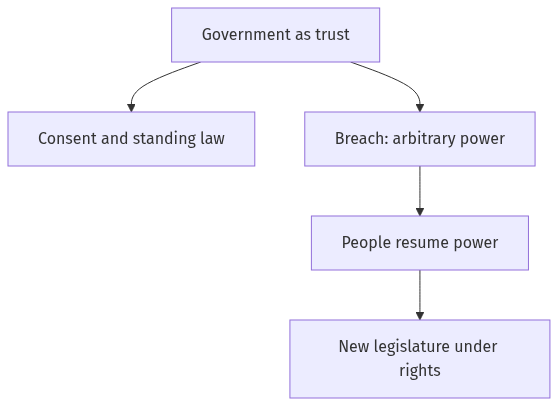
Conclusion
Locke’s view of revolution is the people’s right to resume original power when rulers destroy the trust of consent, law, and rights. It is a constitutional last resort, not a theory of permanent insurrection. Western bills of rights still speak in that language.
Quick related
Students also ask
-
Decline of Liberalism.
Next question on this syllabus topic (2024 · Q1(d)). View answer →
-
Did Locke encourage frequent revolution?
No. He argued that people endure much before they rise, and that the right is triggered by a dissolved constitution, not by ordinary policy disagreement.
-
How does this differ from Hobbes?
Hobbes made sovereign power nearly unlimited once authorised, because the alternative is the state of war. Locke kept a residual popular right against a trustee who becomes a tyrant.
Same topic · past papers
UPSC has asked this before
These previous-year questions sit on the same topic. Open one to practise the earlier ask.
-
2022 · Q1(c) · PSIR GS 1 · 10 marks
"Revolution in Permanence". -
2022 · Q8(b) · PSIR GS 1 · 15 marks
The making of the Indian Constitution is described as an attempt towards a 'social revolution'. Comment
More from this topic
Q8(c) · UPSC Mains 2026 · PSIR GS 1 · 15 marks · Solution
"The lack of political will in preventing environmental degradation is one of the major challenges that India is experiencing." Comment
Political Theory
This 15-mark PSIR answer evaluates India's environmental degradation through the lens of political will, balancing developmental imperatives with ecological imperatives. It examines how electoral cycles, populist short-termism, and growth-first paradigms often sideline ecological security. Key thinkers like Ramachandra Guha and political economy frameworks are integrated to explain the structural inertia. The response provides Indian illustrations ranging from developmental clearances to air pollution crises. It concludes with a policy-forward outlook anchored in constitutional provisions like Article 48A and 51A(g).
Q8(a) · UPSC Mains 2026 · PSIR GS 1 · 20 marks · Solution
Discuss the causes and consequences of inter-State water disputes in India
Political Theory
This answer examines the structural causes and multi-dimensional consequences of inter-State water disputes in India. It highlights federal friction, climate variability, and legal-institutional gaps as primary causes. The consequences span socio-economic losses, inter-regional animosity, and challenges to federal integrity. The response incorporates institutional frameworks like the Inter-State Water Disputes Act and concludes with cooperative water federalism as the way forward.
Q7(c) · UPSC Mains 2026 · PSIR GS 1 · 15 marks · Solution
Map the different types of ethnic conflicts that have emerged in 21st century India
Political Theory
This 15-marker maps the typology of ethnic conflicts in 21st-century India, distinguishing between indigenous-immigrant clashes, tribal identity assertions, and sub-nationalist movements. It examines the structural roots of these conflicts in uneven development, resource competition, and cultural anxiety. The answer integrates theoretical insights on identity politics with concrete Indian case studies across the Northeast and mainland. It concludes with a policy-oriented view emphasizing federal accommodation, democratic dialogue, and inclusive development.