
Revision summary
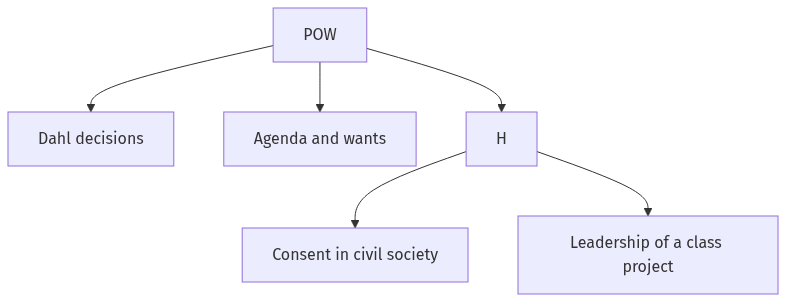
Power is the capacity to produce political effects, from Dahl’s A-over-B decisions to agenda control and class structure. Hegemony, for Gramsci, is leadership plus organised consent in the institutions of civil society. A hegemonic class presents its project as universal; coercion remains in reserve when consent fails. The link is that hegemony is power that has been made to look like common sense rather than like open force. This account sits between a purely behavioural map of decisions and a purely coercive theory of the state.
Model answer
Copper italics in this answer — like this — are the key facts. Each one is unpacked in the Facts & figures rail.
Introduction
Power is the capacity to produce effects on others’ conduct and on public outcomes. Hegemony, in Antonio Gramsci’s sense, is a form of that capacity that works through leadership, culture, and consent in civil society, not only through the police. The two terms are linked: hegemony is power that has become accepted as common sense.
Body
Power
Dahl defined power in behavioural terms: A has power over B to the extent that A can get B to do something B would not otherwise do. Bachrach and Baratz added agenda control. Lukes added the shaping of wants. Marx located class power in ownership of the means of production. These are faces of the same problem: who can determine what happens.
Hegemony
Gramsci wrote in the Prison Notebooks that in the West the state is surrounded by trenches of civil society: parties, churches, schools, press. Rule is not only dominio (coercion) but direzione (leadership). A class is hegemonic when allied groups accept its project as universal. Consent is organised, not spontaneous. Crisis of hegemony appears when that consent cracks and coercion becomes visible.
The link is that hegemony is power plus legitimacy-work in culture. It explains why a constitutional state can serve class ends without daily tanks, and why Dahl’s open decisions may still sit inside a manufactured common sense. Indian nationalist and caste publics show the same: who defines the nation is a hegemonic question, not only a question of votes.
Flow diagram
Conclusion
Power is effective capacity. Hegemony is that capacity exercised as leadership and organised consent in civil society. Gramsci joins the two and thereby extends both Marxist class analysis and Dahl’s decision-making map. Coercion remains when consent fails; it is not the whole of political power.
Quick related
Students also ask
-
Legitimacy adds positive value to political authority and obligation. Discuss.
Next question on this syllabus topic (2024 · Q4(a)). View answer →
-
Is hegemony the same as propaganda?
Propaganda is one tool. Hegemony is a wider organisation of consent across institutions, including education and everyday language.
-
Does hegemony mean people never resist?
No. Gramsci also analysed war of position and crisis of authority, which are names for the breakdown and contest of hegemony.
Same topic · past papers
UPSC has asked this before
These previous-year questions sit on the same topic. Open one to practise the earlier ask.
-
2022 · Q2(a) · PSIR GS 1 · 20 marks
Factors like community, culture and nation weaken the hegemony of neo-liberalism today. Discuss
More from this topic
Q6(b) · UPSC Mains 2026 · PSIR GS 1 · 15 marks · Solution
When there are multiple stakeholders of power, conversation and consensus become the natural ingredients of governance. Analyze with respect to coalition politics
Concept of power, hegemony, ideology and legitimacy.
* Coalition governance requires continuous dialogue and consensus among fragmented power centres rather than unilateral executive dominance. * Hannah Arendt viewed power as stemming from collective communicative discourse instead of structural coercion. * In India, the post-1967 decline of single-party dominance led to regional alliances that strengthened cooperative federalism. * Instruments like Common Minimum Programmes and Coordination Committees help reconcile divergent ideological manifestos and resolve friction. * Cabinet portfolio bargaining acts as a balancing weight to maintain stability among diverse coalition partners. * Vulnerabilities include policy paralysis on structural reforms, executive instability, and regional parties demanding disproportionate concessions. * Despite tactical bargaining risks, coalitions remain essential for managing India's socio-political diversity democratically.
Q4(a) · UPSC Mains 2024 · PSIR GS 1 · 20 marks · Solution
Legitimacy adds positive value to political authority and obligation. Discuss.
Concept of power, hegemony, ideology and legitimacy.
Authority is recognised command; obligation is the reason to obey; legitimacy is the rightfulness that joins them. Weber’s traditional, charismatic, and legal-rational types explain why people experience rule as more than force. Locke grounds obligation in consent and trust; Habermas in public reason; Beetham in legality, justifiability, and expressed consent. Legitimacy adds positive value by making rule compatible with dignity and by making obedience civic rather than merely prudent. Emergency politics and basic-structure judicial review illustrate the loss and the institutional claim of that value.
Q1(d) · UPSC Mains 2023 · PSIR GS 1 · 10 marks · Solution
Foucault's concept of power.
Concept of power, hegemony, ideology and legitimacy.
Foucault treats power as productive relations that form subjects through discipline and the government of populations. The concept goes beyond Hobbes’s sovereign sword and Dahl’s A-over-B decisions. Power and knowledge work together in prisons, clinics, schools, and statistics. Resistance is inside power relations, not a pure exterior. The account describes how people are governed; it does not by itself say which government is just.