
Revision summary
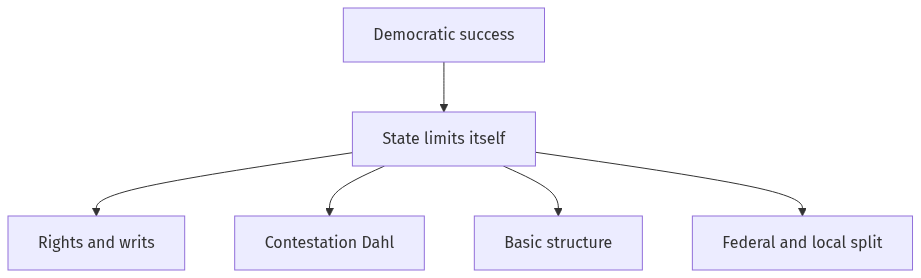
Democratic success is majority rule under rules that bind the state itself. Locke’s trust, Mill’s liberty, and Dahl’s polyarchy name those limits in theory. India institutionalises them in Part III, Articles 32 and 226, federal distribution, and Kesavananda’s basic structure. The Emergency showed that elections without those limits do not preserve democracy. Limitation targets arbitrary power, not the state’s lawful capacity to tax, defend, and provide welfare.
Model answer
Copper italics in this answer — like this — are the key facts. Each one is unpacked in the Facts & figures rail.
Introduction
Contemporary democracy is not only majority election. It is majority election inside rules that bind the state itself. The claim is that those democracies last when public power is legally limited, contestable, and removable, not when the state can do anything a winning coalition wants.
Body
What limitation means
- Locke treated government as a trust for life, liberty, and estate, not as Hobbes’s unlimited sword once authorised.
- J. S. Mill required representative government plus liberty of thought, so that the state cannot close discussion.
- Robert Dahl defined polyarchy by inclusive contestation: elections, opposition, and associational freedom, which are limits on monopoly.
- Constitutionalism writes those limits: a higher law, an independent court, a fixed term, and a public budget.
- Limitation is of arbitrary power. It is not a claim that the state must be weak in capacity to tax, defend, or run welfare.
How contemporary democracies institutionalise the limit
- A written or conventional constitution separates offices so that the same person does not make, execute, and judge the law in one act.
- Fundamental rights, in India Part III, and writs under Articles 32 and 226, let persons sue the state.
- Kesavananda Bharati v. State of Kerala (1973) held that Parliament cannot destroy the Constitution’s basic structure, which is a limit on the amending state itself.
- Independent election authorities, a free press, and opposition parties make removal of rulers possible without civil war.
- Federal distribution, as in Articles 245 to 263, and local bodies after the 73rd and 74th Amendments, split power so that one centre does not hold every function.
Why success depends on this
- Unchecked executive power produces emergency rule, as in 1975–77, which showed that elections alone do not keep a democracy if the state can suspend the conditions of opposition.
- Foucault’s disciplinary power shows that limitation must reach police, prison, and surveillance practice, not only the statute book.
- Easton’s systems language still applies: support collapses when outputs are experienced as predation rather than as authoritative allocation under rules.
- Comparative failure of electoral autocracies shows the same: ballots without limits on the incumbent are not a successful democracy.
What the statement does not say
- A developmental or welfare state can be strong in resources and still limited in procedure, which is Rawls’s well-ordered society rather than a night-watchman minimum.
- Communitarian writers such as Sandel and Walzer warn that a state limited only for unencumbered individuals may ignore social goods; that is a debate about the content of limits, not a licence for unlimited power.
- Granville Austin described the Indian Constitution as a seamless web of democracy, social revolution, and unity; each strand requires a state that can act and a state that can be refused.
- Success therefore lies in self-limitation as law, not in the disappearance of public power.
Flow diagram
Conclusion
Contemporary democracies succeed when the state binds its own power by rights, contestation, federal splits, and higher-law review. Locke, Mill, and Dahl state the theory. Indian Articles 32 and 226 and Kesavananda state the practice. Capacity for welfare is compatible with that limit; arbitrary concentration is not.
Quick related
Students also ask
-
'Credo of Relevance' in post-behaviouralism advocates the importance of action science. Analyze
Next question on this syllabus topic (2023 · Q2(c)). View answer →
-
Does limiting the state mean a weak state?
No. It means legally bound power. A welfare or defence function can be large and still reviewable and time-bound.
-
Is judicial review the only limit?
No. Elections, opposition, federalism, a free press, and internal executive legality are coequal limits. Courts are one institutional form.
Same topic · past papers
UPSC has asked this before
These previous-year questions sit on the same topic. Open one to practise the earlier ask.
More from this topic
Q8(c) · UPSC Mains 2026 · PSIR GS 1 · 15 marks · Solution
"The lack of political will in preventing environmental degradation is one of the major challenges that India is experiencing." Comment
Political Theory
This 15-mark PSIR answer evaluates India's environmental degradation through the lens of political will, balancing developmental imperatives with ecological imperatives. It examines how electoral cycles, populist short-termism, and growth-first paradigms often sideline ecological security. Key thinkers like Ramachandra Guha and political economy frameworks are integrated to explain the structural inertia. The response provides Indian illustrations ranging from developmental clearances to air pollution crises. It concludes with a policy-forward outlook anchored in constitutional provisions like Article 48A and 51A(g).
Q8(a) · UPSC Mains 2026 · PSIR GS 1 · 20 marks · Solution
Discuss the causes and consequences of inter-State water disputes in India
Political Theory
This answer examines the structural causes and multi-dimensional consequences of inter-State water disputes in India. It highlights federal friction, climate variability, and legal-institutional gaps as primary causes. The consequences span socio-economic losses, inter-regional animosity, and challenges to federal integrity. The response incorporates institutional frameworks like the Inter-State Water Disputes Act and concludes with cooperative water federalism as the way forward.
Q7(c) · UPSC Mains 2026 · PSIR GS 1 · 15 marks · Solution
Map the different types of ethnic conflicts that have emerged in 21st century India
Political Theory
This 15-marker maps the typology of ethnic conflicts in 21st-century India, distinguishing between indigenous-immigrant clashes, tribal identity assertions, and sub-nationalist movements. It examines the structural roots of these conflicts in uneven development, resource competition, and cultural anxiety. The answer integrates theoretical insights on identity politics with concrete Indian case studies across the Northeast and mainland. It concludes with a policy-oriented view emphasizing federal accommodation, democratic dialogue, and inclusive development.