
Revision summary
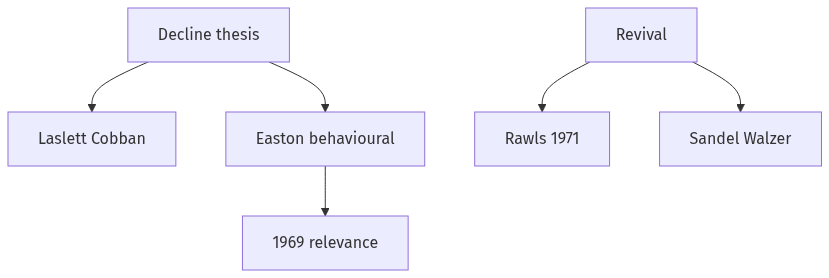
Decline of political theory was a mid-century claim that systematic normative argument had stopped. Laslett, Cobban, positivism, and Easton’s behavioural programme were the main sources of that claim. Easton’s 1969 credo of relevance and Rawls’s 1971 book reopened normative theory. Sandel, Walzer, Berlin, Arendt, and Foucault continued theory under other names. The thesis described a university mood, not the end of political thought in India or elsewhere.
Model answer
Copper italics in this answer — like this — are the key facts. Each one is unpacked in the Facts & figures rail.
Introduction
- The phrase decline of political theory named a mid-twentieth-century diagnosis: that systematic argument about the good regime had given way to history of ideas, ideology, or behavioural science. The diagnosis was later revised when Rawls and others rebuilt normative theory.
Body
What was said to decline
- Peter Laslett wrote in 1956 that political philosophy was dead for the moment, because no one was doing the old systematic work.
- Alfred Cobban and others blamed ideology, war, and a retreat into historical scholarship.
- David Easton in 1951 criticised traditional political theory as unscientific and called for a behavioural science of systems.
- Logical positivism treated value statements as not empirically meaningful, which starved normative argument.
- The result, on this account, was either empty legalism or survey research without justice.
What returned
- Easton’s own 1969 post-behavioural address demanded relevance, which reopened values as a public problem.
- John Rawls’s A Theory of Justice (1971) restored contract argument at a high analytic level.
- Berlin, Arendt, Oakeshott, and later Sandel and Walzer showed that concepts of liberty, action, and community were still live.
- Foucault and post-colonial writers shifted the object of theory to power and empire rather than ending theory.
- Indian constitutional argument after Kesavananda Bharati (1973) continued a public theory of limits on power.
How to read “decline”
- Decline named a professional mood in Anglo-American universities, not the end of political thought in the world.
- Ambedkar, Gandhi, and Aurobindo were already doing political theory in another idiom while the decline thesis was written in England.
- The accurate statement is interruption and specialisation, then revival, not a completed death.
Flow diagram
Conclusion
Decline of political theory referred to a mid-century gap between behavioural science and systematic normative argument. Easton first widened the gap and then asked for relevance. Rawls, communitarians, and constitutional courts show that the gap did not remain.
Quick related
Students also ask
-
Success of contemporary democracies lies in the State limiting its own power. Explain
Next question on this syllabus topic (2023 · Q2(a)). View answer →
-
Did political theory actually stop?
It thinned in some universities as a systematic subject. History of ideas, ideology, and extra-European thought continued.
-
Was behaviouralism the only cause?
No. War, ideology, and positivist suspicion of values also mattered. Behaviouralism was the most organised academic cause.
Same topic · past papers
UPSC has asked this before
These previous-year questions sit on the same topic. Open one to practise the earlier ask.
-
2021 · Q2(b) · PSIR GS 1 · 15 marks
Examine the importance of behavioural approach in political theory. What led to its decline? -
2024 · Q1(d) · PSIR GS 1 · 10 marks
Decline of Liberalism. -
2026 · Q1(a) · PSIR GS 1 · 10 marks
Resurgence of political theory. -
2025 · Q1(a) · PSIR GS 1 · 10 marks
Explain the Philosophical approach to the study of Political theory -
2025 · Q3(a) · PSIR GS 1 · 20 marks
Provide a comparative analysis of behavioural and institutional approach to the study of Political theory
More from this topic
Q8(c) · UPSC Mains 2026 · PSIR GS 1 · 15 marks · Solution
"The lack of political will in preventing environmental degradation is one of the major challenges that India is experiencing." Comment
Political Theory
This 15-mark PSIR answer evaluates India's environmental degradation through the lens of political will, balancing developmental imperatives with ecological imperatives. It examines how electoral cycles, populist short-termism, and growth-first paradigms often sideline ecological security. Key thinkers like Ramachandra Guha and political economy frameworks are integrated to explain the structural inertia. The response provides Indian illustrations ranging from developmental clearances to air pollution crises. It concludes with a policy-forward outlook anchored in constitutional provisions like Article 48A and 51A(g).
Q8(a) · UPSC Mains 2026 · PSIR GS 1 · 20 marks · Solution
Discuss the causes and consequences of inter-State water disputes in India
Political Theory
This answer examines the structural causes and multi-dimensional consequences of inter-State water disputes in India. It highlights federal friction, climate variability, and legal-institutional gaps as primary causes. The consequences span socio-economic losses, inter-regional animosity, and challenges to federal integrity. The response incorporates institutional frameworks like the Inter-State Water Disputes Act and concludes with cooperative water federalism as the way forward.
Q7(c) · UPSC Mains 2026 · PSIR GS 1 · 15 marks · Solution
Map the different types of ethnic conflicts that have emerged in 21st century India
Political Theory
This 15-marker maps the typology of ethnic conflicts in 21st-century India, distinguishing between indigenous-immigrant clashes, tribal identity assertions, and sub-nationalist movements. It examines the structural roots of these conflicts in uneven development, resource competition, and cultural anxiety. The answer integrates theoretical insights on identity politics with concrete Indian case studies across the Northeast and mainland. It concludes with a policy-oriented view emphasizing federal accommodation, democratic dialogue, and inclusive development.