
Revision summary
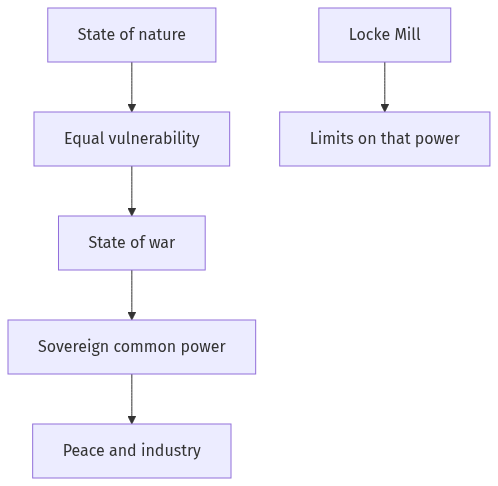
Hobbes’s state of nature is a state of war: a condition of known readiness to fight where there is no common power. Competition, diffidence, and glory are the three causes of quarrel. Natural equality of vulnerability makes pre-emptive violence rational. The sovereign ends the war by monopolising judgment and force. Locke, Mill, and constitutional democracy keep a common power and then limit it, which Hobbes refused as a right against the sovereign.
Model answer
Copper italics in this answer — like this — are the key facts. Each one is unpacked in the Facts & figures rail.
Introduction
Thomas Hobbes in Leviathan (1651) treats the state of nature as a state of war. War here is not only open battle. It is a known disposition to fight when there is no common power to keep all in awe.
Body
Why nature is war
- Hobbes starts from natural equality of vulnerability: the weakest can kill the strongest by secret plot or alliance.
- Three causes of quarrel follow: competition for scarce goods, diffidence (fear of being attacked first), and glory (reputation).
- Without a common judge, each has a natural right to everything that seems necessary to self-preservation, including another’s body.
- The result is continual fear and danger of violent death, and a life that cannot support industry, agriculture, or science.
- Covenants without the sword are words. Only a sovereign with effective power ends the war by monopolising judgment and force.
What the claim is not
- The state of nature is a logical reconstruction of life without political authority, not a dated anthropology of all tribes.
- Locke denied that nature is already war; he treated it as inconvenience without an impartial judge, and he kept a right of revolution.
- Rousseau treated unsocialised humans as not yet in Hobbesian war; war arrives with property and comparison.
- Foucault later studied power inside the ordered state, which Hobbes had pictured as the exit from war, not as war by other means.
Political use
- The argument justifies a strong sovereign, including in a commonwealth by institution, because the alternative is insecurity.
- Limited government after Locke, Mill, and Dahl’s polyarchy accepts the need for a common power and then binds that power by law, rights, and contestation.
- Indian public order clauses and the Union’s duty to protect States against internal disturbance (Article 355) still assume that political authority exists to prevent a return to private force.
Flow diagram
Conclusion
Hobbes identifies the state of nature with a state of war because equal vulnerability, competition, fear, and glory have no common judge. The sovereign is the exit. Later liberals keep the common power and add legal limits that Hobbes did not grant against the sovereign.
Quick related
Students also ask
-
Decline of political theory.
Next question on this syllabus topic (2023 · Q1(e)). View answer →
-
Did Hobbes say all historical societies began in war?
No. The state of nature is an analytical condition of no common authority. It is used to justify why that authority is needed.
-
How does this differ from Locke?
Locke’s nature has natural law and property; war is a later degeneration. Hobbes makes war the default of ungoverned equality.
Same topic · past papers
UPSC has asked this before
These previous-year questions sit on the same topic. Open one to practise the earlier ask.
-
2022 · Q3(c) · PSIR GS 1 · 15 marks
Individualism is inherent in Hobbes' absolutist ideology. Comment
More from this topic
Q8(c) · UPSC Mains 2026 · PSIR GS 1 · 15 marks · Solution
"The lack of political will in preventing environmental degradation is one of the major challenges that India is experiencing." Comment
Political Theory
This 15-mark PSIR answer evaluates India's environmental degradation through the lens of political will, balancing developmental imperatives with ecological imperatives. It examines how electoral cycles, populist short-termism, and growth-first paradigms often sideline ecological security. Key thinkers like Ramachandra Guha and political economy frameworks are integrated to explain the structural inertia. The response provides Indian illustrations ranging from developmental clearances to air pollution crises. It concludes with a policy-forward outlook anchored in constitutional provisions like Article 48A and 51A(g).
Q8(a) · UPSC Mains 2026 · PSIR GS 1 · 20 marks · Solution
Discuss the causes and consequences of inter-State water disputes in India
Political Theory
This answer examines the structural causes and multi-dimensional consequences of inter-State water disputes in India. It highlights federal friction, climate variability, and legal-institutional gaps as primary causes. The consequences span socio-economic losses, inter-regional animosity, and challenges to federal integrity. The response incorporates institutional frameworks like the Inter-State Water Disputes Act and concludes with cooperative water federalism as the way forward.
Q7(c) · UPSC Mains 2026 · PSIR GS 1 · 15 marks · Solution
Map the different types of ethnic conflicts that have emerged in 21st century India
Political Theory
This 15-marker maps the typology of ethnic conflicts in 21st-century India, distinguishing between indigenous-immigrant clashes, tribal identity assertions, and sub-nationalist movements. It examines the structural roots of these conflicts in uneven development, resource competition, and cultural anxiety. The answer integrates theoretical insights on identity politics with concrete Indian case studies across the Northeast and mainland. It concludes with a policy-oriented view emphasizing federal accommodation, democratic dialogue, and inclusive development.