
Revision summary
Multicultural theory treats culture as a condition of using liberty, not as a private hobby. Kymlicka, Taylor, Parekh, and Walzer argue for recognition and, in some cases, group rights. Indian Articles 25 to 30 and linguistic states are the constitutional form of that argument. Ambedkar’s Article 17 and sex-equality limits block a group veto over civil liberty. The perspective fails if it either ignores minorities or traps persons inside the group.
Model answer
Copper italics in this answer — like this — are the key facts. Each one is unpacked in the Facts & figures rail.
Introduction
A multicultural perspective on rights holds that equal citizenship is not only the same list of individual liberties for every person. It also asks how language, religion, and culture structure who can use those liberties.
Body
The claim
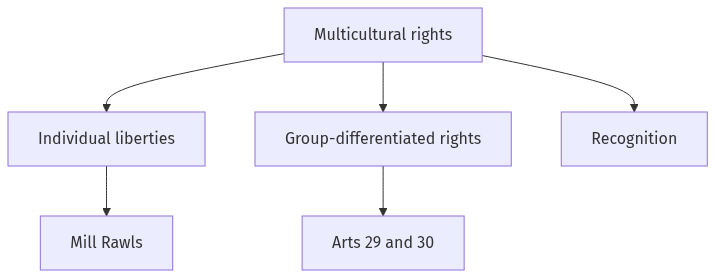
- Liberal rights, in Locke, Mill, and Rawls, attach first to individuals as free and equal persons.
- Will Kymlicka argued that some group-differentiated rights are needed so that minority cultures can supply the context of choice that liberals already value.
- Charles Taylor named recognition: misrecognition can injure dignity even when the civil code is formally equal.
- Bhikhu Parekh treated cultural diversity as a permanent feature of modern states, not as a temporary exception.
- Michael Walzer in Spheres of Justice held that goods should be distributed by the meanings a community already gives them, which resists a single nationwide metric of right.
Indian text
- Articles 25 to 28 protect freedom of religion; Articles 29 and 30 protect the cultural and educational rights of minorities.
- Personal law and linguistic federalism after the States Reorganisation Act, 1956, are institutional forms of this perspective.
- Ambedkar still insisted that group custom cannot cancel equal civil liberty, which is why Article 17 abolishes untouchability.
Limits
- Susan Moller Okin asked whether multicultural accommodation can trap women inside group rules.
- A rights perspective that is only individual can erase minorities; a perspective that is only communal can erase dissenters inside the group.
- The workable line is individual basic liberties plus limited group rights that do not destroy exit, equality of sexes, and the secular public law of the state.
Flow diagram
Conclusion
The multicultural perspective adds recognition and group-differentiated rights to the liberal list of individual liberties. Kymlicka, Taylor, Parekh, and Walzer state the case. Articles 25 to 30 show the Indian form, bounded by Ambedkar’s civil equality.
Quick related
Students also ask
-
State of Nature as State of War (Hobbes).
Next question on this syllabus topic (2023 · Q1(c)). View answer →
-
Does multiculturalism reject individual rights?
No. It says some individual rights are incomplete unless language, religion, and recognition are also secured.
-
Can a group claim exemption from equality of sexes?
Not as a general right. Indian public law and Okin’s critique treat sex equality as a limit on group autonomy.
Same topic · past papers
UPSC has asked this before
These previous-year questions sit on the same topic. Open one to practise the earlier ask.
-
2026 · Q2(a) · PSIR GS 1 · 20 marks
"Rights of the man are separate and independent of the State." Critically analyze the perspective of Laski -
2025 · Q1(b) · PSIR GS 1 · 10 marks
Write a note on the relation between equality and liberty from the multi-cultural perspective -
2024 · Q7(b) · PSIR GS 1 · 15 marks
The blueprint of Gram Swaraj is the key to understanding the Gandhian perspective on planning. Discuss. -
2025 · Q2(c) · PSIR GS 1 · 15 marks
Explain how Rawls used the liberal and egalitarian perspective to develop his theory of justice -
2025 · Q5(b) · PSIR GS 1 · 10 marks
Write a note on the Dalit perspective of Indian National Movement
More from this topic
Q8(c) · UPSC Mains 2026 · PSIR GS 1 · 15 marks · Solution
"The lack of political will in preventing environmental degradation is one of the major challenges that India is experiencing." Comment
Political Theory
This 15-mark PSIR answer evaluates India's environmental degradation through the lens of political will, balancing developmental imperatives with ecological imperatives. It examines how electoral cycles, populist short-termism, and growth-first paradigms often sideline ecological security. Key thinkers like Ramachandra Guha and political economy frameworks are integrated to explain the structural inertia. The response provides Indian illustrations ranging from developmental clearances to air pollution crises. It concludes with a policy-forward outlook anchored in constitutional provisions like Article 48A and 51A(g).
Q8(a) · UPSC Mains 2026 · PSIR GS 1 · 20 marks · Solution
Discuss the causes and consequences of inter-State water disputes in India
Political Theory
This answer examines the structural causes and multi-dimensional consequences of inter-State water disputes in India. It highlights federal friction, climate variability, and legal-institutional gaps as primary causes. The consequences span socio-economic losses, inter-regional animosity, and challenges to federal integrity. The response incorporates institutional frameworks like the Inter-State Water Disputes Act and concludes with cooperative water federalism as the way forward.
Q7(c) · UPSC Mains 2026 · PSIR GS 1 · 15 marks · Solution
Map the different types of ethnic conflicts that have emerged in 21st century India
Political Theory
This 15-marker maps the typology of ethnic conflicts in 21st-century India, distinguishing between indigenous-immigrant clashes, tribal identity assertions, and sub-nationalist movements. It examines the structural roots of these conflicts in uneven development, resource competition, and cultural anxiety. The answer integrates theoretical insights on identity politics with concrete Indian case studies across the Northeast and mainland. It concludes with a policy-oriented view emphasizing federal accommodation, democratic dialogue, and inclusive development.