
Revision summary
Satyagraha is Gandhi’s insistence on truth through non-violent non-cooperation and civil disobedience. It turned Indian nationalism from elite petition into mass movements from Champaran to Quit India. The constructive programme was the social side of the same nationalism. Aurobindo’s swaraj supplied an earlier complete-independence goal; Gandhi supplied the mass method. Ambedkar held that civil liberty for Dalits needed law and organisation, not only satyagraha of conscience.
Model answer
Copper italics in this answer — like this — are the key facts. Each one is unpacked in the Facts & figures rail.
Introduction
M. K. Gandhi made satyagraha the mass method of Indian nationalism: insistence on truth through non-violent non-cooperation and civil disobedience. Nationalism in this form was a claim to swaraj that sought to include the village poor, not only a petition of lawyers.
Body
Satyagraha as method
- Satyagraha treats the opponent as a moral agent who can be converted, not only as an enemy to be destroyed, which rejects Hobbes’s war as the default of politics.
- Champaran (1917), Kheda (1918), the Non-Cooperation Movement (1920–22), the Civil Disobedience Movement (1930–34), and the Quit India Movement (1942) were national applications of the method.
- The constructive programme — khadi, village sanitation, Hindu–Muslim unity, abolition of untouchability — was the social content of the same nationalism.
- Hind Swaraj (1909) tied the method to a critique of modern industrial civilisation, so nationalism was not only capture of the colonial state.
What it did to Indian nationalism
- It widened the nation from elite constitutionalism to peasants, workers, and women in public action.
- It gave Indian nationalism a distinctive public ethic that later informed Article 51A duties and the language of non-violence in political culture.
- Aurobindo had already named complete swaraj; Gandhi supplied a mass technique and a village social programme.
Limits named in theory and in history
- Ambedkar argued that satyagraha of upper-caste conscience did not by itself secure civil liberty for the depressed classes; law, separate political safeguards, and Educate, Agitate, Organise were required.
- Revolutionary nationalists rejected the method as slow; Partition showed that moral conversion did not settle every communal conflict.
- Satyagraha still remains the main explanation of how Indian nationalism became a mass, mostly non-violent, anti-colonial movement.
Flow diagram
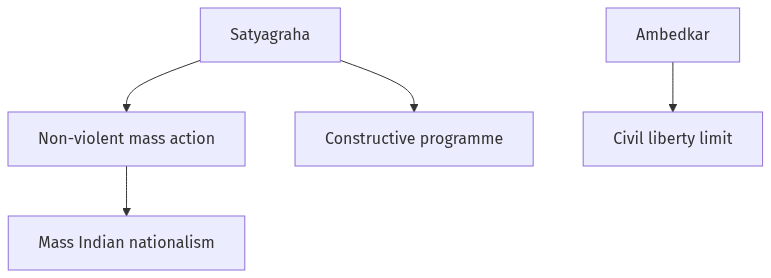
Conclusion
Satyagraha made Indian nationalism a mass non-violent claim to swaraj, joined to a constructive social programme. Gandhi designed the method. Ambedkar’s civil-liberty critique and Partition mark its limits without cancelling its historical role.
Quick related
Students also ask
-
The Constitution of India is the 'cornerstone of a nation'. (Granville Austin). Analyze
Next question on this syllabus topic (2023 · Q6(c)). View answer →
-
Is satyagraha the same as passive resistance?
Gandhi distinguished satyagraha as active truth-force. Passive resistance he treated as a weaker, more tactical term.
-
Did satyagraha create the Constitution?
It created the mass nation that could demand a constituent assembly. The Constitution’s text is Ambedkar’s and the Assembly’s legal work.
More from this topic
Q8(b) · UPSC Mains 2026 · PSIR GS 1 · 15 marks · Solution
Critically comment on the shifts in the functioning of the Indian Parliament in the last two decades
Indian Nationalism
This 15-mark answer analyses the transformation of the Indian Parliament over the past two decades, moving from a deliberative forum to an arena of executive assertion. It highlights declining debate hours, bypassing of Department-Related Standing Committees (DRSCs), and the rise of ordinance-making and bypassing of bicameral consensus through Money Bills. The critique incorporates Morris-Jones and Pratap Bhanu Mehta's insights on the hollowing out of institutions. The conclusion argues for systemic institutional reforms to restore Parliament's core constitutional role as a deliberative check on executive power.
Q7(a) · UPSC Mains 2025 · PSIR GS 1 · 20 marks · Solution
Enunciate the impediments to women's participation in local governance in the process of political decentralisation
Indian Nationalism
The 73rd and 74th Amendments reserved local seats for women, which is a structural opening, not yet equal participation. Sarpanch-pati proxy rule, unpaid care, and a male bureaucracy remain the everyday patriarchal impediments. Caste and class decide which women can act; Dalit women office-holders face additional violence and veto. Thin devolution of money and staff makes many local offices ceremonial, so participation has no policy content. Parties and seat rotation often transfer the reserved ticket to a household rather than building a woman’s public career.
Q7(b) · UPSC Mains 2025 · PSIR GS 1 · 20 marks · Solution
Caste remains a vital axis for political mobilisation in India. How would the caste census address the aspirations of people? Discuss
Indian Nationalism
Caste remains a mobilisation axis because it still structures dignity, land, and access to the state, as Kothari, Mandal, and bahujan politics show. Parties already count jatis; the demand is that the official Census should too, beyond SC and ST. Aspirations include fairer reservation design, targeting of welfare, and recognition after the unpublished 2011 SECC caste data. Risks include reification of identity and a pure percentage war that forgets class, gender, and Ambedkar’s horizon of annihilation. A democratic census would publish usable aggregates while protecting persons and keeping constitutional individual rights at the centre.