
Revision summary
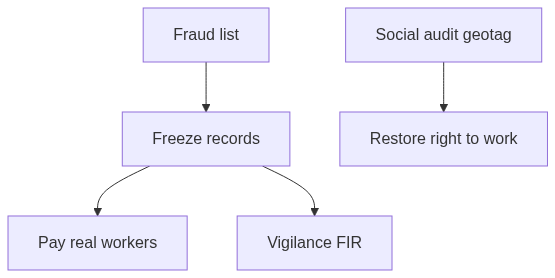
The first duty is to protect records, tell workers the truth, and stop further theft. Arrears must reach real job-seekers while ghosts, fake works and siphoned funds go to vigilance and the police. Job cards should be re-verified without stripping genuine households. The predecessor deserves due process, not a media hanging or a cover-up. Social audit, geotagging and a public dashboard keep the repair from rotting again.
Model answer
Copper italics in this answer — like this — are the key facts. Each one is unpacked in the Facts & figures rail.
Introduction
You take charge of a district and find that MGNREGA, a right to work, has been turned into a trough: money not paid to workers, ghost names, fake works, job cards as favours. Your predecessor built that trough. Your ethics are justice for labour, due process for the accused, and restoration of a law that is the rural poor’s floor.
Body
(a) Reaction and restoration
The right reaction is neither a press conference of rage nor a quiet burial. It is shock that becomes a plan. Freeze doubtful payments, protect records, inform the State rural-development secretary and the CVO/Vigilance, do not destroy the predecessor’s laptop, and tell workers the truth in a jan sunwai: the scheme is yours by law, this office failed you, we will rebuild. Restoration means fresh job-card verification, DBT that actually hits Aadhaar-seeded accounts of living workers, works that exist on the ground (geotag), and a helpdesk for those who were never paid.
(b) Actions on the listed issues
(i) Money not disbursed to job-seekers: trace PFMS, pay arrears with priority, fix the block officer. (ii) Muster rolls: reconstruct from attendance apps, photos, and village memory; end paper ghosts. (iii) Mismatch of work and pay: measurement books versus site; recover from implementing agency. (iv) Fictitious persons: FIR, Aadhaar de-duplication, social audit. (v) Job cards without need: re-verify households; a job card is a right of a rural household willing to work, not a caste gift, but it is also not a trader’s pad. (vi) Siphoning: criminal case, attachment, departmental inquiry. (vii) Non-existent works: site inspection, black-list, recovery. Technical sanction from you now must be earned by a visit, not a signature culture.
(c) How to deal with the whole situation
Use law, not vendetta. The predecessor gets a charge sheet and a chance to reply. Staff who cooperated get a path to turn approver. Do not punish genuine workers for a sarpanch’s crime by closing the panchayat’s entire shelf. Bring Ombudsperson, social audit unit, and geo-MGNREGA to stay. Publish a monthly dashboard. Your personal integrity is the message: this scheme is Gandhi’s employment as right, not a MLA’s cash. Aristotle’s justice is giving each their due — wages to the worker, punishment to the thief, and a functioning office to the village.
Flow diagram
Conclusion
Name the fraud, freeze the leak, pay the real worker, and prosecute with due process. Restore MGNREGA as a right, not as a revenge play against a predecessor and not as a silence that protects him.
Quick related
Students also ask
-
Case study. Ashok is Divisional Commissioner of one of the border districts of the North East State. A few years back, Military has taken over the neighbouring country after overthrowing the elected civil government. Civil war situation is prevailing in the country especially in last two years. However, internal situation further deteriorated due to rebel groups taking over control of certain populated areas near own border. Due to intense fight between military and rebel groups, civilian casualties has increased manifold in recent past. In the meantime, in one night Ashok got information from the local police guarding the border check post that there are about 200-250 people mainly women and children trying to cross over to our side of the border. There are also about 10 soldiers with their weapons in military uniform part of this group who wants to cross over. Women and Children are also crying and begging for help. A few of them are injured and bleeding profusely need immediate medical care. Ashok tried to contact Home Secretary of the State but failed to do so due to poor connectivity mainly due to inclement weather. (a) What are the options available with Ashok to cope with the situation?(b) What are the ethical and legal dilemmas being faced by Ashok?(c) Which of the options, do you think would be more appropriate for Ashok to adopt and why?(d) In the present situation, what are the extra precautionary measures to be taken by the Border Guarding Police in dealing with soldiers in uniform?
Next question on this syllabus topic (2025 · Q12). View answer →
-
Should you suspend the whole panchayat’s MGNREGA?
Suspend the crooked works, not the hungry household’s right, unless the law forces a pause while you rebuild the muster.
-
What if the predecessor is now a powerful posting?
Still write the facts. Fear of a lobby is the second fraud.
Same topic · past papers
UPSC has asked this before
These previous-year questions sit on the same topic. Open one to practise the earlier ask.
More from this topic
Q12 · UPSC Mains 2026 · GS IV · 20 marks · Solution
Case study. Ajit has been recently promoted as the Head of the Department of Weapon Sales (DWS) in the Ministry of Defence Production (MDP). His charter of duties includes international sales of weapons produced domestically by MDP. In two recent wars, MDP weapons have performed admirably, resulting in many countries showing interest in buying them, particularly long-range artillery and missiles. Country A and country B have asked for these weapons. However, production constraints restrict DWS to accept only one purchase order. Country A is a developing nation with a sound technology base. MDP is planning R&D collaboration with it for the next generation of weapons. It is not part of any security alliance and needs weapons for protection from a troublesome neighbour. It seeks a large acquisition on a long-term loan. Country B is also a developing nation. Military strength is its priority, with the military budget often ingressing into allocations for human resources and infrastructure development. It is in security alliance with a superpower who has a large military base there and periodically allots it financial grants. It is a member of an economic bloc with which the government is currently negotiating a free trade agreement. It is not a signatory of NPT but possesses smaller nuclear weapons and delivery systems. It supports some guerrilla forces abroad. It has sought a smaller acquisition and is prepared to make some advance payment. It is currently negotiating arms purchases from another nation too. Ajit discussed this case with his counterparts in the related departments. Therein, the significant economic benefits, employment generation and stronger diplomatic relations arising from this sale were highlighted. It was also emphasized that refusing the deal could result in country B purchasing weapons from some other supplier. Ajit was aware that in arms sales, due diligence at each stage was pivotal to ensure conformity to national policy and international treaties. (a) Discuss the options available to Ajit. Which option should he select and why? (b) How can Ajit balance nation's economic and strategic interests with ethical considerations?
Ethics Case Studies
This case study examines ethical dilemma in defense exports, balancing economic gains, strategic partnerships, and non-proliferation norms. Ajit must choose between Country A for R&D collaboration and self-reliance, or Country B for immediate financial gains and FTA leverage. The recommended course prioritizes long-term strategic security, technological synergy, and international humanitarian norms over short-term mercantile interests.
Q11 · UPSC Mains 2026 · GS IV · 20 marks · Solution
Case study. Rajapuram is a border district. Jhara and Biru, its two major communities are in continual conflict with each other. The social fabric is fractured and demands mending. Ethnic tensions between the two communities have erupted into violence resulting in a large number of deaths. The stated causes are conflicting land claims, uneven resource allocation and inadequate political representation in government bodies. Separate relief camps had to be created for the two communities. The situation is volatile and appears to be getting out of control. Rajan has been appointed the District Magistrate (DM) of Rajapuram and tasked to quickly get the situation under control. His immediate tasks include restoring administrative authority, reopening the highway and initiating peace talks. On taking over his appointment, Rajan realized that the inter-community rivalry had even seeped into the local administration and police. With functional neutrality being the immediate casualty, it had made both communities distrustful of the government. The neighbouring country could utilize the opportunity to spur insurgent activity and further aggravate the situation. Rajan favoured a controlled approach starting with opening the highway to restore food and medical supplies. He toyed with the idea of requisitioning CRPF units to help restore administrative control. (a) Discuss the ethical issues that need to be addressed in this case. (b) What are the options open to Rajan? Which option would ensure protection of his non-partisan image without compromising ethics?
Ethics Case Studies
This GS4 case study examines the ethical dilemmas faced by a District Magistrate in managing an ethnic conflict in a sensitive border district. It analyses the ethical issues involving neutrality, human life, security, and institutional trust. It evaluates options ranging from purely coercive measures to inclusive peace-building. The recommended approach balances administrative firmness with transparent, unbiased stakeholder engagement to uphold public service values.
Q10 · UPSC Mains 2026 · GS IV · 20 marks · Solution
Case study. Vikas is a government officer with over a decade of service in public administration. He has recently moved as the District Collector (DC) of Nainipura, a remote hilly district bordering a forest. Due to Nainipura's low levels of economic development, one of his major duties is to ensure proper functioning of the public distribution system (PDS) amongst the economically weaker sections (EWS). During his on-site visits, Vikas was apprised of a typical administrative challenge in operating the PDS. To prevent leakages, all distributors were required to carry out real-time biometric identification of the beneficiaries, whose fingerprints were tallied with identity card records. This was creating problems as the operating system sometimes rejected fingerprint matching in the cases of growing children, manual labourers and senior citizens. The problem was further compounded in periods of low WIFI connectivity. The distributors, in such cases, resorted to personal discretion when they could identify the recipient. Vikas had to address this problem on priority. Strictly adhering to 'government regulations' would ensure fiscal probity but would greatly trouble the proposed beneficiary, i.e., EWS. It may even impinge on their fundamental right to life as per Article 21 of the Constitution. Conversely, leaving the resolution solely to the discretion of the distributors could lead to misuse and leakages. (a) What are the options open to Vikas? How should he balance fiscal probity with empathy towards the designated beneficiaries? (b) Discuss the ethics of using technology as a gatekeeper for welfare schemes.
Ethics Case Studies
• Balance strict digital rules with human empathy to prevent vulnerable citizens from losing entitled rations due to technical failures. • Avoid extreme approaches like rigid enforcement (causing exclusion) or unchecked discretion (causing leakage and corruption). • Implement practical offline workarounds like manual registers, paper slips, or OTPs backed by periodic audits. • Treat procedural norms and technology as tools for human welfare rather than rigid ends in themselves. • Recognize that digital gatekeeping creates ethical tensions between fiscal efficiency and the exclusion of genuine beneficiaries. • Guard against technology violating human dignity by forcing vulnerable groups to repeatedly prove their identity against system errors. • Ensure administrative accountability so systemic technological failures are not unfairly blamed on the citizens.