
Revision summary
Options range from pushing everyone back to opening the gate to armed men; both extremes fail. The dilemma is non-refoulement and medical duty versus sovereignty and the risk of a ruse. The better path is triage and shelter for civilians, especially women and children, and separate internment of disarmed soldiers pending the Centre. Border police should keep distance, seal weapons, separate camps, and avoid humiliation or leaks. Waiting for a dead phone while a child bleeds is not caution; it is omission.
Model answer
Copper italics in this answer — like this — are the key facts. Each one is unpacked in the Facts & figures rail.
Introduction
Ashok is Divisional Commissioner on a North-East border. A civil war next door has pushed two hundred women and children, some bleeding, and ten armed soldiers toward the check-post. The Home Secretary’s phone does not work. Night, rain, and international law arrive together. This is humanity, sovereignty, and force protection in one queue.
Body
(a) Options
Ashok can push everyone back at gunpoint. He can open the gate to all, including armed men. He can admit civilians, disarm and intern the soldiers pending MHA and MEA. He can give medical aid on the zero line without a formal crossing. He can wait for Delhi while a child bleeds. He can split: women and children to a camp, soldiers to a separate guarded enclosure.
(b) Ethical and legal dilemmas
Non-refoulement (customary against return to torture or indiscriminate harm) versus Foreigners Act and a closed border. IHL: civilians versus combatants. National security: a uniform can be a ruse. Duty of care to the bleeding. Sovereignty of India and of the neighbour. Chain of command: acting without the Home Secretary versus omission as a death. Equality: a soldier is still a human being if disarmed; he is not a tourist. Local politics of the Northeast (load on a small district, ethnic rumours).
(c) Most appropriate
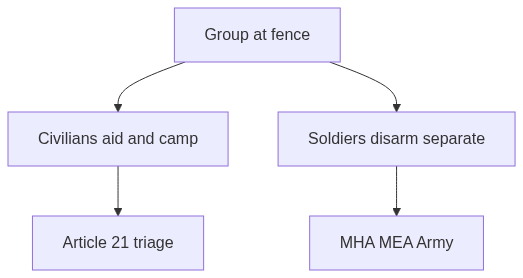
- The most appropriate bundle is: immediate medical triage on Indian soil or at the post for the injured regardless of papers (Article 21 is not only for voters); admit women, children and unarmed civilians to a temporary camp with registration, screening, and FRRO/MHA in the morning; do not let armed soldiers walk in as a unit; require weapons down, separate them, treat as detained foreign military personnel until Army/BSF/ITBP and MEA instruct (possible internment, not a press hug); record every step for the Home Secretary when the weather eases. Pushing a bleeding child back is inhuman. Opening a night gate to loaded rifles is reckless. This is prudence plus compassion, Grotius and the Geneva distinction in a district raincoat.
(d) Extra precautions for border police with soldiers in uniform
Assume ruse until proven. Cover and distance. Night illumination and body cameras if they exist. No crowding of the post. Women police for women refugees. Language and search by same gender. Separate lock-up from civilian camp. Count weapons into a sealed pit. No selfies, no leaked video that becomes a diplomatic mine. Medical before interrogation. Inform BSF/Army at once. Watch the rear for a follow-on group. Do not strip a prisoner as humiliation. Do not hand them to a local mob.
Ashok’s honour is the child who lives and the post that does not fall.
Flow diagram
Conclusion
Help the injured and the civilian women and children; disarm and isolate the soldiers; write to Delhi as soon as the phone lives. A closed heart and an open armoury are both failures on that night.
Quick related
Students also ask
-
Case study. There is a technological company named ABC Incorporated which is the second largest worldwide, situated in the Third World. You are the Chief Executive Officer and the majority shareholder of this company. The fast technological improvements have raised worries among environmental activists, regulatory authorities, and the general public over the sustainability of this scenario. You confront substantial issues about the business's environmental footprint. In 2023, your organization had a significant increase of 48% in greenhouse gas emissions compared to the levels recorded in 2019. The significant rise in energy consumption is mainly due to the surging energy requirements of your data centers, fuelled by the exponential expansion of Artificial Intelligence (AI). AI-powered services need much more computational resources and electrical energy compared to conventional online activities, notwithstanding their notable gains. Although there is already a commitment and goal to achieve net zero emissions by 2030, the challenge of lowering emissions seems overwhelming as the integration of AI continues to increase. (a) What is your immediate response to the challenges posed in the above case? (b) Discuss the ethical issues involved in the above case. (c) Your company has been identified to be penalized by technological giants. What logical and ethical arguments will you put forth to convince about its necessity? (d) Being a conscientious being, what measures would you adopt to maintain balance between AI innovation and environment footprint?
Next question on this syllabus topic (2024 · Q7). View answer →
-
Must India accept every refugee column?
No. Screening, capacity and security apply. A night of first aid and sorting is not a blank visa.
-
Can local police intern foreign soldiers?
They can detain pending the Army and the Ministry of External Affairs. They should not improvise a prisoner-of-war camp without that chain.
Same topic · past papers
UPSC has asked this before
These previous-year questions sit on the same topic. Open one to practise the earlier ask.
More from this topic
Q12 · UPSC Mains 2026 · GS IV · 20 marks · Solution
Case study. Ajit has been recently promoted as the Head of the Department of Weapon Sales (DWS) in the Ministry of Defence Production (MDP). His charter of duties includes international sales of weapons produced domestically by MDP. In two recent wars, MDP weapons have performed admirably, resulting in many countries showing interest in buying them, particularly long-range artillery and missiles. Country A and country B have asked for these weapons. However, production constraints restrict DWS to accept only one purchase order. Country A is a developing nation with a sound technology base. MDP is planning R&D collaboration with it for the next generation of weapons. It is not part of any security alliance and needs weapons for protection from a troublesome neighbour. It seeks a large acquisition on a long-term loan. Country B is also a developing nation. Military strength is its priority, with the military budget often ingressing into allocations for human resources and infrastructure development. It is in security alliance with a superpower who has a large military base there and periodically allots it financial grants. It is a member of an economic bloc with which the government is currently negotiating a free trade agreement. It is not a signatory of NPT but possesses smaller nuclear weapons and delivery systems. It supports some guerrilla forces abroad. It has sought a smaller acquisition and is prepared to make some advance payment. It is currently negotiating arms purchases from another nation too. Ajit discussed this case with his counterparts in the related departments. Therein, the significant economic benefits, employment generation and stronger diplomatic relations arising from this sale were highlighted. It was also emphasized that refusing the deal could result in country B purchasing weapons from some other supplier. Ajit was aware that in arms sales, due diligence at each stage was pivotal to ensure conformity to national policy and international treaties. (a) Discuss the options available to Ajit. Which option should he select and why? (b) How can Ajit balance nation's economic and strategic interests with ethical considerations?
Ethics Case Studies
This case study examines ethical dilemma in defense exports, balancing economic gains, strategic partnerships, and non-proliferation norms. Ajit must choose between Country A for R&D collaboration and self-reliance, or Country B for immediate financial gains and FTA leverage. The recommended course prioritizes long-term strategic security, technological synergy, and international humanitarian norms over short-term mercantile interests.
Q11 · UPSC Mains 2026 · GS IV · 20 marks · Solution
Case study. Rajapuram is a border district. Jhara and Biru, its two major communities are in continual conflict with each other. The social fabric is fractured and demands mending. Ethnic tensions between the two communities have erupted into violence resulting in a large number of deaths. The stated causes are conflicting land claims, uneven resource allocation and inadequate political representation in government bodies. Separate relief camps had to be created for the two communities. The situation is volatile and appears to be getting out of control. Rajan has been appointed the District Magistrate (DM) of Rajapuram and tasked to quickly get the situation under control. His immediate tasks include restoring administrative authority, reopening the highway and initiating peace talks. On taking over his appointment, Rajan realized that the inter-community rivalry had even seeped into the local administration and police. With functional neutrality being the immediate casualty, it had made both communities distrustful of the government. The neighbouring country could utilize the opportunity to spur insurgent activity and further aggravate the situation. Rajan favoured a controlled approach starting with opening the highway to restore food and medical supplies. He toyed with the idea of requisitioning CRPF units to help restore administrative control. (a) Discuss the ethical issues that need to be addressed in this case. (b) What are the options open to Rajan? Which option would ensure protection of his non-partisan image without compromising ethics?
Ethics Case Studies
This GS4 case study examines the ethical dilemmas faced by a District Magistrate in managing an ethnic conflict in a sensitive border district. It analyses the ethical issues involving neutrality, human life, security, and institutional trust. It evaluates options ranging from purely coercive measures to inclusive peace-building. The recommended approach balances administrative firmness with transparent, unbiased stakeholder engagement to uphold public service values.
Q10 · UPSC Mains 2026 · GS IV · 20 marks · Solution
Case study. Vikas is a government officer with over a decade of service in public administration. He has recently moved as the District Collector (DC) of Nainipura, a remote hilly district bordering a forest. Due to Nainipura's low levels of economic development, one of his major duties is to ensure proper functioning of the public distribution system (PDS) amongst the economically weaker sections (EWS). During his on-site visits, Vikas was apprised of a typical administrative challenge in operating the PDS. To prevent leakages, all distributors were required to carry out real-time biometric identification of the beneficiaries, whose fingerprints were tallied with identity card records. This was creating problems as the operating system sometimes rejected fingerprint matching in the cases of growing children, manual labourers and senior citizens. The problem was further compounded in periods of low WIFI connectivity. The distributors, in such cases, resorted to personal discretion when they could identify the recipient. Vikas had to address this problem on priority. Strictly adhering to 'government regulations' would ensure fiscal probity but would greatly trouble the proposed beneficiary, i.e., EWS. It may even impinge on their fundamental right to life as per Article 21 of the Constitution. Conversely, leaving the resolution solely to the discretion of the distributors could lead to misuse and leakages. (a) What are the options open to Vikas? How should he balance fiscal probity with empathy towards the designated beneficiaries? (b) Discuss the ethics of using technology as a gatekeeper for welfare schemes.
Ethics Case Studies
• Balance strict digital rules with human empathy to prevent vulnerable citizens from losing entitled rations due to technical failures. • Avoid extreme approaches like rigid enforcement (causing exclusion) or unchecked discretion (causing leakage and corruption). • Implement practical offline workarounds like manual registers, paper slips, or OTPs backed by periodic audits. • Treat procedural norms and technology as tools for human welfare rather than rigid ends in themselves. • Recognize that digital gatekeeping creates ethical tensions between fiscal efficiency and the exclusion of genuine beneficiaries. • Guard against technology violating human dignity by forcing vulnerable groups to repeatedly prove their identity against system errors. • Ensure administrative accountability so systemic technological failures are not unfairly blamed on the citizens.