
Revision summary
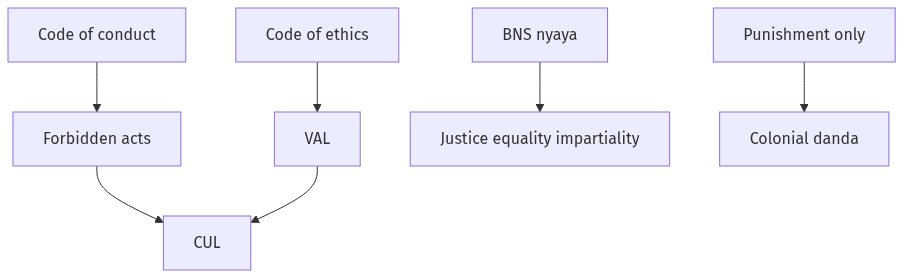
A code of conduct is enforceable do’s and don’ts; a code of ethics states values and how to reason when the rule is silent. India has conduct rules in operation; a living ethics code still needs leaders, cases and whistle protection. A model for integrity, probity and transparency binds the Constitution, public money, reasons on file, impartial queues and data restraint. BNS presents justice, equality and impartiality as its soul and adds victim-centric and community-service tools. The shift from punishment to justice fails if new sections only warehouse the poor.
Model answer
Copper italics in this answer — like this — are the key facts. Each one is unpacked in the Facts & figures rail.
Introduction
India already tells the civil servant what not to do on Tuesday (Conduct Rules). It has been slower to write what we believe on Monday (a living code of ethics). Part (a) wants that model, aimed at integrity, probity and sunlight. Part (b) turns to the Bharatiya Nyaya Sanhita: a claim that the soul of the new criminal law is justice, equality and impartiality, and a shift from punishment as the whole story to justice as the aim.
Body
(a) Code of Conduct versus Code of Ethics — a model
- A Code of Conduct is enforceable behaviour: gifts, political activity, criticism of government, sexual harassment, use of official information, property returns. In the Union it lives in the CCS (Conduct) Rules, 1964 and All-India analogues. It is necessary. It is not sufficient: a person can obey the letter and still hate the citizen, delay a Dalit’s file, or help a nephew within “discretion”.
- A Code of Ethics is values and reasoning: why we refuse the gift, whom we serve, what constitutional morality requires when the rule is silent. Second ARC and the Nolan principles (selflessness, integrity, objectivity, accountability, openness, honesty, leadership) are the usual furniture. Ethics without conduct is a framed poster. Conduct without ethics is a clever compliance.
A suitable model for integrity, probity and transparency: (1) Serve the Constitution, not a person. (2) Integrity: no private price for a public act; family and post-retirement doors counted as conflicts. (3) Probity: public money as trust; GeM, GFR, no split indents, no favourite vendor. (4) Transparency: reasons on the file, proactive disclosure, RTI in spirit. (5) Objectivity and impartiality: same queue for the MLA’s driver and the widow. (6) Empathy and courtesy as professional duties, not extras. (7) Speak-up: protected channel to CVO; no revenge posting. (8) Digital and data ethics: no stalking a citizen through a portal. Induction by cases, leaders who obey first, checked asset declarations, rotation of sensitive desks. The model works only as a culture of Tuesdays.
(b) Bharatiya Nyaya Sanhita: from punishment to justice
- The IPC, 1860 was a colonial penal grammar: the sovereign’s anger, sedition as a mood, procedure that could forget the victim. The BNS, 2023 (in force 2024) claims a soul of nyaya: justice, equality, impartiality named as Indian ethos — not only danda. How far the soul is real is the ethical test, not the Sanskrit title.
Shift from doctrine of punishment to justice shows in design choices: community service as a sentence for some wrongs (repair, not only warehouse); victim-centric timelines and recorded processes; new naming of mob lynching, organised crime, terrorism, hit-and-run — harms that old chapters stretched; recasting sedition-like speech into a sovereignty offence that must not become a slogan jail. Equality demands that a powerful accused and a poor accused meet the same code, which is an old Indian wound. Impartiality is the judge and the police as not a faction. Indian culture here is Ashoka’s dhamma, Gandhi’s means, the Gita’s duty, and also Ambedkar’s warning that forms need cultivation. A harsher clause that only fills prisons with the weak would be punishment in a new font. Justice as soul means proportion, fair hearing, reparation, and a State that does not enjoy pain.
- The civil servant’s ethics in this shift: register the FIR without a caste filter, do not use a new section as a toy, treat community service as work not humiliation, and remember the victim is not a footnote to the accused’s politics.
Flow diagram
Conclusion
Conduct rules fence the worst acts; a code of ethics supplies the values, conflicts and sunlight that fences miss. BNS claims justice rather than colonial danda as its soul; that claim holds only if equality and impartiality reach the weak, and punishment is not simply renamed.
Quick related
Students also ask
-
"In Indian culture and value system, an equal opportunity has been provided irrespective of gender identity. The number of women in public service has been steadily increasing over the years." Examine the gender-specific challenges faced by female public servants and suggest suitable measures to increase their efficiency in discharging their duties and maintaining high standards of probity
Next question on this syllabus topic (2024 · Q6(a)). View answer →
-
Can a code of ethics be litigated like Conduct Rules?
Usually it guides and is used in inquiry reasoning. Conduct Rules remain the charge-sheet spine. Both are needed.
-
Is BNS automatically more ethical because it is ‘Bharatiya’?
A name is not a soul. Ethics will judge the code by fair trial, proportion, and whether the powerful are as reachable as the poor.
Same topic · past papers
UPSC has asked this before
These previous-year questions sit on the same topic. Open one to practise the earlier ask.
More from this topic
Q1(b) · UPSC Mains 2026 · GS IV · 10 marks · Solution
A business house is working on a project that could displace a forest community from their habitat. As the administrative officer of that district, what ethical challenges are you likely to face?
Probity in Governance
This GS4 10-marker examines the ethical dilemmas faced by a district administrator dealing with industrial displacement of a forest community. The answer navigates the core tension between economic development and social justice, highlighting stakeholder conflicts such as corporate pressure versus tribal rights, the paradox of legal compliance versus moral duty, and personal integrity under administrative coercion. It incorporates a structured Mermaid flowchart mapping out the stakeholder dilemma and concludes with a balanced administrative approach upholding constitutional empathy and statutory safeguards like PESA and FRA.
Q1(a) · UPSC Mains 2026 · GS IV · 10 marks · Solution
Owing to paucity of time, a university professor generates a Ph.D. evaluation report using Artificial Intelligence and submits it with some modifications. Discuss this from the perspective of accountability and integrity.
Probity in Governance
This GS4 ethics case study examines the dilemma of a university professor using AI to generate a Ph.D. evaluation report due to time constraints. It analyses the failure of professional accountability in delegating core academic judgment to an automated tool. The response evaluates the breach of intellectual integrity, the erosion of institutional trust in research degrees, and outlines a principled course of action balancing urgency with ethical duty.
Q6 · UPSC Mains 2025 · GS IV · 10 marks · Solution
(a) It is said that for an ethical work culture, there must be code of ethics in place in every organisation. To ensure value-based and compliance-based work culture, what suitable measures would you adopt in your work place? (b) India is an emerging economic power of the world as it has recently secured the status of fourth largest economy of the world as per IMF projection. However, it has been observed that in some sectors, allocated funds remain either under-utilised or misutilised. What specific measures would you recommend for ensuring accountability in this regard to stop leakages and gaining the status of third largest economy of the world in near future?
Probity in Governance
A code of ethics states values; a code of conduct states forbidden acts; both need leaders who obey them. Whistle protection, rotation, checked assets and small consistent punishments build culture. India’s fourth-largest-economy rank (IMF) sits beside under-used and stolen public money in some schemes. PFMS, outcome budgets, social audit, GeM and CAG follow-up are the accountability kit. Growth to third place is ethical only if the ladder is not stolen from the poor.