
Revision summary
SMEs hold environmental certificates yet pollute; migrants fear closure; NGOs want padlocks; you have threats. Doing nothing, taking money, fleeing the file, or closing every unit without a sequence all fail. The mechanism is statute-based sampling, red-orange-green grading, CETP, digital consent, court-ready orders and worker transition. Dilemmas are health versus jobs, safety versus duty, and paper consent versus real discharge. Sequence the harm: stop the worst poison now, and move wages with a plan, not the effluent.
Model answer
Copper italics in this answer — like this — are the key facts. Each one is unpacked in the Facts & figures rail.
Introduction
The certificates are in the drawers; the air, water and soil are not. Migrant workers fear unemployment. Neighbours are already sick. Immediate illegal protection of polluters is forbidden. Immediate blind closure that dumps workers on the road without a sequence is not the only other door.
Body
Stakeholders
- Local residents whose health is already damaged.
- Migrant workers and their families who live on these wages.
- Owners of the small and medium units, and their customers.
- Labour unions, local politicians, NGOs, and colleagues who have taken sides.
- You as the section head in the Environment Pollution Control Board.
- Rivers, groundwater, soil and other species that have no union.
(a) Options
- Option 1: Withdraw the notices, accept the existing certificates, and do nothing.
- Option 2: Order immediate closure of every unit on the NGO timetable, without a sequenced inspection.
- Option 3: Take a private settlement from owners to “go slow”.
- Option 4: Transfer the file and wait out the posting.
- Option 5: Risk-based, time-bound compliance: inspect, grade, shut the worst now, give a short public timeline to the rest with bank-supported abatement, protect workers during transition, and refuse bribes and threats.
(b) Examination
- Option 1 merit: workers stay employed this month; threats may stop.
- Option 1 demerit: you legalise ongoing poisoning. Rejected.
- Option 2 merit: NGOs and the sick get a visible win.
- Option 2 demerit: a blanket padlock without evidence-grade inspection will be struck down, will create a black market of night discharge, and will dump migrants without wages or travel.
- Option 3 merit: none that can be named.
- Option 3 demerit: Prevention of Corruption Act, 1988; you join the vested interest you were posted to check.
- Option 4 merit: personal quiet.
- Option 4 demerit: the stack still runs; the posting was the duty.
- Option 5 merit: health first where harm is proven, jobs where a unit can actually comply, a file that a court can respect.
- Option 5 demerit: both extremes will abuse you; threats may continue — seek official security, do not bargain with them.
(c) Mechanism for environmental compliance
- Legal base: the Environment (Protection) Act, 1986, the Water (Prevention and Control of Pollution) Act, 1974, the Air (Prevention and Control of Pollution) Act, 1981, and the consent conditions already on each unit.
- Mapping: a public list of units, consents, stack and effluent data, and a health overlay from the district hospital — so the fight is about numbers, not rumours.
- Risk class: red units with toxic discharge or no working treatment shut or sealed until they comply; orange units on a 30–90 day clock with bankable common effluent treatment or in-house plants; green units on routine audit.
- Independent sampling: accredited labs, split samples, and surprise night checks so a daytime “show plant” does not pass.
- Common infrastructure: CETP, shared boilers, and a refuse park that small units can actually afford, funded by the cluster and public schemes, not by a bribe.
- Worker transition: notice, unpaid-wage enforcement, skilling, and a travel-and-ration camp if a red unit must close, so migrants are not the unpaid price of clean air.
- Digital consent and auto-expiry: a paper certificate that never meets a sample is not compliance.
- Transparency: weekly bulletin of actions; NGOs get data, not a veto of the sampling protocol.
- Threat protocol: written complaint to police, request for security, and no private meeting with unknown “well-wishers”.
- Court-ready orders: speaking reasons, proportionality, and a review date, so a politician’s stay is answered with a file, not a shrug.
(d) Ethical dilemmas
- Right to health of residents versus right to livelihood of migrant workers.
- Strict enforcement versus the fear that capital will flee to a dirtier district.
- NGO demand for overnight closure versus owners’ plea of financial death.
- Personal safety after threats versus the oath of the Board.
- Colleagues who say “act freely” versus a political class that wants delay.
- Certificates that are formally valid versus the empirical fact of pollution.
- The dilemma is real. It is not resolved by choosing jobs and forgetting lungs, nor by choosing a padlock and forgetting the worker at the gate. It is resolved by sequencing harm: stop the worst poison now, and move the wage, not the effluent, with a plan.
Flow diagram
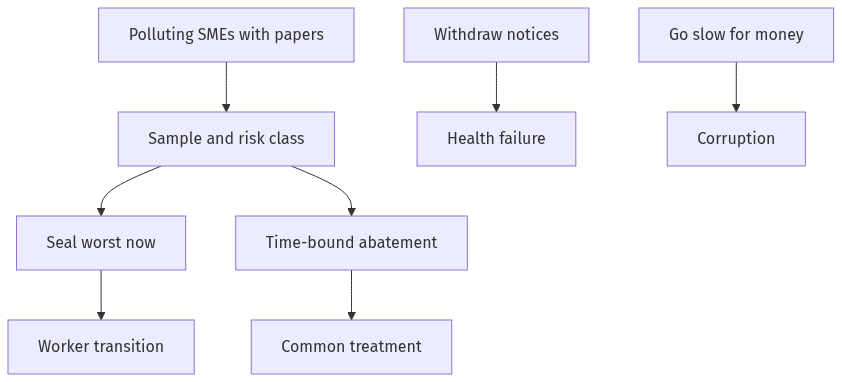
Conclusion
Existing clearances that hide pollution are not ethics. Neither is a bribe nor a theatre of total closure without a worker plan. Grade the harm, seal the worst, time-limit the rest, build common treatment, and keep migrants on a lawful transition. Health and livelihood are both duties; the effluent is not.
Quick related
Students also ask
-
Case study. Sunil is a young civil servant and has a reputation for his competence, integrity, dedication, and relentless pursuit of difficult and onerous jobs. Considering his profile, he was picked up by his bosses to handle a very challenging and sensitive assignment. He was posted in a tribal-dominated district notorious for illegal sand mining. Excavating sand from river belts and transporting it through trucks and selling them in the black market was rampant. This illegal sand mining mafia was operating with the support of local functionaries and tribal musclemen who in turn were bribing selected poor tribals and had kept the tribals under fear and intimidation. Sunil being a sharp and energetic officer immediately grasped the ground realities and the modus operandi followed by the mafia through their devious and dubious mechanism. On making inquiries, he gathered that some of their own office employees are in hand and glove with them and have developed close unholy nexus. Sunil initiated stringent action against them and started conducting raids on their illegal operations of the movement of trucks filled with sand. The mafia got rattled as not many officers in the past had taken such steps against the mafia. Some of the office employees who were allegedly close to mafia informed them that the officer is determined to clean up the mafia's illegal sand mining operations in that the district and may cause them irreparable damage. The mafia turned hostile and launched a counter-offensive. The tribal musclemen and mafia started threatening him with dire consequences. His family (wife and old mother) were stalked and were under virtual surveillance and thus causing mental torture, agony, and stress to all of them. The matter assumed serious proportions when a muscleman came to his office and threatened him to stop raids, etc., otherwise, his fate will not be different than some of his predecessors (ten years back one officer was killed by the mafia). - Identify the different options available to Sunil in attending to this situation. - Critically evaluate each of the options listed by you. - Which of the above, do you think, would be the most appropriate for Sunil to adopt and why?
Next question on this syllabus topic (2021 · Q7). View answer →
-
Do migrant jobs mean the Board must not close anyone?
No. A red unit that is poisoning people closes. The ethical extra is wages, notice and a camp, not a permanent illegal stack.
-
Are NGOs wrong to demand closure?
They are right to demand an end to harm. They are not the sampling authority. Immediate blanket closure without classing risk can fail in court and still leave a night sewer running.
Same topic · past papers
UPSC has asked this before
These previous-year questions sit on the same topic. Open one to practise the earlier ask.
-
2026 · Q11 · GS IV · 20 marks
Case study. Rajapuram is a border district. Jhara and Biru, its two major communities are in continual conflict with each other. The social fabric is fractured and demands mending. Ethnic tensions between the two communities have erupted into violence resulting in a large number of deaths. The stated causes are conflicting land claims, uneven resource allocation and inadequate political representation in government bodies. Separate relief camps had to be created for the two communities. The situation is volatile and appears to be getting out of control. Rajan has been appointed the District Magistrate (DM) of Rajapuram and tasked to quickly get the situation under control. His immediate tasks include restoring administrative authority, reopening the highway and initiating peace talks. On taking over his appointment, Rajan realized that the inter-community rivalry had even seeped into the local administration and police. With functional neutrality being the immediate casualty, it had made both communities distrustful of the government. The neighbouring country could utilize the opportunity to spur insurgent activity and further aggravate the situation. Rajan favoured a controlled approach starting with opening the highway to restore food and medical supplies. He toyed with the idea of requisitioning CRPF units to help restore administrative control. (a) Discuss the ethical issues that need to be addressed in this case. (b) What are the options open to Rajan? Which option would ensure protection of his non-partisan image without compromising ethics? -
2020 · Q12 · GS IV · 20 marks
Case study. Migrant workers have always remained at the socio-economic margins of our society, silently serving as the instrumental labour force of urban economics. The pandemic has brought them into national focus. On announcement of a countrywide lockdown, a very large number of migrant workers decided to move back from their places of employment to their native villages. The non-availability of transport created its own problems. Added to this was the fear of starvation and inconvenience to their families. This caused the migrant workers to demand wages and transport facilities for returning to their villages. Their mental agony was accentuated by multiple factors such as a sudden loss of livelihood, possibility of lack of food and inability to assist in harvesting their rabi crop due to not being able to reach home in time. Reports of inadequate response of some districts in providing the essential boarding and lodging arrangements along the way multiplied their fears. You have learnt many lessons from this situation when you were tasked to oversee the functioning of the District Disaster Relief Force in your district. In your opinion what ethical issues arose in the current migrant crisis? What do you understand by an ethical care giving state? What assistance can the civil society render to mitigate the sufferings of migrants in similar situations? -
2024 · Q11 · GS IV · 20 marks
Case study. With the summer heat being exceptionally severe, the district has been facing severe water shortage. The District Collector has taken strict measures for stopping the over-exploitation of groundwater. Farmers are agitated that they are not being allowed to irrigate their crops while big industries located near the river are drawing huge amounts of water. The farmers allege that the administration is anti-farmer and corrupt. The industry cannot be closed as this would result in a large number of workers being unemployed. (a) Discuss all options available to the District Collector as a District Magistrate. (b) What suitable actions can be taken in view of mutually compatible interests of the stakeholders? (c) What are the potential administrative and ethical dilemmas for the District Collector? -
2021 · Q10 · GS IV · 20 marks
Case study. The coronavirus disease (CoVID-19) pandemic has quickly spread to various countries. As on May 8th, 2020, in India 56342 positive cases of corona had been reported. India with a population of more than 1-35 billion had difficulty in controlling the transmission of coronavirus among its population. Multiple strategies became necessary to handle this outbreak. The Ministry of Health and Family Welfare of India raised awareness about this outbreak and to take all necessary actions to control the spread of COVID-19. Indian Government implemented a 55-day lockdown throughout the country to reduce the transmission of the virus. Schools and colleges had shifted to alternative mode of teaching- learning-evaluation and certification. Online mode became popular during these days. India was not prepared fora sudden onslaught of such a crisis due to limited infrastructure in terms of human resource, money and other facilities needed for taking care of this situation. This disease did not spare anybody irrespective of caste, creed, religion on the one hand and have and have not' on the other. Deficiencies in hospital beds, oxygen cylinders, ambulances, hospital staff and crematorium were the most crucial aspects You are a hospital administrator in a public hospital at the time when coronavirus had attacked large number of people and patients were pouring into hospital day in and day out. - What are your criteria and justification for putting your clinical and non-clinical staff to attend to the patients knowing fully well that it is highly infectious disease and resources and infrastructure are limited? - If yours is a private hospital, whether your justification and decision would remain same as that of a public hospital? -
2020 · Q10 · GS IV · 20 marks
Case study. You are a municipal commissioner of a large city, having the reputation of a very honest and upright officer. A huge multipurpose mall is under construction in your city in which a large number of daily wage earners are employed. One night, during monsoons, a big chunk of the roof collapsed causing instant death of four labourers including two minors. Many more were seriously injured requiring immediate medical attention. The mishap resulted in a big hue and cry, forcing the government to institute an enquiry. Your preliminary enquiry has revealed a series of anomalies. The material used for the construction was of poor quality. Despite the approved building plans permitting only one basement, an additional basement has been constructed. This was overlooked during the periodic inspections by the building inspector of the municipal corporation. In your enquiry, you noticed that the construction of the mall was given the green signal despite encroaching on areas earmarked for a green belt and a slip road in the Zonal Master Plan of the city. The permission to construct the mall was accorded by the previous Municipal Commissioner who is not only your senior and well known to you professionally, but also a good friend. Prima facie, the case appears to be of a widespread nexus between officials of the Municipal Corporation and the builders. Your colleagues are putting pressure on you to go slow in the enquiry. The builder, who is rich and influential, happens to be a close relative of a powerful minister in the state cabinet. The builder is persuading you to hush up the matter, promising you a fortune to do so. He also hinted that if this matter is not resolved at the earliest in his favour there is somebody in his office who is waiting to file a case against you under the POSH Act. Discuss the ethical issues involved in the case. What are the options available to you in this situation? Explain your selected course of action.
More from this topic
Q12 · UPSC Mains 2026 · GS IV · 20 marks · Solution
Case study. Ajit has been recently promoted as the Head of the Department of Weapon Sales (DWS) in the Ministry of Defence Production (MDP). His charter of duties includes international sales of weapons produced domestically by MDP. In two recent wars, MDP weapons have performed admirably, resulting in many countries showing interest in buying them, particularly long-range artillery and missiles. Country A and country B have asked for these weapons. However, production constraints restrict DWS to accept only one purchase order. Country A is a developing nation with a sound technology base. MDP is planning R&D collaboration with it for the next generation of weapons. It is not part of any security alliance and needs weapons for protection from a troublesome neighbour. It seeks a large acquisition on a long-term loan. Country B is also a developing nation. Military strength is its priority, with the military budget often ingressing into allocations for human resources and infrastructure development. It is in security alliance with a superpower who has a large military base there and periodically allots it financial grants. It is a member of an economic bloc with which the government is currently negotiating a free trade agreement. It is not a signatory of NPT but possesses smaller nuclear weapons and delivery systems. It supports some guerrilla forces abroad. It has sought a smaller acquisition and is prepared to make some advance payment. It is currently negotiating arms purchases from another nation too. Ajit discussed this case with his counterparts in the related departments. Therein, the significant economic benefits, employment generation and stronger diplomatic relations arising from this sale were highlighted. It was also emphasized that refusing the deal could result in country B purchasing weapons from some other supplier. Ajit was aware that in arms sales, due diligence at each stage was pivotal to ensure conformity to national policy and international treaties. (a) Discuss the options available to Ajit. Which option should he select and why? (b) How can Ajit balance nation's economic and strategic interests with ethical considerations?
Ethics Case Studies
This case study examines ethical dilemma in defense exports, balancing economic gains, strategic partnerships, and non-proliferation norms. Ajit must choose between Country A for R&D collaboration and self-reliance, or Country B for immediate financial gains and FTA leverage. The recommended course prioritizes long-term strategic security, technological synergy, and international humanitarian norms over short-term mercantile interests.
Q11 · UPSC Mains 2026 · GS IV · 20 marks · Solution
Case study. Rajapuram is a border district. Jhara and Biru, its two major communities are in continual conflict with each other. The social fabric is fractured and demands mending. Ethnic tensions between the two communities have erupted into violence resulting in a large number of deaths. The stated causes are conflicting land claims, uneven resource allocation and inadequate political representation in government bodies. Separate relief camps had to be created for the two communities. The situation is volatile and appears to be getting out of control. Rajan has been appointed the District Magistrate (DM) of Rajapuram and tasked to quickly get the situation under control. His immediate tasks include restoring administrative authority, reopening the highway and initiating peace talks. On taking over his appointment, Rajan realized that the inter-community rivalry had even seeped into the local administration and police. With functional neutrality being the immediate casualty, it had made both communities distrustful of the government. The neighbouring country could utilize the opportunity to spur insurgent activity and further aggravate the situation. Rajan favoured a controlled approach starting with opening the highway to restore food and medical supplies. He toyed with the idea of requisitioning CRPF units to help restore administrative control. (a) Discuss the ethical issues that need to be addressed in this case. (b) What are the options open to Rajan? Which option would ensure protection of his non-partisan image without compromising ethics?
Ethics Case Studies
This GS4 case study examines the ethical dilemmas faced by a District Magistrate in managing an ethnic conflict in a sensitive border district. It analyses the ethical issues involving neutrality, human life, security, and institutional trust. It evaluates options ranging from purely coercive measures to inclusive peace-building. The recommended approach balances administrative firmness with transparent, unbiased stakeholder engagement to uphold public service values.
Q10 · UPSC Mains 2026 · GS IV · 20 marks · Solution
Case study. Vikas is a government officer with over a decade of service in public administration. He has recently moved as the District Collector (DC) of Nainipura, a remote hilly district bordering a forest. Due to Nainipura's low levels of economic development, one of his major duties is to ensure proper functioning of the public distribution system (PDS) amongst the economically weaker sections (EWS). During his on-site visits, Vikas was apprised of a typical administrative challenge in operating the PDS. To prevent leakages, all distributors were required to carry out real-time biometric identification of the beneficiaries, whose fingerprints were tallied with identity card records. This was creating problems as the operating system sometimes rejected fingerprint matching in the cases of growing children, manual labourers and senior citizens. The problem was further compounded in periods of low WIFI connectivity. The distributors, in such cases, resorted to personal discretion when they could identify the recipient. Vikas had to address this problem on priority. Strictly adhering to 'government regulations' would ensure fiscal probity but would greatly trouble the proposed beneficiary, i.e., EWS. It may even impinge on their fundamental right to life as per Article 21 of the Constitution. Conversely, leaving the resolution solely to the discretion of the distributors could lead to misuse and leakages. (a) What are the options open to Vikas? How should he balance fiscal probity with empathy towards the designated beneficiaries? (b) Discuss the ethics of using technology as a gatekeeper for welfare schemes.
Ethics Case Studies
• Balance strict digital rules with human empathy to prevent vulnerable citizens from losing entitled rations due to technical failures. • Avoid extreme approaches like rigid enforcement (causing exclusion) or unchecked discretion (causing leakage and corruption). • Implement practical offline workarounds like manual registers, paper slips, or OTPs backed by periodic audits. • Treat procedural norms and technology as tools for human welfare rather than rigid ends in themselves. • Recognize that digital gatekeeping creates ethical tensions between fiscal efficiency and the exclusion of genuine beneficiaries. • Guard against technology violating human dignity by forcing vulnerable groups to repeatedly prove their identity against system errors. • Ensure administrative accountability so systemic technological failures are not unfairly blamed on the citizens.