
Revision summary
The driver died after starting a fight, not in a driving accident; the union wants on-duty extra pay and a job after ten days of strike. Mass punishment, a false martyrdom package, force without talks, and delay all fail. Dilemmas are compassion versus truth, commuters versus strike, and equality with real on-duty deaths. Rakesh should pay statutory dues at once, add labelled ex gratia help, consider only lawful compassionate hiring, restart buses, and not kill the FIR. Road-rage training and cameras are the follow-through.
Model answer
Copper italics in this answer — like this — are the key facts. Each one is unpacked in the Facts & figures rail.
Introduction
Bus No. 528’s driver died after a street fight he began, not after a crash in the line of driving. The union wants the same extra compensation as a death on duty, plus employment for a kin. The city has had no buses for ten days. Compassion for the widow is mandatory. Falsifying the death as a martyrdom in service is not.
Body
Stakeholders
- The deceased driver, his wife, and two school- and college-going daughters.
- The injured car driver and passers-by who witnessed the fight.
- The drivers’ union and the remaining bus staff.
- Commuters, especially workers and students, after ten days of strike.
- Rakesh as Joint Commissioner and the City Transport Department.
- Police and courts seized of the FIR.
(a) Options
- Option 1: Refuse every rupee beyond the exact statutory minimum, wait the union out, and threaten mass dismissal.
- Option 2: Grant full extra “died on duty” compensation and a job, identical to a crash while driving, to end the strike.
- Option 3: Use police force to break the strike without a talk.
- Option 4: Stay silent and send the file to a committee with no date.
- Option 5: Separate lawful dues from extra grace; do not relabel a fight as on-duty death; talk with the union; restore buses with an interim humane package and a written principle for the future.
(b) Examination of each option
- Option 1 merit: protects the rule that violence is not a service injury.
- Option 1 demerit: a sole-earner family is left in a pit; the city stays angry; the union hardens.
- Option 2 merit: buses may restart tomorrow.
- Option 2 demerit: it lies about the facts, rewards a brawl, and invites the next staged “on duty” claim. Rejected as a false precedent.
- Option 3 merit: fear.
- Option 3 demerit: injury, hatred, and no settlement of the family’s rent.
- Option 4 merit: personal safety for Rakesh.
- Option 4 demerit: day 11 of a dead city; ethics of office is decision, not delay.
- Option 5 merit: truth in the record, buses moving, children not abandoned.
- Option 5 demerit: both hawks will call it incomplete; that is the sign of a public settlement.
(c) Ethical dilemmas
- Compassion for a widow and daughters versus honesty about who started the violence.
- Equality with other families who lost a driver in a genuine on-duty accident versus a special political surrender.
- Commuters’ right to move versus workers’ right to strike in a democracy.
- Union loyalty among drivers versus the injured car driver’s right to a fair story.
- Speed of settlement versus the police case that is still live.
- Personal image of a “tough” or “kind” commissioner versus a speaking order that can be defended.
(d) Course of action to defuse
- Call a recorded meeting the same day: management, union, labour officer, and a family representative. Put the police brief on the table: the quarrel was started by the bus driver.
- Pay immediately every undisputed statutory amount: wages due, provident fund, gratuity, and any insurance that the policy actually covers. Do not hold the funeral rupee as a bargaining chip.
- Extra compensation: create a humanitarian, ex gratia head that is explicitly not “death on duty while driving”, so the precedent stays clean. Size it so that school and college do not collapse, using welfare funds, not a fake classification.
- Employment of a family member: consider only if recruitment rules allow a compassionate appointment and a suitable vacancy exists; do not create an illegal post as the price of a strike. If no post is lawful, fund skill training and a stipend for a fixed period.
- Restore essential buses with a written return-to-work, no victimisation clause, and a deadline. Keep a skeleton service even during talks if the law on essential services so requires.
- Do not drop the FIR as a bargain. The car driver’s case proceeds; the department cooperates with police.
- Communicate to the city in plain language: the family will not be abandoned; a street fight will not be rewritten as a crash.
- After service resumes, issue a conduct circular on road rage, counselling for drivers, and cameras on buses, so the next intersection is not another death.
Flow diagram
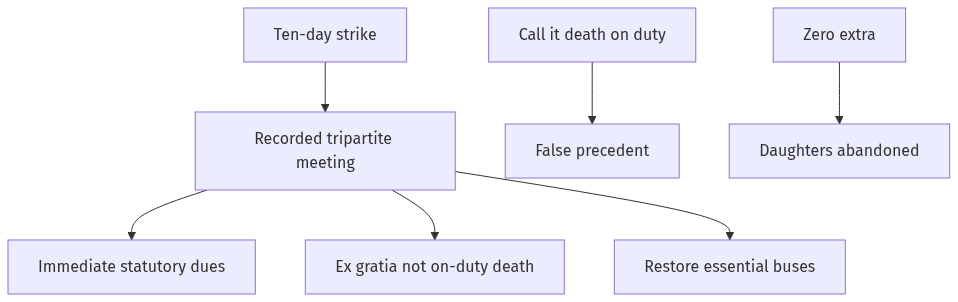
Conclusion
Defusing the strike means telling the truth about the fight, paying lawful and humane money without a false “on duty” stamp, restoring buses, and leaving the criminal case intact. Kindness is the daughters’ education. Kindness is not a forged service-death.
Quick related
Students also ask
-
Case study. You are appointed as an officer heading the section in Environment Pollution Control Board to ensure compliance and its follow-up. In that region, there were large number of small and medium industries which had been granted clearance. You learnt that these industries provide employment to many migrant worker. Most of the industrial units have got environmental clearance certificate in their possession. The environmental clearance seeks to curb industries and projects that supposedly hamper environment and living species in the region, But in practice. most of these units remain to be polluting units in several ways like air, water and soil pollution. As such, local people encountered persistent health problems. It was confirmed that majority of the industries were violating environmental compliance. You issued notice to all the industrial units to apply for fresh environmental clearance certificate from the competent authority. However, your action met with hostile response from a section of the industrial units, other vested interest persons and a section of the local politicians. The workers also became hostile to you as they felt that your action would lead to the closure of these industrial units, and the resultant unemployment will lead to insecurity uncertainty in their livelihood. Many owners of the industries approached you with the plea that you should not initiate harsh action as it would compel them their units, and cause huge financial loss, shortage of their products in the market. These would obviously add to the sufferings of the labourers and the consumers alike. The labour union also sent you representation requesting against the closure of the units. You simultaneously started receiving threats from unknown corners. You however received supports from some of your colleagues, who advised you to act freely to ensure environmental compliance. Local NGOs also came to your support and they demanded the closure of the polluting units immediately. (a) What are the options available to you under the given situation? (b) Critically examine the options listed by you. (c) What type of mechanism would you suggest to ensure environmental compliance? (d) What are the ethical dilemmas you faced in exercising your option?
Next question on this syllabus topic (2022 · Q12). View answer →
-
Is any extra money a surrender to the union?
Not if it is named as humanitarian aid and the on-duty category stays closed. Starving the daughters would be another ethical failure.
-
Should Rakesh wait for the criminal trial before paying the family?
Statutory dues wait for nobody. Extra ex gratia can be paid without deciding the criminal guilt of the dead man as a service hero.
Same topic · past papers
UPSC has asked this before
These previous-year questions sit on the same topic. Open one to practise the earlier ask.
More from this topic
Q12 · UPSC Mains 2026 · GS IV · 20 marks · Solution
Case study. Ajit has been recently promoted as the Head of the Department of Weapon Sales (DWS) in the Ministry of Defence Production (MDP). His charter of duties includes international sales of weapons produced domestically by MDP. In two recent wars, MDP weapons have performed admirably, resulting in many countries showing interest in buying them, particularly long-range artillery and missiles. Country A and country B have asked for these weapons. However, production constraints restrict DWS to accept only one purchase order. Country A is a developing nation with a sound technology base. MDP is planning R&D collaboration with it for the next generation of weapons. It is not part of any security alliance and needs weapons for protection from a troublesome neighbour. It seeks a large acquisition on a long-term loan. Country B is also a developing nation. Military strength is its priority, with the military budget often ingressing into allocations for human resources and infrastructure development. It is in security alliance with a superpower who has a large military base there and periodically allots it financial grants. It is a member of an economic bloc with which the government is currently negotiating a free trade agreement. It is not a signatory of NPT but possesses smaller nuclear weapons and delivery systems. It supports some guerrilla forces abroad. It has sought a smaller acquisition and is prepared to make some advance payment. It is currently negotiating arms purchases from another nation too. Ajit discussed this case with his counterparts in the related departments. Therein, the significant economic benefits, employment generation and stronger diplomatic relations arising from this sale were highlighted. It was also emphasized that refusing the deal could result in country B purchasing weapons from some other supplier. Ajit was aware that in arms sales, due diligence at each stage was pivotal to ensure conformity to national policy and international treaties. (a) Discuss the options available to Ajit. Which option should he select and why? (b) How can Ajit balance nation's economic and strategic interests with ethical considerations?
Ethics Case Studies
This case study examines ethical dilemma in defense exports, balancing economic gains, strategic partnerships, and non-proliferation norms. Ajit must choose between Country A for R&D collaboration and self-reliance, or Country B for immediate financial gains and FTA leverage. The recommended course prioritizes long-term strategic security, technological synergy, and international humanitarian norms over short-term mercantile interests.
Q11 · UPSC Mains 2026 · GS IV · 20 marks · Solution
Case study. Rajapuram is a border district. Jhara and Biru, its two major communities are in continual conflict with each other. The social fabric is fractured and demands mending. Ethnic tensions between the two communities have erupted into violence resulting in a large number of deaths. The stated causes are conflicting land claims, uneven resource allocation and inadequate political representation in government bodies. Separate relief camps had to be created for the two communities. The situation is volatile and appears to be getting out of control. Rajan has been appointed the District Magistrate (DM) of Rajapuram and tasked to quickly get the situation under control. His immediate tasks include restoring administrative authority, reopening the highway and initiating peace talks. On taking over his appointment, Rajan realized that the inter-community rivalry had even seeped into the local administration and police. With functional neutrality being the immediate casualty, it had made both communities distrustful of the government. The neighbouring country could utilize the opportunity to spur insurgent activity and further aggravate the situation. Rajan favoured a controlled approach starting with opening the highway to restore food and medical supplies. He toyed with the idea of requisitioning CRPF units to help restore administrative control. (a) Discuss the ethical issues that need to be addressed in this case. (b) What are the options open to Rajan? Which option would ensure protection of his non-partisan image without compromising ethics?
Ethics Case Studies
This GS4 case study examines the ethical dilemmas faced by a District Magistrate in managing an ethnic conflict in a sensitive border district. It analyses the ethical issues involving neutrality, human life, security, and institutional trust. It evaluates options ranging from purely coercive measures to inclusive peace-building. The recommended approach balances administrative firmness with transparent, unbiased stakeholder engagement to uphold public service values.
Q10 · UPSC Mains 2026 · GS IV · 20 marks · Solution
Case study. Vikas is a government officer with over a decade of service in public administration. He has recently moved as the District Collector (DC) of Nainipura, a remote hilly district bordering a forest. Due to Nainipura's low levels of economic development, one of his major duties is to ensure proper functioning of the public distribution system (PDS) amongst the economically weaker sections (EWS). During his on-site visits, Vikas was apprised of a typical administrative challenge in operating the PDS. To prevent leakages, all distributors were required to carry out real-time biometric identification of the beneficiaries, whose fingerprints were tallied with identity card records. This was creating problems as the operating system sometimes rejected fingerprint matching in the cases of growing children, manual labourers and senior citizens. The problem was further compounded in periods of low WIFI connectivity. The distributors, in such cases, resorted to personal discretion when they could identify the recipient. Vikas had to address this problem on priority. Strictly adhering to 'government regulations' would ensure fiscal probity but would greatly trouble the proposed beneficiary, i.e., EWS. It may even impinge on their fundamental right to life as per Article 21 of the Constitution. Conversely, leaving the resolution solely to the discretion of the distributors could lead to misuse and leakages. (a) What are the options open to Vikas? How should he balance fiscal probity with empathy towards the designated beneficiaries? (b) Discuss the ethics of using technology as a gatekeeper for welfare schemes.
Ethics Case Studies
• Balance strict digital rules with human empathy to prevent vulnerable citizens from losing entitled rations due to technical failures. • Avoid extreme approaches like rigid enforcement (causing exclusion) or unchecked discretion (causing leakage and corruption). • Implement practical offline workarounds like manual registers, paper slips, or OTPs backed by periodic audits. • Treat procedural norms and technology as tools for human welfare rather than rigid ends in themselves. • Recognize that digital gatekeeping creates ethical tensions between fiscal efficiency and the exclusion of genuine beneficiaries. • Guard against technology violating human dignity by forcing vulnerable groups to repeatedly prove their identity against system errors. • Ensure administrative accountability so systemic technological failures are not unfairly blamed on the citizens.