
Revision summary
• Financial inclusion supplies the rails for welfare, wages, savings and shock management in India. • It advances social inclusion by recognising citizens in formal systems, especially women and migrants. • It advances economic inclusion via credit, insurance and enterprise finance for farms and MSMEs. • JAM, UPI and BC networks extend reach but need literacy and grievance support. • RBI FI-Index (from 2021 framing) blends banking, insurance, pension, postal and investment indicators. • Weights: Access 35%, Usage 45%, Quality 20%; score 0–100. • Index reported 67.0 (March 2025) and about 70.0 (March 2026), with usage as a recent driver. • Usefulness lies in diagnosing whether India is stuck at access or moving into deep, safe usage.
Model answer
Copper italics in this answer — like this — are the key facts. Each one is unpacked in the Facts & figures rail.
Introduction
In a country where livelihood risk, informal work and geographic remoteness still shape daily life, leaving people outside the formal financial net is not merely a banking gap—it is a social and economic exclusion. Financial inclusion—affordable access to savings, credit, insurance, pensions and payments—lets households smooth shocks, invest in skills and farms, and receive Direct Benefit Transfers without leakages. RBI's Financial Inclusion Index (FI-Index) compresses this multi-sector story into one measurable score so that policy can track not only how many accounts exist, but whether people actually use and trust them.
Body
Financial inclusion as social and economic inclusion
Access to formal finance and social dignity: When a household holds a verified bank account, it can receive wages, scholarships and welfare without depending on middlemen. That reduces petty corruption, builds a documented identity trail, and gives women and migrant workers a safer place to park remittances. Social inclusion here means being recognised by the state and the market as an economic citizen, not as a perpetual cash-only outsider.
- Eg: Pradhan Mantri Jan Dhan Yojana accounts, paired with Aadhaar and mobile under the JAM trinity, became the rail for DBT of LPG subsidies, pensions and scholarships into women's accounts in many districts.
Economic inclusion through credit, insurance and enterprise: Mere account opening is not enough. Working-capital credit for SHGs and micro-enterprises, crop and health insurance, and small savings products convert inclusion into livelihood security. Without credit at reasonable cost, a drought or a medical bill pushes families back into moneylender debt; with it, they can rebuild productive assets.
- Eg: Priority-sector lending to agriculture and MSMEs, Mudra loans for micro-units, and crop insurance under PMFBY illustrate how finance tools try to keep small producers inside the growth process rather than at its margins.
Gender, digital rails and last-mile delivery: Women's ownership of accounts and digital payment literacy change intra-household bargaining and reduce travel costs to distant bank branches. Business Correspondents and UPI have stretched formal finance into villages where brick-and-mortar branches are thin. Social inclusion thus rides on digital inclusion—but only if grievance redress and literacy keep pace with app downloads.
- Eg: Rise of UPI volumes and BC networks shows usage deepening beyond metro India, yet Quality gaps in literacy and fraud awareness remain visible in FI-Index discussions.
Why the link is tighter in India than in richer economies: India's large informal sector, monsoon-linked farm incomes and federal welfare architecture make finance a bridge between social policy and markets. Exclusion from finance therefore compounds caste, gender and regional disadvantage; inclusion becomes a necessary—though not sufficient—condition for broader equity.
- Eg: Districts with thin banking density historically showed weaker credit penetration and slower uptake of insurance, reinforcing spatial patterns of underdevelopment that FI metrics now help flag.
Usefulness of RBI's Financial Inclusion Index
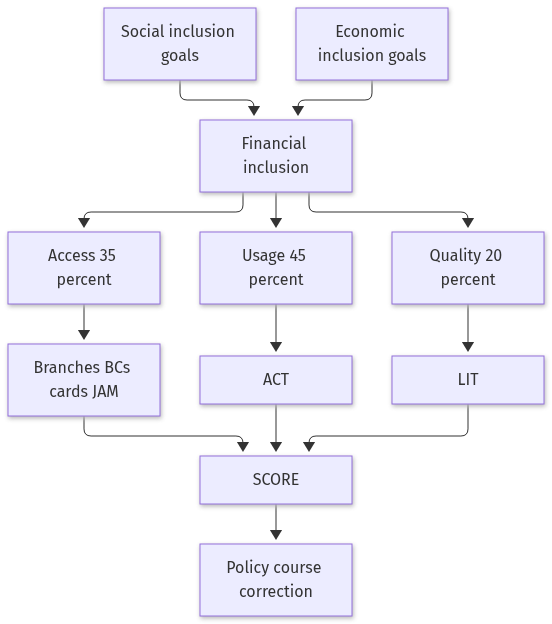
What the FI-Index measures: Launched conceptually around 2021 as a cumulative, no-base-year composite, the FI-Index ranges from 0 (complete exclusion) to 100 (full inclusion). It blends banking, investment, insurance, postal and pension indicators—97 in all—into three weighted pillars: Access (35%), Usage (45%) and Quality (20%). Higher weight on Usage and Quality signals that India has moved past a pure branch-counting phase.
- Eg: Access tracks outlets, cards, PoS, JAM ecosystem and insurance offices; Usage tracks credit accounts, UPI volumes/value, DBT and insurance uptake; Quality covers literacy, consumer protection and inequality measures such as district-level Gini on key indicators.
Policy usefulness as a dashboard: A single score lets RBI, Government and regulators see whether inclusion is deepening or stalling year to year, and which pillar is driving change. If Access rises but Usage lags, the message is clear: infrastructure exists, behaviour and product design need work. If Quality lags, literacy camps and grievance systems deserve budget, not only more ATMs.
- Eg: FI-Index rose to 67.0 for March 2025 from 64.2 in March 2024, with improvement noted especially in usage and quality dimensions in official commentary.
Recent trend and diagnostic value: For March 2026 the index was reported at 70.0 against 67.0 a year earlier, with growth across sub-indices and usage as a key driver. That movement helps separate "accounts opened" success stories from "accounts used" reality. States and sectors that underperform on Quality or Usage become candidates for targeted literacy, BC expansion or insurance push.
- Eg: Business Standard and Economic Times reporting on RBI's FY26 FI-Index release highlighted the jump to 70, mainly on higher usage—useful for exam answers that need a concrete recent figure.
Limits and complementary reading: The index is national and composite; it cannot alone reveal village-level exclusion or the experience of persons with disabilities. It should be read with NFHS, AISHE, or state banking data. Still, as a multi-regulator construct without a fixed base year, it remains one of the cleaner tools India has for scoring financial inclusion as both social and economic progress.
- Eg: RBI speeches note that while access improved sharply over iterations (earlier March 2017 value cited around 43.4 in speech material), the frontier challenge is now active usage and service quality—exactly what the index weights emphasise.
Flow diagram
Conclusion
Financial inclusion in India is not a side-show to social and economic inclusion; it is one of the main pipes through which welfare, wages and opportunity flow. Jan Dhan–Aadhaar–mobile rails, credit and insurance schemes, and digital payments have pulled millions into formal circuits, yet dormant accounts and uneven literacy show the job is unfinished. RBI's FI-Index—Access, Usage, Quality on a 0–100 scale—gives policymakers a living scorecard, recently touching about 70 in March 2026. Used honestly, it pushes attention from opening accounts to making finance usable, safe and equal across districts.
Quick related
Students also ask
-
Describe the various Technology Missions initiated in Indian agriculture and examine their role in food security.
Next question in the 2026 paper (Q3). View answer →
-
Why is financial inclusion linked to social inclusion in India?
Because bank accounts, DBT and digital payments let citizens receive welfare and wages without middlemen, document identity, and participate in formal economic life—especially women, migrants and rural households.
-
What does RBI's Financial Inclusion Index measure?
It is a 0–100 composite of Access, Usage and Quality across banking, insurance, pension, postal and investment indicators, designed to track deepening of inclusion beyond mere account opening.
-
What was the recent FI-Index reading?
About 70.0 for March 2026, up from 67.0 in March 2025, with improvement across sub-indices and usage highlighted as a major driver in reporting on the RBI release.
Same topic · past papers
UPSC has asked this before
These previous-year questions sit on the same topic. Open one to practise the earlier ask.
-
2016 · Q3 · GS III · 12 marks
Pradhan Mantri Jan Dhan Yojana (PMJDY) is necessary for bringing unbanked to the institutional finance fold. Do you agree with this for financial inclusion of the poor section of the Indian society? Give arguments to justify your opinion. -
2022 · Q2 · GS III · 10 marks
Is inclusive growth possible under market economy ? State the significance of financial inclusion in achieving economic growth in India.
More from this paper
Q1 · UPSC Mains 2026 · GS III · 10 marks · Solution
What do you mean by Digital Rupee? In this context, explain the working and progress of India's Central Bank Digital Currency (CBDC).
Indian Economy
• Digital Rupee (e₹) is India's RBI-issued CBDC, at par with cash and legal tender under Section 26 of the RBI Act. • It differs from UPI (a payment rail) and from private crypto (no sovereign backing or legal-tender status). • Two-tier working: RBI creates e₹; banks/non-banks distribute wallets and onboard users. • Retail e₹-R serves P2P/P2M payments; wholesale e₹-W settles G-Secs, call money and tokenised instruments. • Pilots: e₹-W from 1 November 2022; e₹-R from 1 December 2022; features now include programmability and BHIM wallet discovery. • DBT/PDS programmable CBDC trials ran in Gujarat, Puducherry and Chandigarh; offline NFC/SMS solutions are under test. • Retail e₹ in circulation was about ₹771.66 crore at end-March 2026; CAT Sandbox and UMI push tokenisation innovation. • Cross-border work includes MAS MoU and talks with UAE, plus BIS Innovation Hub engagement.
Q3 · UPSC Mains 2026 · GS III · 10 marks · Solution
Describe the various Technology Missions initiated in Indian agriculture and examine their role in food security.
Crops, Irrigation and Marketing
• Technology Missions deliver packaged seed–agronomy–extension solutions for priority crops. • NFSM lineage targets rice, wheat, pulses and coarse cereals to close yield gaps. • Oilseed/edible-oil missions aim to cut edible-oil import dependence. • MIDH builds horticulture productivity, nurseries, protected cultivation and post-harvest links. • NMSA emphasises soil, water, rainfed systems and climate resilience. • Newer pulses and millets mission language stresses protein and climate-smart calories. • Food-security role spans availability, income-based access, nutrition utilisation and stability. • Gaps remain in oilseed self-reliance, extension reach and market risk management.
Q4 · UPSC Mains 2026 · GS III · 10 marks · Solution
Explain the factors responsible for inefficiency of agri-produce marketing. How does e-commerce help to reduce inefficiency of agri-produce marketing? Explain.
Indian Economy
• Multi-layer intermediaries and distress sales shrink farmers' price share. • Weak APMC competition, storage and assaying deepen inefficiency. • Information asymmetry and trader-linked credit lock selling choices. • E-commerce widens buyer reach and makes prices more visible. • Platforms link trade to assaying, e-payments and logistics matching. • FPO–platform contracts can shorten chains for graded produce. • e-NAM aims at inter-mandi digital discovery where states integrate. • Digital tools fail without physical logistics and fair market rules.