
Revision summary
Objectives were to end intermediaries, secure tenants, redistribute surplus, consolidate plots, and fix records. Measures included zamindari abolition, tenancy laws, ceiling statutes, Bhoodan, consolidation, and digital land records. A ceiling helps the economy if land moves to tillers and output and credit rise. It fails if plots become uneconomic or surplus stays benami. Legal leasing, records and a credit-water package make ceiling an economic reform, not only a slogan.
Model answer
Copper italics in this answer — like this — are the key facts. Each one is unpacked in the Facts & figures rail.
Introduction
Land reforms after Independence tried to break the old rentier order and put the tiller closer to the title. The political aim was justice. The economic test is whether the same measures raise output, credit and investment, or only split plots until they cannot feed a household.
Body
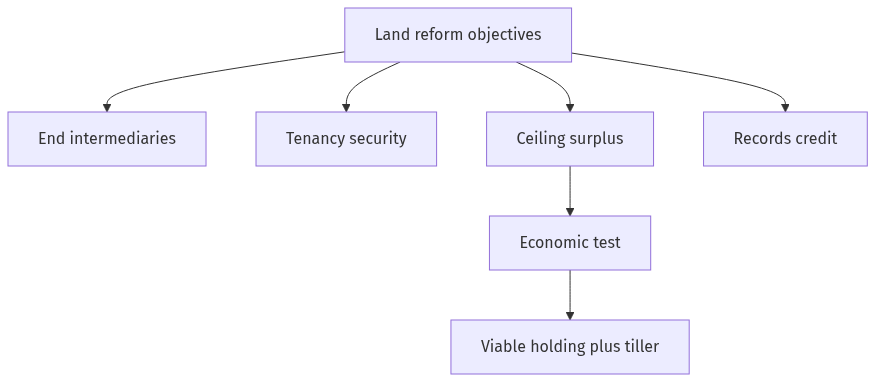
Objectives
- Abolish intermediaries so the State and the cultivator meet without a zamindar.
- Give security of tenure and fair rent to tenants.
- Redistribute surplus land through ceilings so the landless get a plot.
- Consolidate fragments so a holding can take a tube well and a tractor.
- Update records so title supports credit.
Measures
- Abolition of zamindari and similar intermediaries in the 1950s, with compensation, under State laws and Ninth Schedule protection.
- Tenancy laws: regulation of rent, prohibition of eviction without cause, and in some States a path to ownership.
- Land ceiling statutes from the 1960s–70s, with declared surplus and allotment to the landless; implementation was uneven and exemptions were wide.
- Bhoodan and gramdan as voluntary transfers, limited in area.
- Consolidation of holdings in parts of the north; weaker in the east and south.
- Digital India Land Records Modernization Programme and unique land-parcel IDs try to make the record match the ground.
- Recent policy also discusses legal leasing (NITI Aayog model Agricultural Land Leasing Act, 2016) so ceilings are not evaded by oral tenancy.
Ceiling under economic criteria
- A ceiling is economically useful if it cuts unproductive concentration and puts land with those who will till it, raising labour absorption and local demand.
- It fails the economic test if it creates uneconomic fragments, if surplus is benami, or if the new owner has no credit, water or extension.
- Effectiveness therefore needs: accurate records, few unjustified exemptions, a floor as well as a ceiling through consolidation or cooperatives, and legal lease markets so a viable operational holding can form without reversing equity.
- Ceiling is then a reform of structure, not a one-time seizure: title plus water plus credit is the economic package.
Flow diagram
Conclusion
Land reforms aimed at equity, tenure and records. Ceiling can be an effective economic reform only if surplus actually reaches tillers and holdings remain viable through consolidation, credit and lawful leasing. A paper ceiling with benami land fails both justice and output.
Quick related
Students also ask
-
Discuss the role of land reforms in agricultural development. Identify the factors that were responsible for the success of land reforms in India.
Next question on this syllabus topic (2016 · Q9). View answer →
-
Is a lower ceiling always better economics?
No. If the plot cannot support a pump or a crop cycle, equity is achieved on paper and poverty stays.
-
Does computerisation replace ceiling?
No. Records make any ceiling or lease enforceable. They do not themselves redistribute land.
Same topic · past papers
UPSC has asked this before
These previous-year questions sit on the same topic. Open one to practise the earlier ask.
-
2019 · Q11 · GS III · 15 marks
It is argued that the strategy of inclusive growth is intended to meet the objectives of inclusiveness and sustainability together. Comment on this statement. -
2017 · Q11 · GS III · 15 marks
One of the intended objectives of Union Budget 2017-18 is to 'transform, energize and clean India'. Analyse the measures proposed in the Budget 2017-18 to achieve the objective.
More from this topic
Q3 · UPSC Mains 2024 · GS III · 10 marks · Solution
What were the factors responsible for the successful implementation of land reforms in some parts of the country? Elaborate.
Land Reforms
Successful land reform needed political will, peasant organisation and records that named the tiller. West Bengal’s Operation Barga and Kerala’s occupancy reforms are the standard successful cases; early J&K also went far on ceilings. Zamindari abolition was wide; ceiling and tenancy security were not. Benami, litigation and informal tenancy explain failure in much of the heartland. A gazette cannot substitute for a union and a mutation register.
Q9 · UPSC Mains 2016 · GS III · 12 marks · Solution
Discuss the role of land reforms in agricultural development. Identify the factors that were responsible for the success of land reforms in India.
Land Reforms
Land reforms assign secure rights to the tiller, which raises investment, credit and the social base of farming. Abolition of intermediaries worked more widely than ceiling redistribution. Tenancy security and consolidation support irrigation and technology use. Success factors were political will, peasant organisation, usable records and complementary irrigation. Failure came from benami evasion, concealed tenancy and slow courts.