
Revision summary
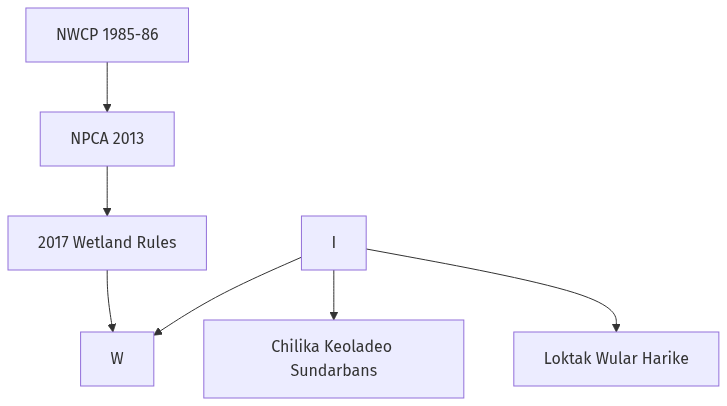
The National Wetland Conservation Programme began in 1985–86 to fund wetlands of national importance. It merged with the lake plan in 2013 into the National Plan for Conservation of Aquatic Ecosystems. The Wetlands Rules 2017 add a legal bar on filling and dumping in notified sites. India had about 75 Ramsar sites by 2022–23; examples are Chilika, Keoladeo, Sundarbans, Loktak and Wular. Listing is not protection unless sewage and encroachment are actually stopped.
Model answer
Copper italics in this answer — like this — are the key facts. Each one is unpacked in the Facts & figures rail.
Introduction
Wetlands store flood water, recharge wells, hold fish and birds, and buffer the coast. India began a dedicated National Wetland Conservation Programme (NWCP) in the mid-1980s so these sites would not become the next landfill. The global badge for the most important of them is the Ramsar list.
Body
National Wetland Conservation Programme
- NWCP started in 1985–86 to identify and fund wetlands of national importance: inventory, protection, catchment treatment, and awareness.
- It ran beside the National Lake Conservation Plan. In 2013 the two were merged into the National Plan for Conservation of Aquatic Ecosystems (NPCA), so lakes and wetlands share one Union scheme.
- Legal backup later includes the Wetlands (Conservation and Management) Rules, 2017, which bar notification-violating filling, dumping, and untreated discharge in listed wetlands, with State wetland authorities.
- Comment: the programme created a national list and some restoration money. On the ground, many urban wetlands still shrink under real estate, sewage, and encroachment. Rules exist; enforcement and city planning are the weak joint. NWCP/NPCA is necessary but not sufficient without State land records and sewage plants.
Ramsar sites in India (examples)
- India is a party to the Ramsar Convention on Wetlands (1971). By 2022–23 it had about 75 Ramsar sites (the count rose further after the 2023 paper; use the then figure as “about 75”).
- Chilika Lake (Odisha) — brackish lagoon; Irrawaddy dolphin and migratory birds.
- Keoladeo National Park (Rajasthan) — former Bharatpur bird sanctuary.
- Sundarbans (West Bengal) — mangrove; tiger and storm buffer.
- Loktak Lake (Manipur) — floating phumdis; Keibul Lamjao.
- Wular Lake (Jammu and Kashmir) — large freshwater lake of the Jhelum.
- Others often cited: Harike (Punjab), Point Calimere (Tamil Nadu), Ashtamudi (Kerala), Bhitarkanika (Odisha), Sambhar (Rajasthan), Kolleru (Andhra Pradesh).
Ramsar listing brings international attention and some funds. It does not by itself stop a local landfill. NWCP/NPCA and the 2017 Rules are the domestic tools that must match the badge.
Flow diagram
Conclusion
NWCP put nationally important wetlands on a funded list from 1985–86 and later folded into NPCA. A few dozen Indian sites, about 75 by 2022–23, are Ramsar wetlands of international importance, including Chilika, Keoladeo, Sundarbans, Loktak and Wular. The programme’s gap is enforcement against fill and sewage, not the absence of a scheme name.
Quick related
Students also ask
-
The Intergovernmental Panel on Climate Change(IPCC) has predicted a global sea level rise of about one metre by AD 2100. What would be its impact in India and the other countries in the Indian Ocean region?
Next question on this syllabus topic (2023 · Q18). View answer →
-
Is every NWCP wetland a Ramsar site?
No. Ramsar is a smaller international list. NWCP/NPCA covers a wider national set.
-
Does Ramsar listing stop construction?
Not by itself. Indian 2017 Rules and local enforcement have to do that work.
Same topic · past papers
UPSC has asked this before
These previous-year questions sit on the same topic. Open one to practise the earlier ask.
More from this topic
Q8 · UPSC Mains 2026 · GS III · 10 marks · Solution
Discuss the aim and goals of Kunming-Montreal global biodiversity framework. Mention India's commitments and initiatives to achieve the goals and targets of this framework giving suitable examples.
Environment and Conservation
• Adopted at CBD COP15, the Kunming-Montreal Global Biodiversity Framework aims to halt and reverse biodiversity loss by 2030. • It outlines a 2050 vision of living in harmony with nature, supported by four long-term goals and 23 actionable targets. • Key global targets include the "30x30" initiative (conserving 30% of land and oceans), restoring 30% of degraded ecosystems, and cutting harmful subsidies. • India aligns its national policies by updating its National Biodiversity Action Plan (NBAP) to match the framework's 23 targets. • India supports the 30x30 goal through an extensive network of over 990 protected areas covering roughly 5.3% of its landmass. • Flagship species conservation efforts like Project Tiger, Project Elephant, and cheetah introductions drive direct ecosystem restoration. • The Biological Diversity Act, 2002 empowers grassroots conservation via local Biodiversity Management Committees and People's Biodiversity Registers.
Q18 · UPSC Mains 2025 · GS III · 15 marks · Solution
Write a review on India's climate commitments under the Paris Agreement (2015) and mention how these have been further strengthened in COP26 (2021). In this direction, how has the first Nationally Determined Contribution intended by India been updated in 2022?
Environment and Conservation
The 2015 NDC promised a 33–35 per cent cut in emissions intensity by 2030, 40 per cent non-fossil power capacity, and a large forest sink. COP26’s Panchamrit raised the political bar, including 500 GW non-fossil, a billion-tonne cut and net zero by 2070. In August 2022 India updated the NDC to 45 per cent intensity reduction and 50 per cent non-fossil installed capacity by 2030. Per-capita equity remains India’s diplomatic line. Pledges now need coal-path honesty and real forest carbon.
Q17 · UPSC Mains 2025 · GS III · 15 marks · Solution
Mineral resources are fundamental to the country's economy and these are exploited by mining. Why is mining considered an environmental hazard? Explain the remedial measures required to reduce the environmental hazard due to mining.
Environment and Conservation
Mining underpins industry but strips forest, dirties air and water, and displaces people. Open-cast coal, metal tailings, sand mining and illegal pits are the main Indian hazard types. EIA, District Mineral Foundations, scientific closure and forest rights are the legal remedies. Illegal mining needs satellite watch and police, not only a new rule. Some deposits should remain unmined where ecology and consent fail.