
Revision summary
Organised crime includes narcotics, arms, trafficking, extortion, cyber fraud, smuggling and laundering. Terrorism is political; crime is profit. They meet where terrorists need money, weapons, documents and routes. Nationally, linkages are extortion in conflict areas, hawala, gun-running, prison mixing and narco-terror corridors. Transnationally, the same dhows, containers, diaspora finance and mixers serve both. Policing must join narcotics, financial intelligence and counter-terror, not run them as separate worlds.
Model answer
Copper italics in this answer — like this — are the key facts. Each one is unpacked in the Facts & figures rail.
Introduction
Organised crime is a continuing enterprise that sells illegal goods or services and uses violence, corruption and secrecy for profit. Terrorism seeks political change through fear. The two are not the same motive. They link where the terrorist needs money, arms, fake papers and routes that criminals already run.
Body
Types of organised crime
- Narcotics trafficking: heroin, methamphetamine, cannabis, precursor chemicals.
- Arms trafficking: small arms, ammunition, explosives.
- Human trafficking and migrant smuggling: sexual exploitation, forced labour, illegal crossing.
- Extortion, protection rackets and contract killing.
- Cyber-enabled fraud, ransomware-as-a-service, and identity theft.
- Wildlife, timber and gold smuggling; counterfeit currency and goods.
- Money laundering through hawala, trade mis-invoicing, shells and real estate.
- In India, mafia-type urban gangs, coastal smuggling, and insurgent taxation in some conflict belts sit on this list.
Linkages with terrorists — national
- Terror groups levy extortion and ‘taxes’ on timber, poppy, mining or transport in areas they influence—crime as finance.
- They use criminal gun-runners and hawala to move weapons and cash inside the country.
- Prison and undertrial networks mix gangsters and radicals; radicalisation of criminals and criminalisation of radicals both occur.
- Fake identity, stolen vehicles and safe houses are often bought from the crime market, not built from ideology.
- Narco-terror in border belts (for example Punjab and Jammu drug-arms drops) blurs the line in operational terms even if motives differ.
Linkages — transnational
- Shared routes: the same dhow, container or drone corridor can carry heroin, fake currency and a militant’s kit.
- Diaspora and hawala corridors fund both cartels and outfits listed under UAPA / UNSC 1267.
- Groups may tax or escort drug caravans (a pattern seen in parts of the Af-Pak theatre) without becoming a cartel themselves.
- Cybercrime-as-a-service and cryptocurrency mixers can pay for logistics across borders.
- Response must therefore join NIA, State police, NCB, ED, FIU-IND and coastal / BSF work, plus MLATs and FATF-style financial standards—not only a terror docket.
Flow diagram
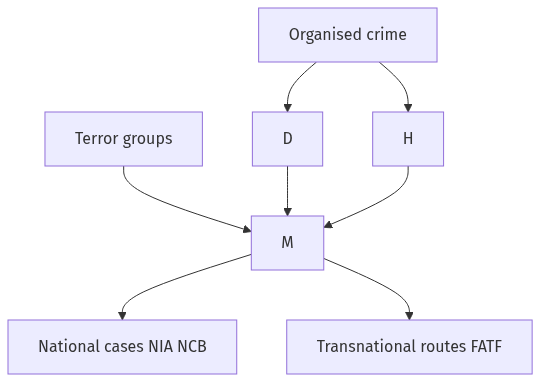
Conclusion
Organised crime is a profit industry with many product lines. Terrorists buy its logistics. Nationally that is hawala, arms, extortion and narco-routes; transnationally it is the same corridors and laundering rails. Treating crime and terror as sealed boxes misses the finance.
Quick related
Students also ask
-
Analyse the complexity and intensity of terrorism, its causes, linkages and obnoxious nexus. Also suggest measures required to be taken to eradicate the menace of terrorism.
Next question on this syllabus topic (2021 · Q20). View answer →
-
Is every drug smuggler a terrorist?
No. Most are profit criminals. The security problem is the subset of routes, taxes and arms that terrorists use.
-
Why mention FATF in a crime-terror answer?
Because the shared link is money. FATF standards force banks and hawala controls that starve both.
Same topic · past papers
UPSC has asked this before
These previous-year questions sit on the same topic. Open one to practise the earlier ask.
-
2021 · Q20 · GS III · 15 marks
Analyse the complexity and intensity of terrorism, its causes, linkages and obnoxious nexus. Also suggest measures required to be taken to eradicate the menace of terrorism. -
2018 · Q20 · GS III · 15 marks
India's proximity to two of the world's biggest illicit opium-growing states has enhanced her internal security concerns. Explain the linkages between drug trafficking and other illicit activities such as gunrunning, money laundering and human trafficking. What countermeasures should be taken to prevent the same? (250 Words, 15 Marks).
More from this topic
Q10 · UPSC Mains 2026 · GS III · 10 marks · Solution
Ladakh is strategically located between China and Pakistan. As a measure to win hearts and minds of locals, discuss the Border Area Development Programmes (BADP) by the Central Government and civic actions by the Army. Also discuss demand of promulgation of provision of the Sixth Schedule of the Constitution for Ladakh.
Border Security and Organised Crime
• **Strategic Location:** Ladakh sits between China and Pakistan, making local civilian support vital for national security in this sensitive frontier. • **BADP Focus:** The Border Area Development Programmes bridge remote infrastructure gaps by funding schools, health centres, and local connectivity. • **Livelihood Growth:** BADP aims to reduce regional imbalances by empowering remote border habitations with sustainable economic opportunities. • **Army Civic Action:** Through Sadbhavana projects, the Indian Army builds local trust via healthcare camps, skill centres, and educational support. • **Humanitarian Aid:** The military provides vital winter stocking, high-altitude disaster relief, and youth engagement tours in isolated valleys. • **Sixth Schedule Demand:** Locals demand Sixth Schedule status to protect indigenous Ladakhi culture, land ownership, and demographic identity. • **Autonomous Governance:** This constitutional demand seeks to empower Hill Councils with greater legislative and financial decision-making powers.
Q9 · UPSC Mains 2025 · GS III · 10 marks · Solution
Terrorism is a global scourge. How has it manifested in India? Elaborate with contemporary examples. What are the counter measures adopted by the State? Explain.
Border Security and Organised Crime
Terrorism is political violence meant to frighten civilians and coerce a state. India has faced it in Kashmir, in city bombings such as 26/11, in small hinterland modules, and online. Some Northeast and Khalistani violence uses the same methods. Counters include UAPA and the NIA, intelligence fusion, NSG, border and coastal security, and terror-finance rules. Politics and deradicalisation lag force; rights costs of broad laws remain a live issue.
Q19 · UPSC Mains 2024 · GS III · 15 marks · Solution
India has a long and troubled border with China and Pakistan, fraught with contentious issues. Examine the conflicting issues and security challenges along the border. Also give out the development being undertaken in these areas under the Border Area Development Programme (BADP) and Border Infrastructure andManagement (BIM) Scheme.
Border Security and Organised Crime
With Pakistan the live issues are the LoC, PoK, Sir Creek, Siachen, infiltration and drone-aided terror or narcotics. With China the issues are an undelimited LAC, Aksai Chin, Arunachal, patrol face-offs and a roads-and-villages race after Galwan 2020. A two-front stress is the strategic envelope. BADP funds border-block development so hamlets do not empty. BIM funds fencing, lighting, BOPs, roads and surveillance; it must not reduce the border resident to a cleared field of fire.