
Revision summary
Small UAVs drop arms, ammunition and narcotics across foggy and riverine borders, especially Punjab and Jammu. The operator can remain across the fence, which makes attribution hard. BSF has specialised drone response and works with police and the Narcotics Control Bureau. CIBMS adds sensors and cameras to high-risk fence stretches. Anti-drone radars, jammers and DRDO-type systems must sit with criminal cases against handlers.
Model answer
Copper italics in this answer — like this — are the key facts. Each one is unpacked in the Facts & figures rail.
Introduction
A small unmanned aerial vehicle (UAV) can cross a fence that a person cannot. Adversaries and criminal groups have used quadcopters to drop arms, ammunition and narcotics into Indian border belts, especially along Punjab and Jammu. The threat is internal security because the payload is meant for terror modules and drug networks inside the country.
Body
The threat
- Low-cost drones fly below many older radars, at night, and from short range across a riverine or foggy border.
- Payloads have included pistols, ammunition, explosives and heroin in documented Border Security Force seizures.
- The operator can stay on the other side; attribution is slow.
- The same method can later carry better explosives or surveillance, so the problem scales.
Measures
- Border Security Force (BSF) has raised drone squads, night optics, and specialised companies; it seizes drones and payloads and works with State police and the Narcotics Control Bureau.
- Comprehensive Integrated Border Management System (CIBMS) layers fences, sensors, cameras, and command rooms on high-risk stretches so a small flight is not only a human lookout’s problem.
- Anti-drone tools: detection (radar, radio-frequency, electro-optic), and defeat (jammers, nets, spoofing, and in some forces DRDO D4-type systems and directed-energy pilots). The Ministry of Home Affairs has issued anti-drone guidelines for police and vital installations.
- Air-defence and Indian Air Force sensors cover higher and longer-range unmanned aircraft; the small commercial quadcopter is mainly a BSF–police problem.
- Legal and investigative follow-up uses Unlawful Activities (Prevention) Act and Narcotic Drugs and Psychotropic Substances Act cases so a drop is not treated as a petty smuggle.
- Gaps: cheap drones outpace jammers, civilian drones are dual-use, and riverine fog still blinds sensors. Measures must combine tech, patrol, and disruption of the handler network, not only a new gadget on the fence.
Flow diagram
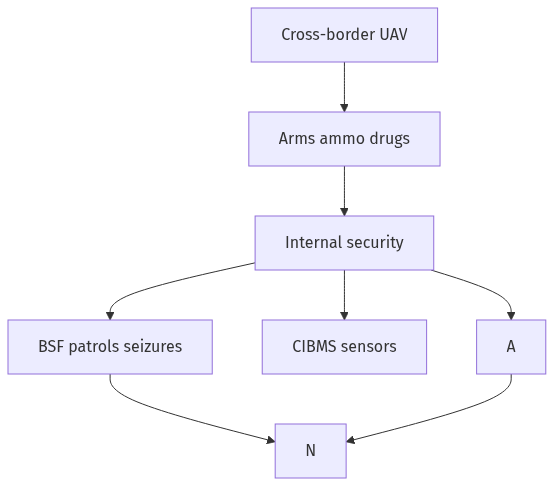
Conclusion
Cross-border UAVs ferry arms and drugs under the radar of a fence-era border. BSF seizures, CIBMS sensors, and anti-drone detect-and-jam systems are the present reply. They work if handlers are also caught and if the sensor layer is kept ahead of cheap aircraft.
Quick related
Students also ask
-
Discuss the types of organised crimes. Describe the linkages between terrorists and organised crime that exist at the national and transnational levels.
Next question on this syllabus topic (2022 · Q9). View answer →
-
Can a fence stop a drone?
No. A fence stops a walker. A UAV flies over it. Sensors and jammers are the relevant layer.
-
Is this only a military air-defence problem?
Large UAVs are. The cheap quadcopter drop is mainly a BSF and police problem at fence height.
Same topic · past papers
UPSC has asked this before
These previous-year questions sit on the same topic. Open one to practise the earlier ask.
-
2024 · Q9 · GS III · 10 marks
Explain how narco-terrorism has emerged as a serious threat across the country. Suggest suitable measures to counter narco-terrorism. -
2017 · Q7 · GS III · 10 marks
India has achieved remarkable successes in unmanned space missions including the Chandrayaan and Mars Orbitter Mission, but has not ventured into manned space mission, both in terms of technology and logistics? Explain critically.
More from this topic
Q10 · UPSC Mains 2026 · GS III · 10 marks · Solution
Ladakh is strategically located between China and Pakistan. As a measure to win hearts and minds of locals, discuss the Border Area Development Programmes (BADP) by the Central Government and civic actions by the Army. Also discuss demand of promulgation of provision of the Sixth Schedule of the Constitution for Ladakh.
Border Security and Organised Crime
• **Strategic Location:** Ladakh sits between China and Pakistan, making local civilian support vital for national security in this sensitive frontier. • **BADP Focus:** The Border Area Development Programmes bridge remote infrastructure gaps by funding schools, health centres, and local connectivity. • **Livelihood Growth:** BADP aims to reduce regional imbalances by empowering remote border habitations with sustainable economic opportunities. • **Army Civic Action:** Through Sadbhavana projects, the Indian Army builds local trust via healthcare camps, skill centres, and educational support. • **Humanitarian Aid:** The military provides vital winter stocking, high-altitude disaster relief, and youth engagement tours in isolated valleys. • **Sixth Schedule Demand:** Locals demand Sixth Schedule status to protect indigenous Ladakhi culture, land ownership, and demographic identity. • **Autonomous Governance:** This constitutional demand seeks to empower Hill Councils with greater legislative and financial decision-making powers.
Q9 · UPSC Mains 2025 · GS III · 10 marks · Solution
Terrorism is a global scourge. How has it manifested in India? Elaborate with contemporary examples. What are the counter measures adopted by the State? Explain.
Border Security and Organised Crime
Terrorism is political violence meant to frighten civilians and coerce a state. India has faced it in Kashmir, in city bombings such as 26/11, in small hinterland modules, and online. Some Northeast and Khalistani violence uses the same methods. Counters include UAPA and the NIA, intelligence fusion, NSG, border and coastal security, and terror-finance rules. Politics and deradicalisation lag force; rights costs of broad laws remain a live issue.
Q19 · UPSC Mains 2024 · GS III · 15 marks · Solution
India has a long and troubled border with China and Pakistan, fraught with contentious issues. Examine the conflicting issues and security challenges along the border. Also give out the development being undertaken in these areas under the Border Area Development Programme (BADP) and Border Infrastructure andManagement (BIM) Scheme.
Border Security and Organised Crime
With Pakistan the live issues are the LoC, PoK, Sir Creek, Siachen, infiltration and drone-aided terror or narcotics. With China the issues are an undelimited LAC, Aksai Chin, Arunachal, patrol face-offs and a roads-and-villages race after Galwan 2020. A two-front stress is the strategic envelope. BADP funds border-block development so hamlets do not empty. BIM funds fencing, lighting, BOPs, roads and surveillance; it must not reduce the border resident to a cleared field of fire.