
Revision summary
Section 123 RPA lists corrupt practices for election petitions: bribery, undue influence, communal appeal, false statements, booth capturing and related heads. Undue influence is interference with the free exercise of an electoral right, not every unfair gain. ADR and PUCL made asset affidavits part of an informed vote; false disclosure can be litigated. A legislator’s unexplained wealth is primarily a Prevention of Corruption Act and ethics issue. It is not, by itself, undue influence under the 1951 Act unless tied to bribery or intimidation of electors.
Model answer
Copper italics in this answer — like this — are the key facts. Each one is unpacked in the Facts & figures rail.
Introduction
The Representation of the People Act, 1951 (RPA) identifies specific electoral misconduct as corrupt practices to protect free and fair elections. Section 123 covers bribery, undue influence, false statements and other prohibited practices. However, disproportionate increase in assets is not, by itself, undue influence unless it is connected with interference in the electoral process.
Body
Corrupt practices under RPA, 1951
- Bribery: Offering gratification to induce an elector to vote, not vote, or a candidate to withdraw.
- Undue influence: Direct or indirect interference with the free exercise of an electoral right, including threats or use of authority to overawe voters.
- Communal appeals: Seeking votes on grounds of religion, race, caste, community or language.
- False statements: Publishing false statements concerning a candidate's personal character or conduct to affect the election.
- Other practices: The Act also covers specified misconduct such as booth capturing and misuse of official machinery.
Undue influence and electoral freedom
- Core principle: Undue influence concerns interference with the voter's freedom of choice; every form of political unfairness does not constitute undue influence.
- Judicial approach: Ram Dial and Shiv Kirpal Singh emphasised protection of the free exercise of electoral rights.
- Krishnamoorthy v. Sivakumar: The Supreme Court stressed the importance of preserving the free and genuine choice of voters and electoral integrity.
Example:
- Threatening an elector with injury to force a particular vote can constitute undue influence.
Disproportionate assets: Not automatically undue influence
- Asset increase: Disproportionate growth in a legislator's assets may raise questions of corruption, illicit enrichment and accountability.
- Primary legal route: Unexplained wealth is principally relevant to the Prevention of Corruption Act, investigation and disclosure mechanisms.
- Key distinction: Mere possession of unexplained wealth does not itself interfere with an elector's free choice.
Example:
- A legislator becoming substantially wealthier without a satisfactory explanation does not automatically constitute undue influence without evidence of electoral interference.
When assets can become an RPA issue
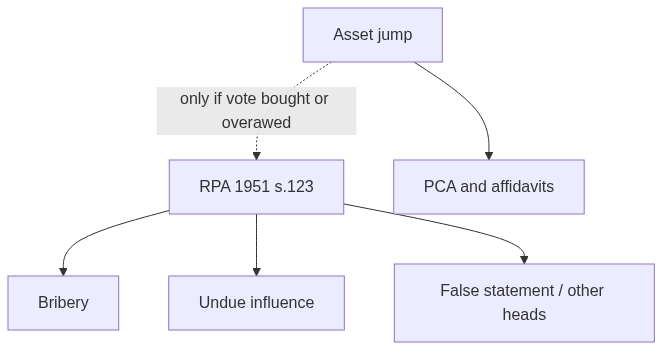
- Bribery: If illicit wealth is used to purchase votes, it may constitute bribery under Section 123.
Example:
- Using unexplained funds to distribute cash to electors can convert a wealth issue into a potential electoral corrupt practice.
- Intimidation: If wealth or office is used to threaten or overawe electors, it may constitute undue influence.
- False disclosure: Deliberately concealing or falsifying mandatory election disclosures can undermine informed voting and attract separate legal consequences.
Asset disclosure and informed choice
- ADR / PUCL: Supreme Court jurisprudence strengthened disclosure of candidates' assets, liabilities, criminal antecedents and educational qualifications.
- Purpose: Disclosure promotes transparency and informed electoral choice without treating wealth itself as proof of electoral corruption.
Disqualification and corrupt practices
- Lily Thomas v. Union of India: The Supreme Court struck down the protection under Section 8(4) of the RPA, making disqualification of a sitting MP/MLA upon conviction under Section 8(1) or 8(2) immediate, subject to the statutory appeal process.
- Relevance: Conviction-based disqualification is distinct from a corrupt-practice finding under Section 123.
Distinct legal frameworks
- RPA: Protects the integrity of the electoral process.
- Prevention of Corruption framework: Addresses corruption and illicit enrichment.
- Disclosure mechanisms: Promote electoral transparency and informed voting.
- Disqualification provisions: Address the electoral consequences of specified convictions.
Flow diagram
Conclusion
Section 123 of the RPA targets conduct that corrupts the electoral process, while disproportionate assets primarily raise questions of corruption and disclosure. An increase in a legislator's assets, standing alone, is not undue influence. It becomes an RPA issue when wealth is connected with bribery, intimidation or other prohibited electoral conduct. This distinction preserves both electoral integrity and the statutory boundaries of the RPA.
Quick related
Students also ask
-
Can the Election Commission unseat an MP only for getting richer in office?
Not under the RPA’s corrupt-practice heads alone. Unseating needs a successful election petition on a listed practice, or disqualification on another statutory ground.
-
Is a false asset affidavit a corrupt practice?
Material false statements in the electoral context can be proceeded against. The safer and usual path is disclosure jurisprudence plus criminal and vigilance law, with facts pleaded with particulars.
Same topic · past papers
UPSC has asked this before
These previous-year questions sit on the same topic. Open one to practise the earlier ask.
-
2020 · Q1 · GS II · 10 marks
"There is a need for simplification of procedure for disqualification of persons found guilty of corrupt practices under the Representation of peoples Act" Comment. -
2020 · Q5 · GS II · 10 marks
"Once a speaker, Always a speaker'! Do you think the practice should be adopted to impart objectivity to the office of the Speaker of Lok Sabha? What could be its implications for the robust functioning of parliamentary business in India.