
Revision summary
The Public Examinations (Prevention of Unfair Means) Act, 2024 targets organised leaks and unfair means in central public exams. Scheduled authorities include UPSC, SSC, Railway Recruitment Boards, IBPS and NTA; the Centre can add names. Offences are serious, including for service providers who handle papers. University and State board exams are not covered unless notified or a State copies the Act. The political spur was high-stakes testing in 2024; the legal scope remains the Schedule. The Act adds crime and punishment; cancellation of a paper remains an administrative and judicial decision.
Model answer
Copper italics in this answer — like this — are the key facts. Each one is unpacked in the Facts & figures rail.
Introduction
Paper leaks had become a recruitment crisis, not a campus prank. The Public Examinations (Prevention of Unfair Means) Act, 2024, brought into force in June 2024, is the Union’s criminal statute against organised cheating in central public exams. It is a narrow, named-authority law. It is not, by its own text, a law for every university semester or every State board paper.
Body
Aims and objects
The Act tries to make an organised leak a serious Union crime, not only an administrative cancellation.
- Peg: The object is to deter unfair means in public examinations: leaking papers, unauthorised access to question banks, impersonation, collusion with printers and IT vendors, and the industry around a leak.
- Peg: It creates cognisable, non-bailable offences with heavy jail terms and fines, including for service providers who hold the paper.
- Peg: It closes a gap where a leak was often only a weak State exam-offence or an Information Technology Act count, while lakhs of candidates lost a year.
- Peg: The political spur was the 2024 high-stakes testing controversy; the legal design is a central criminal template, not a news recap.
Who is covered
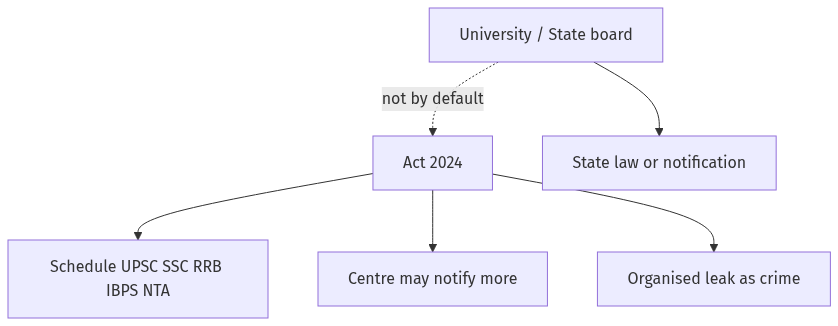
A public examination under this Act is one conducted by a listed or notified authority.
- Peg: The Schedule names, among others, the Union Public Service Commission, Staff Selection Commission, Railway Recruitment Boards, Institute of Banking Personnel Selection and the National Testing Agency.
- Peg: The Central Government may notify more authorities; that is how the map grows.
- Peg: Candidates, insiders and organised groups are hit on different rungs; the organised leak is the serious end.
Universities and State boards
University and State Education Board examinations are not covered by default.
- Peg: A State board Class-12 paper or a university semester exam is not a “public examination” under the 2024 Union Act unless that board or university is notified, or the State legislates a clone.
- Peg: Until then those papers remain under State exam laws, university ordinances and ordinary cheating sections of the criminal law.
- Peg: A national anti-leak statute that skipped the B.Ed. and constable papers where leaks have been frequent would be a brochure; expansion is by notification and State adoption, not by the preamble.
Flow diagram
Conclusion
The 2024 Act criminalises organised unfair means in exams run by listed central authorities. University and State board examinations are outside it unless notified or cloned by a State. The object is deterrence at the Union gate, not a single law for every hall ticket in India.
Quick related
Students also ask
-
In a crucial domain like the public healthcare system, the Indian State should play a vital role to contain the adverse impact of marketization of the system. Suggest some measures through which the State can enhance the reach of public healthcare at the grassroots level.
Next question on this syllabus topic (2024 · Q17). View answer →
-
Does the Act automatically cover NEET if NTA conducts it?
NTA is a scheduled authority, so an NTA public examination can fall under the Act. Cancellation of a session is still a separate administrative and court question.
-
Can a State use this Act for its Public Service Commission?
Not by borrowing the Union Schedule. The authority must be notified, or the State must pass its own law on the same pattern.
Same topic · past papers
UPSC has asked this before
These previous-year questions sit on the same topic. Open one to practise the earlier ask.
More from this topic
Q18 · UPSC Mains 2026 · GS II · 15 marks · Solution
Should education be treated primarily as a welfare obligation of the state or as a strategic investment for building a globally competitive, knowledge-driven nation? Critically evaluate.
Health, Education and Human Resources
Education in India balances a constitutional welfare duty with economic utility. Article 21A
Q7 · UPSC Mains 2026 · GS II · 10 marks · Solution
Malnutrition in India is not merely a public health concern; it is also a challenge of social equity, human development and effective welfare governance. Discuss.
Health, Education and Human Resources
• **Social Inequity:** Malnutrition heavily affects marginalised castes, tribal groups, and low-income households due to deep-rooted social stratification. • **Gender Bias:** Intra-household food discrimination and early motherhood create an intergenerational cycle of undernutrition for women and girls. • **Human Capital Loss:** Early childhood stunting causes irreversible cognitive damage, directly lowering educational outcomes and workforce productivity. • **Demographic Risk:** Without urgent nutritional interventions, India's demographic dividend risks turning into a socioeconomic liability. • **Governance Failures:** Administrative leakages in the Public Distribution System (PDS) and Integrated Child Development Services (ICDS) weaken last-mile delivery. • **Siloed Approach:** Poor coordination among health, sanitation, and rural development departments reduces the effectiveness of welfare schemes. • **Way Forward:** Success requires shifting from basic food security to nutritional justice through POSHAN Abhiyaan convergence and Article 21 rights.
Q17 · UPSC Mains 2024 · GS II · 15 marks · Solution
In a crucial domain like the public healthcare system, the Indian State should play a vital role to contain the adverse impact of marketization of the system. Suggest some measures through which the State can enhance the reach of public healthcare at the grassroots level.
Health, Education and Human Resources
Private-heavy care and out-of-pocket spend are the face of marketization in Indian health. Information asymmetry and cream-skimming make a pure market unsafe for the poor. Grassroots State role: Health and Wellness Centres, ASHA and ANM, district hospitals, public colleges, pooled drugs, ambulances. Insurance purchases care; it does not replace a public provider that sets a price floor. Article 47 and Article 21 emergency-care cases already treat basic health as a State duty. Capex on buildings is not enough; people who stay and drugs that exist are the reach.