
Revision summary
Public interest litigation grew because the Court stopped insisting that only a personally injured plaintiff could knock. Hussainara Khatoon read speedy trial into Article 21 for Bihar undertrials. S.P. Gupta opened standing; Bandhua Mukti Morcha let a voluntary body sue for bonded labourers. A letter could be treated as a writ; continuing mandamus kept administrations under watch. The Court is unusually interventionist on appointments and social rights. It is not the world’s most powerful if power means being always obeyed. Frivolous PIL should shrink; voiceless litigants have not vanished because GDP rose.
Model answer
Copper italics in this answer — like this — are the key facts. Each one is unpacked in the Facts & figures rail.
Introduction
Public interest litigation was India’s answer to a poor litigant and a rich Constitution. From the late 1970s the Supreme Court loosened who may knock and how. That growth made the Court a household forum for bonded labour, undertrials and air. Whether it is the world’s most powerful court is a different sentence — half true about jurisdiction, less true about obedience.
Body
Why PIL grew
Ordinary civil procedure asked the petitioner to show a personal injury; that rule shut out those who could not instruct a lawyer.
- Peg: The Court relaxed locus standi: a public-spirited person, a journalist or a social worker could move for bonded labourers, undertrials and pavement dwellers.
- Peg: Hussainara Khatoon v. State of Bihar treated years of undertrial detention as a denial of Article 21 and read speedy trial into that article.
- Peg: S.P. Gupta v. Union of India opened standing for public-spirited lawyers; Bandhua Mukti Morcha let a voluntary body sue for quarry workers and keep the file under watch.
- Peg: After the Emergency the Court needed public legitimacy; newspapers, Article 39A legal aid and later rights institutions supplied facts and lawyers.
Method: letter, Article 21, continuing mandamus
The invention was procedure, not a new article.
- Peg: Epistolary jurisdiction let a postcard or a newspaper cutting be registered as a writ when the victim was voiceless; Article 32 was not to be ornamental.
- Peg: After Maneka Gandhi, Article 21 required fair, just and reasonable procedure, which opened undertrials, livelihood, environment and dignity.
- Peg: Vineet Narain used continuing mandamus so an investigation could not be buried; environment benches have done the same with rivers and air.
- Peg: Olga Tellis, Unni Krishnan and Vishaka show socio-economic and dignity claims riding the same expansion — with a later shadow of hobby petitions and publicity benches.
The world’s most powerful judiciary?
Power here mixes docket, appointments and obedience.
- Peg: After the Judges cases the Court largely appoints its own colleagues; in 2015 it struck down the 99th Amendment and the NJAC Act.
- Peg: Kesavananda Bharati lets it police constitutional amendments through the basic-structure doctrine — language the US Supreme Court does not use.
- Peg: It has no army and no budget of its own; farm-law protests, reservation politics and missed river-cleaning deadlines show that orders can be delayed or politically overrun.
- Peg: A fair sentence: PIL made the Court one of the most interventionist constitutional courts, and the collegium made it unusually self-recruiting. That is real power. In a republic, power still stops where legislatures, budgets and street politics refuse to follow.
Flow diagram
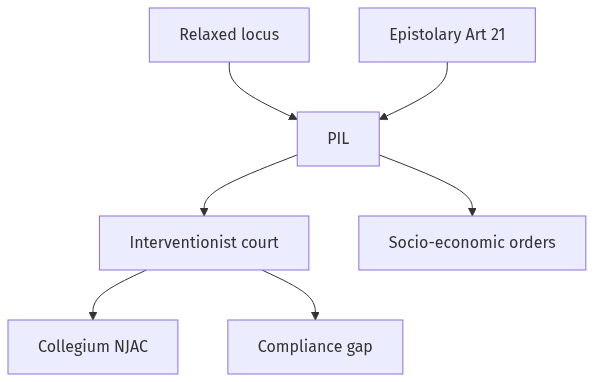
Conclusion
PIL grew because standing, Article 21 and epistolary practice opened the Court to those without retainers. That made a remarkably interventionist judiciary. ‘Most powerful in the world’ is true only if power means docket and appointments — not if it means always being obeyed.
Quick related
Students also ask
-
"The most significant achievement of modern law in India is the constitutionalization of environmental problems by the Supreme Court." Discuss this statement with the help of relevant case laws.
Next question on this syllabus topic (2022 · Q1). View answer →
-
Did Justices Bhagwati and Iyer invent PIL?
They built the practice. The text was always Articles 32 and 226. The invention was standing and the letter.
-
Should PIL shrink now that India is richer?
Frivolous PIL should. Bonded labour and undertrials have not vanished because GDP rose.
Same topic · past papers
UPSC has asked this before
These previous-year questions sit on the same topic. Open one to practise the earlier ask.
-
2019 · Q4 · GS II · 10 marks
From the resolution of contentious issues regarding distribution of legislative powers by the courts, 'Principle of Federal Supremacy' and 'Harmonious Construction' have emerged. Explain. -
2017 · Q4 · GS II · 10 marks
How do pressure groups influence Indian political process? Do you agree with this view that informal pressure groups have emerged as powerful than formal pressure groups in recent years?
More from this topic
Q13 · UPSC Mains 2025 · GS II · 15 marks · Solution
Discuss the evolution of collegium system in India. Critically examine the advantages and disadvantages of the system of appointment of the Judges of the Supreme Court of India and that of the USA.
Executive and Judiciary
First Judges Case gave the executive primacy; Second and Third Judges Cases created the collegium of the CJI and senior colleagues. NJAC (99th Amendment) was struck down in 2015; the collegium returned, still criticised for opacity and delay. The US President nominates Supreme Court Justices; the Senate confirms; tenure is effectively for life. India’s gain is insulation from a sudden majority; its cost is unexplained selection. America’s gain is public democratic input; its cost is partisan life tenure.
Q11 · UPSC Mains 2025 · GS II · 15 marks · Solution
"Constitutional morality is the fulcrum which acts as an essential check upon the high functionaries and citizens alike…"In view of the above observation of the Supreme Court, explain the concept of constitutional morality and its application to ensure balance between judicial independence and judicial accountability in India.
Executive and Judiciary
Ambedkar treated constitutional morality as cultivated respect for constitutional forms in an unequal society. The Court has used it in Manoj Narula, NCT of Delhi, Navtej Johar and Sabarimala as process plus dignity against convenience. It checks both high office and majoritarian citizens. Judicial independence (tenure, collegium, basic structure) is one application; accountability (impeachment, in-house, Veeraswami, open reasons) is the other. NJAC 2015 protected independence; unexplained collegium power still fails the same morality if it will not give reasons.
Q1 · UPSC Mains 2022 · GS II · 10 marks · Solution
"The most significant achievement of modern law in India is the constitutionalization of environmental problems by the Supreme Court." Discuss this statement with the help of relevant case laws.
Executive and Judiciary
Environmental harm in India was brought under Articles 21, 48A and 51A(g) by the Supreme Court, not only under pollution statutes. M.C. Mehta (Oleum gas) imposed absolute liability on hazardous industry and a capacity-based measure of damages. Vellore Citizens’ Welfare Forum (1996) adopted the precautionary principle, polluter pays, and sustainable development as Indian environmental law. PIL under Article 32 made those holdings usable against public authorities and factories. The achievement is doctrinal and remedial; boards and municipalities still decide whether the right is real on the ground.