
Revision summary
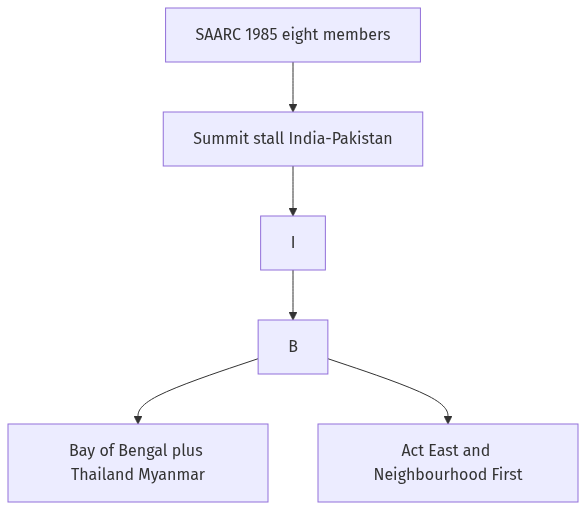
SAARC is a South Asian organisation including Pakistan; BIMSTEC is a Bay of Bengal grouping including Myanmar and Thailand. They share five members and a development vocabulary. They differ in geography, in Pakistan’s presence, and in SAARC’s summit freeze after 2016. BIMSTEC is therefore not a duplicate SAARC; it is a different regional canvas. India uses BIMSTEC to join Neighbourhood First with Act East without a Pakistan veto. SAARC still exists on paper; BIMSTEC is the platform that currently works.
Model answer
Copper italics in this answer — like this — are the key facts. Each one is unpacked in the Facts & figures rail.
Introduction
SAARC (1985) is a South Asian political-economic club of eight members, including Pakistan. BIMSTEC (1997) is a Bay of Bengal grouping of seven members that links South Asia to South-East Asia. They overlap in membership and in development language, but BIMSTEC is not a carbon copy of SAARC, which is why India has invested in it while SAARC summits have stalled.
Body
Similarities
- Both are regional organisations that talk connectivity, trade, energy, people-to-people contact, and disaster management rather than a NATO-style alliance.
- Both include India, Bangladesh, Bhutan, Nepal and Sri Lanka, so several files — transit, power trade, and coastal shipping — appear on both tables.
- Both have suffered from thin secretariats, slow free-trade implementation, and a gap between summit declarations and hard infrastructure.
- Both let smaller members multilateralise what would otherwise be asymmetric bilateral bargains with India.
Dissimilarities
- SAARC’s membership is the subcontinent plus Afghanistan; Pakistan’s presence has repeatedly frozen the SAARC summit process after cross-border terror and the 2016 cancellation of the Islamabad summit.
- BIMSTEC’s membership is Bangladesh, Bhutan, India, Myanmar, Nepal, Sri Lanka and Thailand: no Pakistan, and two South-East Asian coastal states, which changes the map from the Himalayas-plus-Pakistan to the Bay of Bengal.
- SAARC has a longer institutional memory (SAPTA/SAFTA, specialised centres); BIMSTEC adopted a Charter at the 2022 Colombo summit, which is a later, tighter legal identity.
- BIMSTEC’s agenda is physically maritime and multimodal (Kaladan, trilateral highway, coastal shipping); SAARC’s political centre of gravity was always India–Pakistan.
Not “parallel” in the sense of a duplicate SAARC
- A parallel organisation would be the same theatre with a different letterhead. BIMSTEC is a different theatre that happens to share five members with SAARC.
- India can work BIMSTEC without a Pakistan veto; that is the operational difference that makes the “SAARC minus Pakistan” shorthand tempting and still slightly wrong, because Myanmar and Thailand are not SAARC states.
- SAARC is not legally dead; it is politically inert at the summit level. BIMSTEC is the working platform, not a formal repeal of SAARC.
How BIMSTEC serves Indian foreign policy
- It is an instrument of Neighbourhood First plus Act East: the north-east’s access to the sea and to Thailand runs through BIMSTEC geography.
- It offers a forum for energy grids, disaster response, and security dialogue in the Bay without waiting for SAARC consensus.
- It balances extra-regional influence in the Bay by thickening India’s own regional public goods — shipping, power, and humanitarian assistance — with willing partners.
- It does not replace the Quad or ASEAN-centric diplomacy; it fills the subregional gap that SAARC no longer fills.
Flow diagram
Conclusion
BIMSTEC is similar to SAARC in development aims and in overlapping membership, but it is not a parallel SAARC: different map, no Pakistan veto, and a Bay of Bengal–ASEAN hinge. For India it is the usable regional tool while SAARC remains blocked.
Quick related
Students also ask
-
Critically examine the aims and objectives of SCO. what importance does it hold for India.
Next question on this syllabus topic (2021 · Q19). View answer →
-
Is Pakistan a BIMSTEC member?
No. That absence is a principal reason India can still convene BIMSTEC when SAARC summits cannot meet.
-
Does using BIMSTEC abolish SAARC?
No. SAARC remains the South Asian charter organisation. BIMSTEC is the grouping India can currently operationalise.
Same topic · past papers
UPSC has asked this before
These previous-year questions sit on the same topic. Open one to practise the earlier ask.
More from this topic
Q10 · UPSC Mains 2026 · GS II · 10 marks · Solution
"BRICS acts as a powerful counterweight in global governance, actively amplifying the voice and influence of the Global South." Explain the role of BRICS in projecting itself as an alternative to other groupings.
Bilateral and Regional Groupings
• BRICS acts as a major geopolitical platform challenging Western-dominated global governance to champion the Global South. • The New Development Bank (NDB) offers infrastructure funding without the strict conditions of the IMF or World Bank. • The Contingent Reserve Arrangement (CRA) provides a mutual financial safety net during balance of payment crises. • Promoting local currency trade settlements helps member states reduce their heavy dependency on the US Dollar. • The grouping pushes for UN Security Council expansion to give permanent representation to emerging economies. • It firmly opposes unilateral sanctions and protectionism, advocating instead for inclusive, WTO-centric trade rules. • Balancing internal differences and maintaining strategic autonomy are key to its future success in a multipolar world.
Q9 · UPSC Mains 2026 · GS II · 10 marks · Solution
"IPMDA (Indo-Pacific Partnership for Maritime Domain Awareness) bridges the gap between India's SAGAR (Security and Growth for All in the Region) vision and the Quad's collective Indo-Pacific strategy." Make a critical assessment of the statement focusing on IPMDA.
Bilateral and Regional Groupings
• Launched at the 2022 Quad Tokyo Summit, IPMDA provides a near-real-time maritime picture across the Indo-Pacific. • It directly links India’s SAGAR vision of regional security and growth with the Quad’s free and open Indo-Pacific strategy. • The initiative utilizes commercial satellite tracking and radio frequency data to monitor un-transpondered or 'dark' shipping. • It empowers smaller island nations against illegal, unreported, and unregulated (IUU) fishing by connecting regional information fusion centres. • Key challenges include heavy reliance on US-led funding and potential institutional overlaps with existing bodies like Gurugram's IFC-IOR. • Long-term success depends on equitable burden-sharing, smooth data integration, and respect for ASEAN centrality in regional security.
Q9 · UPSC Mains 2023 · GS II · 10 marks · Solution
'Virus of Conflict is affecting the functioning of the SCO'. In the light of the above statement point out the role of India in mitigating problems.
Bilateral and Regional Groupings
The SCO is consensus-based, so India–China LAC tension and India–Pakistan terror disputes stall it. Russia–Ukraine and expansion add further strain among members. India mitigates by keeping channels, chairing practical 2023 cooperation, and putting counter-terrorism on the agenda. It will not treat Jammu and Kashmir as an SCO bilateral dispute. Full political settlement of LAC or Pakistan issues will not come from the SCO itself.