
Revision summary
Sulh-i-kul meant a public peace that did not rest only on Islamic juristic privilege. Akbar abolished jizya, married Rajput houses, and opened the Ibadat Khana to several faiths. Din-i-Ilahi was a small court discipleship, not a popular religion. Abu’l Fazl praised the experiment; Badauni condemned it. The policy was both spiritual search and the need for a composite imperial elite. Orthodoxy and later reigns show the limits of that syncretism.
Model answer
Copper italics in this answer — like this — are the key facts. Each one is unpacked in the Facts & figures rail.
Introduction
Akbar’s religious policy was not a modern textbook of secularism. It was a Mughal answer to ruling a Hindu-majority empire with a Muslim court. Syncretism here means drawing Rajput blood, Hindu ritual, Sufi language, and a personal quest into one imperial peace. The Persian name for that peace was sulh-i-kul, peace with all.
Body
Sulh-i-kul in practice
- Sulh-i-kul: The court sought a public peace that did not rest only on Islamic juristic privilege.
- Pilgrim tax: Akbar ended this levy as an early signal of a wider imperial bargain.
- Jizya, 1564: Abolition of the poll tax on non-Muslims widened the base of imperial loyalty.
- Rajput marriage: Alliances with houses such as Amber made Hindu kin partners of the Timurid state.
- Mansab and office: Rajput nobles could rise in rank without converting to Islam.
- Temple grants: Patronage continued even while the emperor sat in a mosque.
- Ibadat Khana: At Fatehpur Sikri, Sunni, Shia, Jesuit, Hindu, Jain, and Zoroastrian voices debated before the emperor.
- Abu’l Fazl: The Akbarnama and Ain-i-Akbari framed the king as a just light, not a sectarian captain.
- Razmnama: The Persian court version of the Mahabharata showed culture as part of the same project.
- Din-i-Ilahi: A small imperial discipleship around Akbar used sun veneration, dietary rules, and loyalty, not a mass church.
- Birbal and Badauni: One courtier is linked with the circle; the conservative chronicler condemned the experiment.
Limits and statecraft
- Orthodox pushback: Voices such as Badauni, and later Shaikh Ahmad Sirhindi, show that the ulama were never fully converted.
- War and force: Chittor and other campaigns prove that syncretism did not mean a soft empire in every field.
- Uneven practice: Local officers could still harm temples even when the centre spoke of peace.
- Statecraft need: Rajput cavalry and a reputation for justice were political needs, not only spiritual ones.
- Not mass conversion: Most nobles stayed outside Din-i-Ilahi, so the cult was narrow.
- Later Mughals: Not every successor walked the same road, which shows the policy was personal as well as structural.
- Exam verdict: Syncretism widened the elite and changed the centre’s public law, but it was also imperial management.
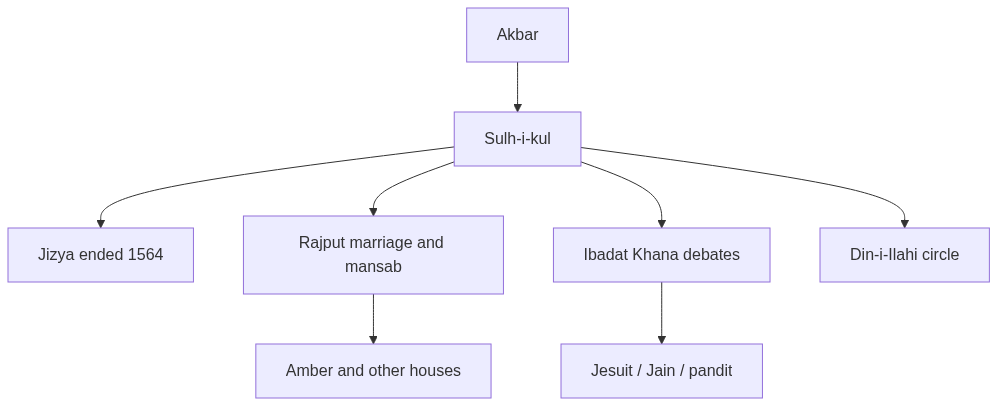
Flow diagram
Conclusion
- Akbar’s syncretism was sulh-i-kul in practice: no jizya, Rajput marriage, open debate, and a small imperial cult. It was faith and politics together. It did not convert the whole ulama. It still changed the Mughal state.
Quick related
Students also ask
-
'The sculptors filled the Chandella artform with resilient vigor and breadth of life.' Elucidate.
Next question on this syllabus topic (2025 · Q3). View answer →
-
Was Din-i-Ilahi a new world religion?
No. It was a tiny imperial order around Akbar’s person. Most of the empire never joined it.
-
Did syncretism mean Akbar left Islam?
He remained a Muslim emperor who stretched practice. Hostile chroniclers said he had left the faith. The state still used Islamic titles and coin.
More from this topic
Q11 · UPSC Mains 2026 · GS I · 15 marks · Solution
Vijayanagara architecture exemplifies the amalgamation of past traditions with contemporary practices. Elucidate with examples.
Indian Heritage and Culture
• The Vijayanagara architectural style (14th–17th centuries) brilliantly synthesized classical Dravidian traditions with contemporary Deccan innovations. • It preserved grand spatial layouts, towering gopurams, and enclosed prakaras inspired by earlier Chola and Pandya idioms. • Sacred centers maintained canonical sanctum alignments while expanding peripheral structures to encourage greater public participation. • Secular buildings, such as the Lotus Mahal and Elephant Stables, integrated Islamic arched vaults and domes. • Builders utilized locally available hard granite, shifting ornamentation techniques toward bold, deep-relief stone carving. • Innovative structural typologies included multi-shafted composite pillars featuring rearing yalis, horse riders, and hanging brackets. • The Vittalaswami Temple at Hampi showcased pioneering acoustic engineering through famous resonant musical pillars.
Q1 · UPSC Mains 2026 · GS I · 10 marks · Solution
Analyze the importance of Ashokan inscriptions for reconstructing Mauryan history.
Indian Heritage and Culture
Ashokan inscriptions serve as the bedrock for reconstructing Mauryan history by offering authentic, contemporaneous evidence directly from the emperor. Written primarily in Brahmi, Kharosthi, Aramaic, and Greek scripts, they illuminate Ashoka's administrative reach, socio-religious policies, and the moral framework of Dhamma. Distributed across the Indian subcontinent and beyond, these edicts document spatial boundaries, diplomatic ties with Hellenistic kingdoms, and the socio-economic milieu. They bridge the gap between literary accounts and archaeological finds, providing an invaluable indigenous chronology.
Q15 · UPSC Mains 2025 · GS I · 15 marks · Solution
How can Artificial Intelligence (AI) and drones be effectively used along with GIS and RS techniques in locational and areal planning?
Indian Heritage and Culture
Remote sensing supplies pictures of land and water; GIS stores them with administrative boundaries. Drones add cheap, repeatable local maps for disasters, utilities and village layouts. Artificial intelligence classifies pixels and can forecast flood, heat or sprawl on that GIS base. Indian platforms such as Bhuvan and Gati Shakti already try to combine these tools. Planning still needs ground checks and a public purpose, or the map only watches the poor. The four tools are a chain: locate, refresh, read, then choose the public use.