
Revision summary
The Cholas are remembered for the living temples at Thanjavur, Gangaikonda Cholapuram, and Darasuram. Rajaraja I and Rajendra I used the granite vimana as a royal and sacred statement. Lost-wax bronzes, especially Nataraja and processional icons, are the other half of that achievement. Painting and inscriptions show the temple as court, archive, and cult. The praise is fair on artistic quality. It is incomplete if navy, irrigation, and agrarian order are left out. Later builders enlarged the Dravida form. The Chola high point remains the imperial vimana and the bronze.
Model answer
Copper italics in this answer — like this — are the key facts. Each one is unpacked in the Facts & figures rail.
Introduction
The Chola dynasty of the Tamil country, especially under Rajaraja I and Rajendra I, is remembered in India for large stone temples and bronze images. Those kings built temples that are still used for worship. Their sculptors made the Nataraja bronze that is now widely known. The same state also kept a navy, a land-revenue system, and a ritual form of kingship. Pride in Chola art is justified. A complete comment must also name the political and economic power that paid for that art.
Body
Imperial temples as state and stone
The Brihadisvara temple at Thanjavur was built by Rajaraja I. It is a granite Dravida temple with a tall vimana, a large Shiva image, and walls that still hold painting and inscriptions of court life. Gangaikonda Cholapuram was Rajendra’s new capital after his Ganga expedition. He built a second great linga shrine there. Airavatesvara at Darasuram, built under a later Chola, is smaller and more finely carved. Together these three are the Great Living Chola Temples, a UNESCO set, because worship has continued in them. The temple was also a political building. It held treasure, staged public ritual, and showed the king’s claim to cosmic order. The Dravida form of a storeyed vimana, an enclosed prakara, and later gateway growth is taught in these courtyards.
- Thanjavur: The temple shows large scale, axial planning, and a royal cult of Rajarajesvara.
- Gangaikonda: Military success in the north was marked by a second sacred capital.
- Darasuram: Later Chola work refined the earlier height and mass of Thanjavur.
Bronze, painting and processional images
Chola bronzes were made by the lost-wax (cire perdue) method. They are the other half of the artistic achievement. The Nataraja, the processional utsava murti, and the Uma-Maheshvara groups were meant to be carried in festival streets. They were not meant only to sit in a garbhagriha. This was art used in public religion. Murals in the Thanjavur circumambulatory, where they survive, and temple jewellery complete the same programme. Stone sculpture of dvarapalas, narrative panels, and portraits of donors is strong. It is less erotic than Khajuraho. The Chola wall is more hierarchical and dynastic.
- Lost-wax icons: Portable metal images served a mobile bhakti public.
- Nataraja: Chola-period bronzes fixed Tamil Shaiva thought in metal in a lasting form.
- Painting and inscription: The temple recorded land gifts, dance, and court life.
How far the praise is complete
The comment is fair on quality. Few Indian dynasties left a sacred landscape that is still so fully in use. It is incomplete as history. Chola pride also rests on the navy in the Bay of Bengal, the Sri Lanka and Srivijaya campaigns, irrigation of the Kaveri delta, and a brahmadeya–nagaram agrarian order. Art was the visible surplus of that order. Later Vijayanagara gopurams grew larger than Chola gateways. Pallava Mamallapuram had already shown how to cut stone. The Cholas stand at a high point in a longer South Indian line. They did not invent temple building in a vacuum.
- Not only art: Water, war, and temple urbanism funded the vimana.
- Living continuity: Pride survives because worship continued.
- Balanced comment: The stone and bronze deserve praise. The state that paid for them should also be named.
The sentence in the question is therefore a right emphasis for GS art history. It is only a partial portrait of the Chola century.
Flow diagram
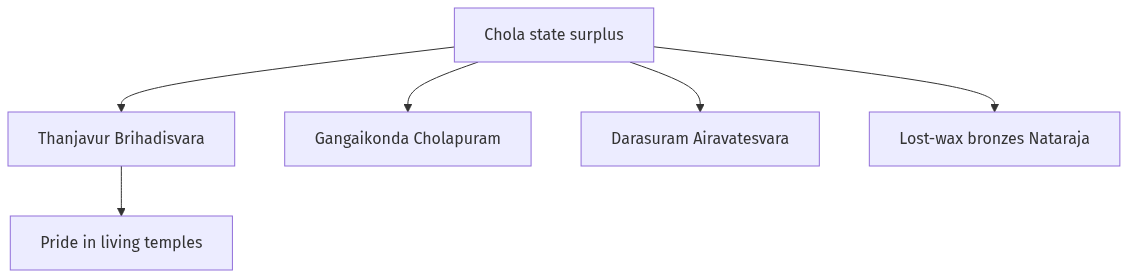
Conclusion
The great Cholas deserve the pride attached to Thanjavur, Gangaikonda Cholapuram, Darasuram, and the bronzes. Those works are among India’s highest temple achievements. They were also paid for by a delta empire. A full account keeps both the Nataraja image and the Kaveri agrarian base.
Quick related
Students also ask
-
What are the main features of Vedic society and religion? Do you think some of the features are still prevailing in Indian society?
Next question on this syllabus topic (2023 · Q11). View answer →
-
Are Chola temples only architecture answers?
They are also political and economic documents: inscriptions record land, labour and royal gifts.
-
Did the Cholas invent Nataraja?
Shaiva dance theology is older. The Chola bronze canon fixed the image the world now treats as classic.
Same topic · past papers
UPSC has asked this before
These previous-year questions sit on the same topic. Open one to practise the earlier ask.
More from this topic
Q11 · UPSC Mains 2026 · GS I · 15 marks · Solution
Vijayanagara architecture exemplifies the amalgamation of past traditions with contemporary practices. Elucidate with examples.
Indian Heritage and Culture
• The Vijayanagara architectural style (14th–17th centuries) brilliantly synthesized classical Dravidian traditions with contemporary Deccan innovations. • It preserved grand spatial layouts, towering gopurams, and enclosed prakaras inspired by earlier Chola and Pandya idioms. • Sacred centers maintained canonical sanctum alignments while expanding peripheral structures to encourage greater public participation. • Secular buildings, such as the Lotus Mahal and Elephant Stables, integrated Islamic arched vaults and domes. • Builders utilized locally available hard granite, shifting ornamentation techniques toward bold, deep-relief stone carving. • Innovative structural typologies included multi-shafted composite pillars featuring rearing yalis, horse riders, and hanging brackets. • The Vittalaswami Temple at Hampi showcased pioneering acoustic engineering through famous resonant musical pillars.
Q1 · UPSC Mains 2026 · GS I · 10 marks · Solution
Analyze the importance of Ashokan inscriptions for reconstructing Mauryan history.
Indian Heritage and Culture
Ashokan inscriptions serve as the bedrock for reconstructing Mauryan history by offering authentic, contemporaneous evidence directly from the emperor. Written primarily in Brahmi, Kharosthi, Aramaic, and Greek scripts, they illuminate Ashoka's administrative reach, socio-religious policies, and the moral framework of Dhamma. Distributed across the Indian subcontinent and beyond, these edicts document spatial boundaries, diplomatic ties with Hellenistic kingdoms, and the socio-economic milieu. They bridge the gap between literary accounts and archaeological finds, providing an invaluable indigenous chronology.
Q15 · UPSC Mains 2025 · GS I · 15 marks · Solution
How can Artificial Intelligence (AI) and drones be effectively used along with GIS and RS techniques in locational and areal planning?
Indian Heritage and Culture
Remote sensing supplies pictures of land and water; GIS stores them with administrative boundaries. Drones add cheap, repeatable local maps for disasters, utilities and village layouts. Artificial intelligence classifies pixels and can forecast flood, heat or sprawl on that GIS base. Indian platforms such as Bhuvan and Gati Shakti already try to combine these tools. Planning still needs ground checks and a public purpose, or the map only watches the poor. The four tools are a chain: locate, refresh, read, then choose the public use.