
Revision summary
Usable freshwater is a small and uneven share of global water. Farms, falling groundwater, climate shifts, and pollution cut availability. Poverty, tanker markets, and transboundary politics cut access. Virtual water in trade moves scarcity from one region to another. SDG 6 will fail unless drinking rights, irrigation reform, and clean rivers are treated as one task.
Model answer
Copper italics in this answer — like this — are the key facts. Each one is unpacked in the Facts & figures rail.
Introduction
The world is not running out of all water, but usable freshwater is uneven, overused, and often unsafe. The crisis is therefore about how much water nature supplies in the right place and who can actually drink, farm, and work with it.
Body
Crisis of availability
- Only a tiny share of Earth’s water is liquid freshwater in rivers, lakes, and shallow aquifers, and that share is concentrated in a few basins.
- Agriculture takes about seventy percent of global freshwater withdrawals, so food demand and thirsty crops such as paddy and sugarcane strain rivers.
- Groundwater is falling in intensively farmed plains such as north-west India, the North China Plain, and parts of the United States, because wells run faster than recharge.
- Climate change shifts snowmelt, intensifies drought, and makes monsoon and Mediterranean rainfall less reliable, which cuts the water that rivers used to deliver on time.
- Pollution from sewage, industry, and farm chemicals makes many rivers unfit, so water that exists on the map is not available as a resource.
Crisis of access
- Cities grow faster than pipes and treatment plants, so slums and peri-urban wards buy tanker water at a high price while gated colonies get treated supply.
- Rural women and the poorest households still walk for water where public taps, quality tests, and rights are weak.
- Transboundary rivers such as the Nile, Tigris–Euphrates, Mekong, and Indus create political scarcity even when the basin has flow.
- Virtual water in exported grain and meat moves water from dry regions to rich consumers, which hides scarcity in trade.
Why the two crises meet
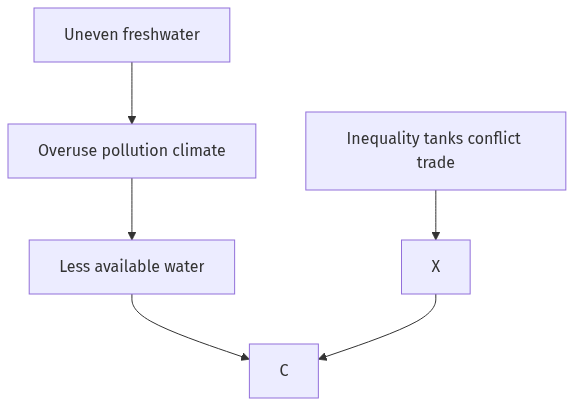
- SDG 6 asks for water and sanitation for all, but under-priced irrigation, leaky utilities, and unequal land power keep both supply and access broken.
- Conflict, displacement, and weak local government turn a dry year into a human crisis.
Way forward
- Price irrigation and urban water so waste falls, while protecting a basic drinking quota for the poor.
- Recharge aquifers, reuse treated wastewater, and share basin data across borders.
- Treat sanitation and pollution control as part of freshwater policy, not as a later add-on.
Flow diagram
Conclusion
Freshwater is in crisis because nature’s supply is uneven and because farms, cities, and politics waste or lock what remains. Availability and access must be fixed together through conservation, fair pricing, and clean supply.
Quick related
Students also ask
-
Comment on the resource potentials of the long coastline of India and highlight the status of natural hazard preparedness in these areas.
Next question on this syllabus topic (2023 · Q14). View answer →
-
Is the world running out of water in a physical sense?
The planet still has water. The crisis is usable freshwater in the right place, at the right quality, for people who can reach it.
-
Why separate availability from access?
A full aquifer does not help a slum without a tap. A pipe does not help if the river is poisoned or dry.
Same topic · past papers
UPSC has asked this before
These previous-year questions sit on the same topic. Open one to practise the earlier ask.
-
2026 · Q7 · GS I · 10 marks
"Water resources are both an asset and a source of conflict in South Asia." Examine this statement giving examples. -
2020 · Q6 · GS I · 10 marks
How will the melting of Himalayan glaciers have a far- reaching impact on the water resources of India? -
2020 · Q17 · GS I · 15 marks
Examine the status of forest resources of India and its resultant impact on climate change. -
2016 · Q15 · GS I · 12 marks
The effective management of land and water resources will drastically reduce the human miseries. Explain. -
2015 · Q16 · GS I · 12 marks
India is well endowed with fresh water resources. Critically examine why it still suffers from water scarcity.
More from this topic
Q7 · UPSC Mains 2026 · GS I · 10 marks · Solution
"Water resources are both an asset and a source of conflict in South Asia." Examine this statement giving examples.
Natural Resources and Industries
• South Asian river systems drive regional economies through massive agricultural irrigation and vital hydropower generation. • Rapid population growth and climate change have increasingly turned these shared lifelines into geopolitical flashpoints. • India-Pakistan water friction persists through disputes over run-of-the-river hydroelectric projects under the Indus Waters Treaty. • Unresolved bilateral deadlocks, such as the Teesta river sharing impasse, highlight complex domestic political challenges. • Upstream Chinese dam construction on the Brahmaputra creates severe ecological and strategic anxiety for downstream nations. • Effective regional stability requires moving away from zero-sum basin nationalism toward cooperative hydro-diplomacy. • Institutional frameworks must treat shared river basins as common ecological trusts to ensure sustainable regional development.
Q14 · UPSC Mains 2025 · GS I · 15 marks · Solution
Give a geographical explanation of the distribution of off-shore oil reserves of the world. How are they different from the on-shore occurrences of oil reserves?
Natural Resources and Industries
Offshore oil lies in sedimentary traps on continental shelves and slopes. Major provinces include the Persian Gulf, North Sea, Gulf of Mexico, West Africa, Brazil's pre-salt, and India's Mumbai High and KG basin. The geology is kin to onshore basins; the difference is water depth, platforms and spill behaviour. Onshore fields are usually cheaper to develop and easier for a state to hold physically. Disputed seas turn offshore oil into a geopolitical resource, not only a geological one. Deep water is capital-heavy, so price slumps hit it first.
Q14 · UPSC Mains 2023 · GS I · 15 marks · Solution
Comment on the resource potentials of the long coastline of India and highlight the status of natural hazard preparedness in these areas.
Natural Resources and Industries
India’s coast and EEZ hold fish, ports, offshore energy, beach minerals, salt, and tourism. Cyclones, the 2004 tsunami, surge, and erosion are the main natural hazards. The Disaster Management Act, 2005, IMD, INCOIS, and cyclone shelters have lowered death counts. CRZ rules and mangrove buffers are unevenly enforced. Ports and fishers need the same map of hazard before the next surge.