
Revision summary
Gandhi’s Wardha scheme of 1937 put mother tongue, craft, and character at the centre of schooling. Tagore’s Santiniketan and Visva-Bharati put nature, art, and world learning at the centre. Gandhi’s nationalism was mass satyagraha and village swaraj. Tagore’s nationalism was freedom without the cult of the nation. Both opposed colonial rule; they split on industrial civilisation and on how open India should stay.
Model answer
Copper italics in this answer — like this — are the key facts. Each one is unpacked in the Facts & figures rail.
Introduction
Gandhi and Tagore both rejected colonial schooling that produced clerks, and both wanted a free India. They differed on what a school should teach and on how far the nation should close itself against the world.
Body
Education
- Gandhi’s Nai Talim, stated at Wardha in 1937, made the mother tongue, a productive craft, and character the centre of the school.
- He wanted learning to serve the village, the spinning wheel, and swaraj as self-rule in daily work, not only in exams.
- Tagore founded Santiniketan and Visva-Bharati in 1921 as an open ashram of art, nature, and world literature rather than a craft mill.
- He criticised rote, fear, and the prison of the classroom, and he wanted the child to meet many cultures, not only the local trade.
- Gandhi feared that English and city colleges would cut the mass of Indians from their own life; Tagore feared that a narrow craft school would cut India from science and the world.
Nationalism
- Gandhi’s nationalism was mass satyagraha, the constructive programme, khadi, and Hind Swaraj (1909), which treated modern industrial civilisation as a moral problem.
- He accepted the nation as a field of duty and used Hindu–Muslim unity and village India as its social base.
- Tagore warned against the cult of the nation in lectures such as Nationalism (1917) and in his debate with Gandhi after Non-Cooperation.
- He opposed the burning of foreign cloth when it became hatred of the foreigner, and he wanted India to be a meeting place of civilisations.
- Both wanted freedom from British rule; Gandhi organised the nation as a moral army, while Tagore wanted freedom without making the nation an idol.
How the two differences join
- A craft-centred school fitted Gandhi’s village nation; a world university fitted Tagore’s universal humanism.
- The difference is of emphasis, not of loyalty, because both criticised colonial power and both loved the Indian poor.
Flow diagram
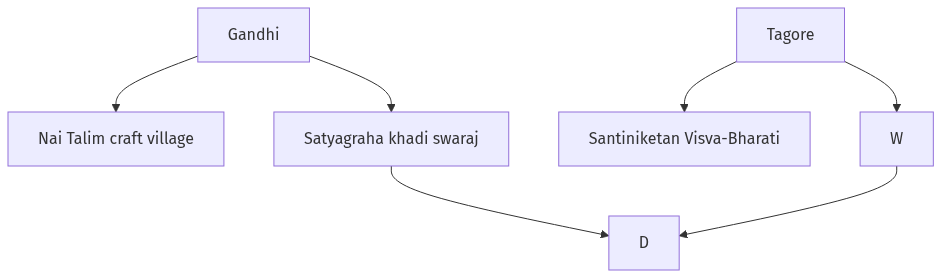
Conclusion
Gandhi tied education to craft, village, and mass swaraj; Tagore tied it to art, freedom, and the world. Indian public life still needs both the constructive village programme and the warning against a closed nationalism.
Quick related
Students also ask
-
To what extent did the role of the moderates prepare a base for the wider freedom movement? Comment.
Next question on this syllabus topic (2021 · Q11). View answer →
-
Did Tagore oppose Indian independence?
No. He wanted political freedom. He opposed a nationalism that taught hatred and closed the mind.
-
Did Gandhi reject all modern knowledge?
He rejected schooling that produced clerks and dependence. He still used print, law, and organisation for satyagraha.
Same topic · past papers
UPSC has asked this before
These previous-year questions sit on the same topic. Open one to practise the earlier ask.
More from this topic
Q3 · UPSC Mains 2026 · GS I · 10 marks · Solution
The significance of the Gandhian movements lay in the masses they mobilized. Elucidate.
The Freedom Struggle
• Shifted the national movement from elite-led constitutionalism to grassroots mass mobilization. • Integrated peasants and rural populations through indigenous symbols like khadi and the charkha. • Engaged women extensively in direct actions such as salt law violations and liquor shop picketing. • Linked the anti-imperialist struggle with social reform, focusing on the upliftment of marginalized classes. • Transformed ordinary Indians from passive colonial subjects into active, politically conscious citizens. • Laid the foundational socio-political bedrock for a resilient and inclusive post-independence democracy.
Q12 · UPSC Mains 2025 · GS I · 15 marks · Solution
Trace India's consolidation process during early phase of independence in terms of polity, economy, education and international relations.
The Freedom Struggle
Princely integration and the 1950 Constitution, with the first general election, built the political union. The Planning Commission and the First Plan set a mixed, public-investment economy after Partition's economic cut. Radhakrishnan and Mudaliar commissions and IIT Kharagpur began a national education architecture. Non-alignment, Panchsheel and Bandung defined an independent foreign policy while Kashmir stayed live. Consolidation was simultaneous on all four fronts. Land, food and literacy remained unfinished, so the process was real and incomplete.
Q3 · UPSC Mains 2024 · GS I · 10 marks · Solution
What were the events that led to the Quit India Movement? Point out its results.
The Freedom Struggle
Britain took India into World War II without Congress consent, and the provincial ministries resigned. The Cripps Mission of 1942 offered post-war status without a real wartime national government. The AICC in Bombay on 8 August 1942 launched Quit India, and leaders were jailed the next day. Mass action, sabotage and local parallel governments followed, and then heavy repression followed those actions. The Muslim League gained organisational space, and the government’s claim to quiet rule did not recover. Independence in 1947 had many causes. 1942 was the mass proof that delay had a political price.