
Revision summary
Tropical staple crops already sit near heat and rainfall limits, so extra warming cuts yields. Floods, droughts, and glacier-fed irrigation loss make supply unstable. The poor lose access when local prices rise, even if global trade still moves grain. Heat, pests, and disease reduce the nutrition that food can deliver. Women, rainfed farmers, and small islands carry the first losses.
Model answer
Copper italics in this answer — like this — are the key facts. Each one is unpacked in the Facts & figures rail.
Introduction
Tropical countries already live close to heat and rainfall limits for rice, maize, millet, and fish. Climate change hits food security there through failed harvests, higher prices, and weaker nutrition, not only through a rise in global mean temperature.
Body
Availability of food
- Higher night temperatures and heatwaves reduce yields of rice and maize in large parts of South Asia, sub-Saharan Africa, and tropical Latin America.
- Rainfall becomes more erratic, so drought in the Sahel or the Indian drylands and floods in Bangladesh or the Mekong destroy standing crops in the same decade.
- Mountain ice loss in the Andes and the Himalaya threatens dry-season irrigation that tropical farmers use for a second crop.
- Warm seas bleach coral and shift fish, which cuts protein for coastal communities from the Pacific islands to the Bay of Bengal.
Access, utilisation, and stability
- Crop failure raises local prices, so the poor in tropical cities spend more of their wage on grain even when global stocks exist.
- Pests such as locusts and fall armyworm spread in warmer weather, which raises the cost of protection for smallholders.
- Heat and humidity increase food spoilage and water-borne disease, so calories on the plate do not become nutrition in the body.
- Small island and least-developed tropical states have thin storage, insurance, and trade buffers, so one cyclone can create a food emergency.
Who is hit hardest
- Women farmers, rainfed households, and pastoralists have the least irrigation, credit, and land title, so they absorb the first shock.
- Export plantations may still ship coffee or cocoa while local staple plots fail, which splits national accounts from household hunger.
Way forward
- Expand heat-tolerant and short-duration varieties through public research such as IRRI and national systems like ICAR.
- Combine irrigation, crop insurance, and social grain stocks so access does not collapse when the monsoon fails.
- Protect mangroves, soils, and small fisheries because they are food systems, not only environmental extras.
Flow diagram
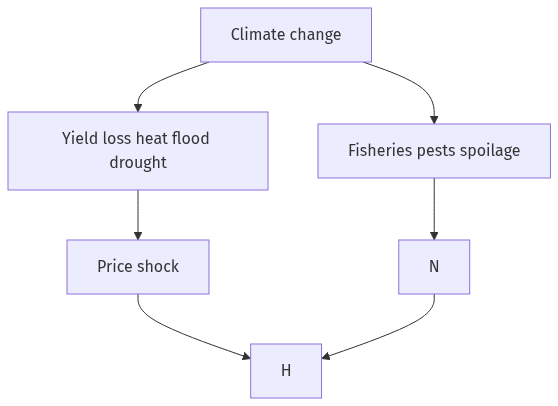
Conclusion
In the tropics, climate change cuts harvests, raises prices, and spoils nutrition at the same time. Food security policy has to treat seeds, water, storage, and social protection as one climate task.
Quick related
Students also ask
-
Why is the South-West monsoon called 'Purvaiya' (easterly) in Bhojpur Region? How has this directional seasonal wind system influenced the cultural ethos of the region?
Next question on this syllabus topic (2023 · Q7). View answer →
-
Is food insecurity in the tropics only a production problem?
No. Prices, storage, health, and gender decide access and utilisation even when some grain is still grown.
-
Do tropical countries face the same climate food risk?
They share heat and monsoon or trade-wind climates, but irrigation, income, and governance make the shock unequal.
Same topic · past papers
UPSC has asked this before
These previous-year questions sit on the same topic. Open one to practise the earlier ask.
-
2025 · Q4 · GS I · 10 marks
How are climate change and the sea level rise affecting the very existence of many island nations? Discuss with examples. -
2020 · Q17 · GS I · 15 marks
Examine the status of forest resources of India and its resultant impact on climate change.
More from this topic
Q15 · UPSC Mains 2026 · GS I · 15 marks · Solution
Analyze the role of satellite-based technologies in achieving climate-smart agriculture and food security in India.
Geophysical Phenomena
Satellite-based technologies are transforming Indian agriculture from a monsoon-dependent gamble into a precision
Q4 · UPSC Mains 2026 · GS I · 10 marks · Solution
What is the Fujiwhara effect? Explain its impact on the movement and intensity of tropical cyclones.
Geophysical Phenomena
The Fujiwhara effect occurs when two neighboring tropical cyclones rotate cyclonically around a common center due to interacting vortex dynamics. It alters the standard movement of cyclones, causing trajectories to deviate, merge, or orbit each other. In terms of intensity, the interaction can suppress the weaker storm while potentially energizing the stronger one. Understanding this phenomenon is vital for improving cyclone track forecasting in regions like the Northwest Pacific and the Bay of Bengal. Meteorological agencies use advanced numerical models to predict these complex binary cyclone interactions. Proper tracking mitigates coastal disaster risks by providing timely warnings for erratic landfall paths.
Q7 · UPSC Mains 2025 · GS I · 10 marks · Solution
What are Tsunamis? How and where are they formed? What are their consequences? Explain with examples.
Geophysical Phenomena
A tsunami is a train of long ocean waves caused by sudden motion of the seafloor. Most begin on subduction megathrusts; landslides and volcanoes can also trigger them. In deep water they are fast and low; near shore they flood. The 2004 Sumatra quake devastated the Andamans, Tamil Nadu, Sri Lanka, the Maldives and coasts as far as Africa. Warning systems work only with drills, and mangroves take some of the blow. The Makran zone remains a local tsunami source for India’s west coast.