
Revision summary
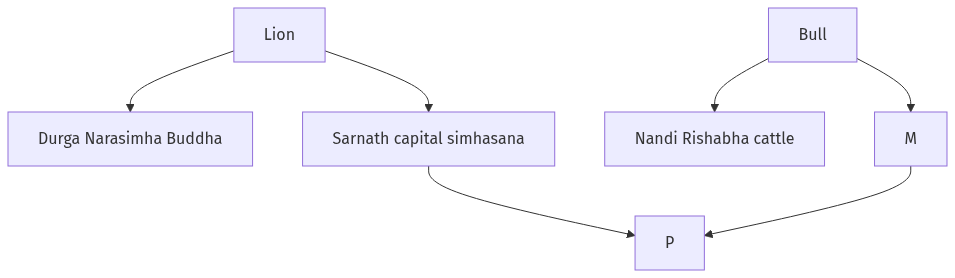
The lion is Durga’s mount, Narasimha’s form, and the Buddha as Shakyasimha. The bull is Nandi, Jaina Rishabha, and an older emblem of cattle wealth. Indus seals and Ashokan lion and bull capitals fix both in early art. Temples use simhasana, vyala, and the Nandi mandapa as built theology. The Republic’s emblem continues the architectural lion as a public sign.
Model answer
Copper italics in this answer — like this — are the key facts. Each one is unpacked in the Facts & figures rail.
Introduction
The lion and the bull are two of India’s oldest royal and sacred animals. They mark power, dharma, and devotion from Indus seals to Ashoka’s capitals and to the Nandi mandapa of the Hindu temple.
Body
Mythology
- The lion is the vahana of Durga and the man-lion Narasimha of Vaishnava myth, so it stands for the goddess’s force and for Vishnu’s terrible protection of the devotee.
- The Buddha is Shakyasimha, the lion of the Shakya clan, which is why the lion roar of the dharma is a Buddhist figure of speech and of throne.
- The bull is Nandi, Siva’s vahana and gate-keeper, and Rishabha in Jaina memory; it also recalls Vedic cattle wealth and the uncastrated strength of dharma.
- Together they pair forest kingship and pastoral-agrarian strength, which Indian myth needed as much as river and mountain gods.
Art
- Indus seals show powerful bulls and related bovids, which already treat the animal as a ritual and economic emblem, even where the later Hindu names are absent.
- Mauryan polish gives the Sarnath lion capital and the Rampurva bull capital, so early historic art made both beasts into imperial standards.
- Buddhist railings and later Hindu sculpture use vyala-lions, simha-vyala, and recumbent Nandi as a visual grammar of the sacred compound.
- Chola and later bronzes and stone Nandis, and Durga-slaying-the-buffalo panels that still keep the lion beside the goddess, keep the pair in living worship.
Architecture
- Ashokan pillars used the lion as a capital that the Republic later took as the State Emblem, so the architectural lion became a national sign.
- Temple gateways, thrones (simhasana), and pillar bases use lions as load-bearing and apotropaic figures that warn as well as decorate.
- Separate Nandi mandapas face the linga on an axis, which is architecture as theology: the bull hears and waits.
- Step-wells, forts, and palace brackets repeat lion and mythical yali forms, so the beasts left the temple for court building as well.
Shared political meaning
- Kings sat on lion thrones and issued coins with bulls, as on some Gupta and later types, which made the animals a language of legitimate force.
- The pair therefore works at three levels: story, image, and built space, all teaching who may rule and who may worship.
Flow diagram
Conclusion
The lion signifies royal and goddess power and the Buddha’s roar; the bull signifies Siva, cattle wealth, and steadfast hearing. Indian art and architecture placed both at capitals, thrones, and temple doors, which is why they still read as sacred public signs.
Quick related
Students also ask
-
Evaluate the nature of the Bhakti Literature and its contribution to Indian culture.
Next question on this syllabus topic (2021 · Q1). View answer →
-
Is the Ashokan lion a Hindu Durga lion?
It is a Mauryan Buddhist-imperial sign. Later Hindu use of the lion is related in symbol, not the same cult.
-
Why is Nandi always in front of the linga?
The bull is the hearing devotee and vahana. The axis teaches approach, not a zoo display.
Same topic · past papers
UPSC has asked this before
These previous-year questions sit on the same topic. Open one to practise the earlier ask.
-
2026 · Q11 · GS I · 15 marks
Vijayanagara architecture exemplifies the amalgamation of past traditions with contemporary practices. Elucidate with examples. -
2025 · Q1 · GS I · 10 marks
Discuss the salient features of the Harappan architecture. -
2024 · Q11 · GS I · 15 marks
"Though the great Cholas are no more, yet their name is still remembered with great pride because of their highest achievements in the domain of art and architecture." Comment. -
2020 · Q1 · GS I · 10 marks
The rock-cut architecture represents one of the most important sources of our knowledge of early Indian art and history. Discuss. -
2015 · Q2 · GS I · 12 marks
Mesolithic rock cut architecture of India not only reflects the cultural life of the times but also a fine aesthetic sense comparable to modern painting. Critically evaluate this comment.
More from this topic
Q11 · UPSC Mains 2026 · GS I · 15 marks · Solution
Vijayanagara architecture exemplifies the amalgamation of past traditions with contemporary practices. Elucidate with examples.
Indian Heritage and Culture
• The Vijayanagara architectural style (14th–17th centuries) brilliantly synthesized classical Dravidian traditions with contemporary Deccan innovations. • It preserved grand spatial layouts, towering gopurams, and enclosed prakaras inspired by earlier Chola and Pandya idioms. • Sacred centers maintained canonical sanctum alignments while expanding peripheral structures to encourage greater public participation. • Secular buildings, such as the Lotus Mahal and Elephant Stables, integrated Islamic arched vaults and domes. • Builders utilized locally available hard granite, shifting ornamentation techniques toward bold, deep-relief stone carving. • Innovative structural typologies included multi-shafted composite pillars featuring rearing yalis, horse riders, and hanging brackets. • The Vittalaswami Temple at Hampi showcased pioneering acoustic engineering through famous resonant musical pillars.
Q1 · UPSC Mains 2026 · GS I · 10 marks · Solution
Analyze the importance of Ashokan inscriptions for reconstructing Mauryan history.
Indian Heritage and Culture
Ashokan inscriptions serve as the bedrock for reconstructing Mauryan history by offering authentic, contemporaneous evidence directly from the emperor. Written primarily in Brahmi, Kharosthi, Aramaic, and Greek scripts, they illuminate Ashoka's administrative reach, socio-religious policies, and the moral framework of Dhamma. Distributed across the Indian subcontinent and beyond, these edicts document spatial boundaries, diplomatic ties with Hellenistic kingdoms, and the socio-economic milieu. They bridge the gap between literary accounts and archaeological finds, providing an invaluable indigenous chronology.
Q15 · UPSC Mains 2025 · GS I · 15 marks · Solution
How can Artificial Intelligence (AI) and drones be effectively used along with GIS and RS techniques in locational and areal planning?
Indian Heritage and Culture
Remote sensing supplies pictures of land and water; GIS stores them with administrative boundaries. Drones add cheap, repeatable local maps for disasters, utilities and village layouts. Artificial intelligence classifies pixels and can forecast flood, heat or sprawl on that GIS base. Indian platforms such as Bhuvan and Gati Shakti already try to combine these tools. Planning still needs ground checks and a public purpose, or the map only watches the poor. The four tools are a chain: locate, refresh, read, then choose the public use.