
Revision summary
Harmful unexamined custom does suppress reason and becomes obscurantism. Child marriage, honour violence, and ritual humiliation are exhibits. Craft, grove, and care customs can hold empirical knowledge. Article 51A(h) asks for scientific temper, not cultural demolition. Stand: partial agreement, reform the closed custom, keep the arguable one.
Model answer
Copper italics in this answer — like this — are the key facts. Each one is unpacked in the Facts & figures rail.
Introduction
Custom is inherited practice. Reason is public argument. When custom forbids evidence — witch hunts, child marriage, ritual humiliation — it becomes obscurantism. When custom carries diet, craft, and care, it is social memory. Agreement with the statement should be partial and sharp, not a war on all tradition.
Body
Where the charge holds
- Practices that punish questions — honour violence, khap bans on marriage, superstition as medicine — suppress reason and harm the body.
- Gendered custom has long blocked girls’ schooling and widow rights; reformers from Rammohan to Phule, Narayana Guru, and Ambedkar used reason and law against that obscurantism.
- Communal myth as history, and astrology as public policy, are tradition-talk used to avoid evidence.
Where the charge overreaches
- Not every custom is anti-reason. Panchayat water-sharing, sacred grove protection, and craft guilds can be empirical knowledge in another idiom.
- Blind modernism can itself be dogmatic. Scientific temper (Article 51A(h)) is a constitutional duty, not a licence to sneer at every festival.
- Living traditions reform from inside — bhakti critique, Sikh langar, Buddhist reason — which shows custom is not a sealed dark room.
How a republic should stand
- Agree that unexamined custom breeds obscurantism when it claims immunity from harm tests.
- Disagree that tradition as such is the enemy of reason. The enemy is authority that cannot be argued with.
- Tools: education, IPC and special laws against harmful practices, and reformers who speak the community’s language.
- Courts already balance Articles 25–26 with dignity and public order; that is reason disciplining custom without erasing religion.
Flow diagram
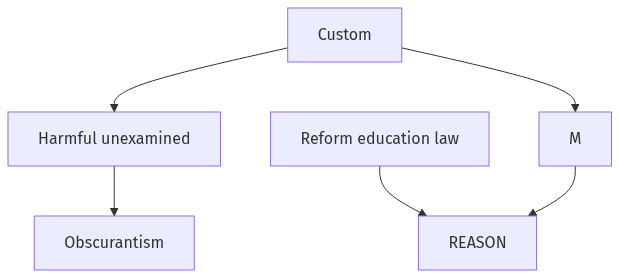
Conclusion
Agree that many customs have suppressed reason and produced obscurantism. Do not agree that tradition is only a darkener. Keep the practices that can face evidence; drop those that cannot. That is the constitutional middle.
Quick related
Students also ask
-
How have digital initiatives in India contributed to the functioning of the education system in the country? Elaborate your answer.
Next question on this syllabus topic (2020 · Q20). View answer →
-
Is all ritual obscurantist?
Ritual can be art and memory. It becomes obscurantism when it forbids evidence and inflicts harm.
-
Should the state abolish tradition?
The state should abolish harm. Communities should be free to keep non-harmful custom under the Constitution.
Same topic · past papers
UPSC has asked this before
These previous-year questions sit on the same topic. Open one to practise the earlier ask.
-
2026 · Q11 · GS I · 15 marks
Vijayanagara architecture exemplifies the amalgamation of past traditions with contemporary practices. Elucidate with examples. -
2015 · Q1 · GS I · 12 marks
The ancient civilization in Indian sub continent differed from those of Egypt, Mesopotamia and Greece in that its culture and traditions have been preserved without breakdown to the present day. Comment.
More from this topic
Q17 · UPSC Mains 2026 · GS I · 15 marks · Solution
Analyze the major drivers of human-induced land-use changes in India and their geographical consequences.
World's Physical Geography
India's land-use change is driven by agricultural intensification, urban growth, infrastructure, mining, plantations, tourism and livelihood shifts. These changes support food, connectivity and jobs, but they also disturb hydrology, soil, habitats, microclimates, hills, coasts and access to commons. Sustainable land governance must combine mapping, carrying-capacity assessment and local participation.
Q16 · UPSC Mains 2026 · GS I · 15 marks · Solution
"The centre of global trade is gradually shifting from the Atlantic region to the Indo-Pacific region." Examine this statement.
World's Physical Geography
Global trade’s centre of gravity is moving towards the Indo-Pacific because manufacturing, consumption, energy shipping and new tech rules are concentrating between the Indian and Pacific Oceans. China-plus-one, ASEAN growth, India’s market, Malacca–Hormuz lanes, RCEP/IPEF and semiconductor corridors drive the trend. The Atlantic still matters in finance and standards, so the change is gradual rebalancing. India gains only if ports, manufacturing and sea-lane security keep pace.
Q14 · UPSC Mains 2026 · GS I · 15 marks · Solution
Compare the Loo, Chinook and Foehn winds with respect to their regions of prevalence, their nature and climatic impacts.
World's Physical Geography
The Loo is a hot, dusty pre-monsoon wind of northwestern India and the Indo-Gangetic plains. Chinook and Foehn are warm, dry downslope winds of the Rockies and Alps, formed by adiabatic compression. Their impacts differ from Indian heat stress to snowmelt and mountain hazards.