
Revision summary
Chhattisgarh, Jharkhand, Uttarakhand (2000) and Telangana (2014) are the recent cases. Gains are closer administration, resource focus, and sometimes faster urban and service growth. Costs are bifurcation disputes, new capitals, and no automatic end to poverty in mineral belts. Telangana’s Hyderabad economy rose while Andhra Pradesh paid a reorganisation price. New states help the Indian economy only when fiscal capacity and asset-sharing are real.
Model answer
Copper italics in this answer — like this — are the key facts. Each one is unpacked in the Facts & figures rail.
Introduction
India created Chhattisgarh, Jharkhand, and Uttarakhand in 2000 and Telangana in 2014 after long regional demands. Smaller states can focus spending and identity, but they also split assets, raise capital costs, and do not automatically raise growth.
Body
Why new states were expected to help the economy
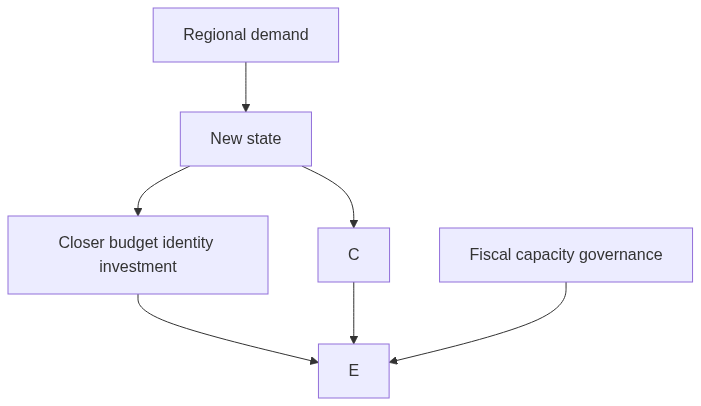
- A smaller state can put a capital, a secretariat, and a budget closer to a neglected belt, as Ranchi, Raipur, Dehradun, and Hyderabad were meant to do for plateau, forest, hill, and Telangana dryland economies.
- Resource-rich units such as Jharkhand and Chhattisgarh can, in principle, keep more mining and power policy attention than they received as hinterlands of Bihar and Madhya Pradesh.
- Political voice and local language administration can cut the cost of reaching the state, which is an economic gain if it speeds roads, schools, and land records.
- Competition among states for investment, after 1991, rewards units that can clear land and power faster; a new government sometimes uses that window.
What the recent record shows on the benefit side
- Uttarakhand’s hill services, tourism, and some industry along the plains belt grew with a dedicated government, though disaster and migration remain.
- Telangana after 2014 pushed IT, irrigation (including large lift schemes), and urban Hyderabad, which raised state GSDP even while Andhra Pradesh faced a capital and revenue shock.
- Chhattisgarh improved some human-development and paddy-procurement focus compared with its earlier status as a distant MP region.
Costs and limits for the national economy
- Bifurcation creates two secretariats, two high-court benches in practice, and disputes over water, power, cadres, and institutions, as Andhra Pradesh–Telangana showed after the Andhra Pradesh Reorganisation Act, 2014.
- New capitals and unplanned urban sprawl absorb public money that could have gone to villages.
- Jharkhand’s mineral wealth did not by itself end poverty or left-wing extremism; governance and leakages matter more than the map.
- Endless demands for further splits raise uncertainty for investors and can weaken fiscal federalism if many small states depend on Finance Commission transfers without a tax base.
- Article 3 lets Parliament form states; the economic test is capacity, not only identity.
Conditional view
- New states help when the parent state was too large to see a region, when the new unit has a viable tax and urban base, and when water and power are settled by law.
- They hurt when the split is only electoral, when the hill or forest unit lacks revenue, or when mineral rents are captured without local jobs.
Way forward
- Prefer administrative devolution, Sixth Schedule and district councils, and Finance Commission grants before another round of state-carving.
- Where a state is formed, lock asset-sharing, river boards, and a time-bound capital plan so the economy does not pay a permanent political premium.
Flow diagram
Conclusion
Recent new states have been beneficial where a neglected region gained a government and a growth engine, as in parts of Telangana and Uttarakhand. They are not a general economic law: split costs, water disputes, and weak mining governance can cancel the map change. The fair answer is conditional yes, not automatic yes.
Quick related
Students also ask
-
Mention core strategies for the transformation of aspirational districts in India and explain the nature of convergence, collaboration and competition for its success.
Next question on this syllabus topic (2018 · Q17). View answer →
-
Does a new state always raise growth?
No. A dedicated government can help, but capital costs, disputes, and weak institutions can wipe out the gain.
-
Is further splitting good for India?
Only if the unit is fiscally viable. Identity demand alone is not an economic argument.
More from this topic
Q17 · UPSC Mains 2026 · GS I · 15 marks · Solution
Analyze the major drivers of human-induced land-use changes in India and their geographical consequences.
World's Physical Geography
India's land-use change is driven by agricultural intensification, urban growth, infrastructure, mining, plantations, tourism and livelihood shifts. These changes support food, connectivity and jobs, but they also disturb hydrology, soil, habitats, microclimates, hills, coasts and access to commons. Sustainable land governance must combine mapping, carrying-capacity assessment and local participation.
Q16 · UPSC Mains 2026 · GS I · 15 marks · Solution
"The centre of global trade is gradually shifting from the Atlantic region to the Indo-Pacific region." Examine this statement.
World's Physical Geography
Global trade’s centre of gravity is moving towards the Indo-Pacific because manufacturing, consumption, energy shipping and new tech rules are concentrating between the Indian and Pacific Oceans. China-plus-one, ASEAN growth, India’s market, Malacca–Hormuz lanes, RCEP/IPEF and semiconductor corridors drive the trend. The Atlantic still matters in finance and standards, so the change is gradual rebalancing. India gains only if ports, manufacturing and sea-lane security keep pace.
Q14 · UPSC Mains 2026 · GS I · 15 marks · Solution
Compare the Loo, Chinook and Foehn winds with respect to their regions of prevalence, their nature and climatic impacts.
World's Physical Geography
The Loo is a hot, dusty pre-monsoon wind of northwestern India and the Indo-Gangetic plains. Chinook and Foehn are warm, dry downslope winds of the Rockies and Alps, formed by adiabatic compression. Their impacts differ from Indian heat stress to snowmelt and mountain hazards.