
Revision summary
Bengaluru, Hyderabad, Pune, Chennai, and Gurugram became IT hubs with software, BPO, and start-up jobs. Multiplier work in transport, food, and real estate widened employment beyond engineers. Women’s urban service work grew in these centres. New problems are sprawl, lake and groundwater stress, congestion, social dualism, and e-waste. The statement is substantiated: hubs hire, and they strain the city unless planning catches up.
Model answer
Copper italics in this answer — like this — are the key facts. Each one is unpacked in the Facts & figures rail.
Introduction
From the 1990s, Bengaluru, Hyderabad, Pune, Chennai, Gurugram, and Noida grew as information-technology hubs on the back of software exports, telecom, and campus colleges. They opened white-collar and allied jobs on a scale older mill towns did not. They also produced housing stress, water and traffic failure, and a dual city of campuses and informal edges.
Body
New avenues of employment
- Software services, business-process work, product start-ups, and global capability centres hired engineers, managers, and English-medium graduates who would earlier have waited for a scarce government or factory post.
- Multiplier jobs grew around campuses: drivers, security, housekeeping, food delivery, real estate, retail, and hotels, which absorbed migrants even when they were not ‘IT employees’.
- Women’s share in urban services rose in these hubs compared with heavy industry, which changed household income in cities such as Bengaluru and Hyderabad.
- Secondary centres—Pune, Chennai, Kochi, Jaipur, Bhubaneswar, and Chandigarh—spread some of the same employment beyond the first two southern hubs.
- Night shifts and export time-zones created a 24-hour service economy, including transport and catering, that older nine-to-five cities did not have.
New problems, with examples
- Land and housing: IT corridors (Outer Ring Road in Bengaluru, Cyberabad, Gurugram’s Millennium City) pushed land prices, gated sprawl, and long commutes, while service workers packed into distant slums and paying-guest rooms.
- Water and ecology: Bengaluru’s lake loss and tanker dependence, Hyderabad’s Musi and lake stress, and Gurugram’s groundwater fall show that a ‘clean’ industry still has a heavy urban ecological footprint.
- Transport and air: private cars, inadequate last-mile public transport, and flyover-led planning produced congestion and pollution even without mill smoke.
- Social dualism: glass campuses and informal support labour sit side by side; local Kannada, Telugu, or Haryanvi youth often feel locked out of high-wage English jobs, which feeds nativist politics.
- Infrastructure lag: power, solid waste, and sewage did not keep pace with footloose firms that can leave if another city offers a cheaper park.
- Health and work culture: long hours, night shifts, and weak social security for contract staff created new occupational stress; e-waste is a later industrial waste of the same boom.
- Regional imbalance: eastern and Hindi-heartland cities gained less, so IT employment also deepened the map of urban winners and losers inside India.
A balanced substantiation
- The statement is true on both clauses: employment is real and broader than coding, and the problems are urban-planning and inequality problems, not a reason to reject IT as such.
Way forward
- Pair IT growth with public rental housing, lake and aquifer protection, mass transit, and skilling for local youth, so the hub is a city, not only a campus.
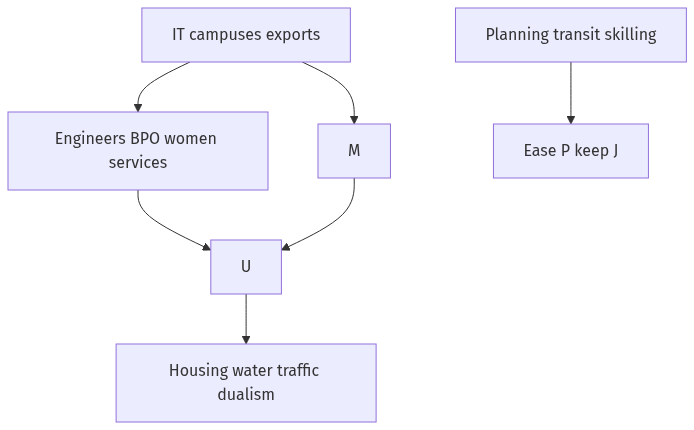
Flow diagram
Conclusion
IT-hub cities such as Bengaluru, Hyderabad, Pune, and Gurugram opened large new streams of skilled and multiplier work. They also created housing, water, traffic, e-waste, and dual-labour problems that mill towns never had in this form. The statement stands: new avenues and new urban wounds arrived together.
Quick related
Students also ask
-
Discuss the concept of air mass and explain its role in macro-climatic changes.
Next question on this syllabus topic (2016 · Q13). View answer →
-
Are IT jobs only for engineers?
The high wage is. A larger ring of drivers, cleaners, cooks, and construction workers also lives off the hub.
-
Is water stress caused by software itself?
Code uses little water. The IT city—sprawl, lakes filled for layouts, and groundwater for campuses and apartments—uses a great deal.
Same topic · past papers
UPSC has asked this before
These previous-year questions sit on the same topic. Open one to practise the earlier ask.
-
2019 · Q6 · GS I · 10 marks
Can the strategy of regional resource-based manufacturing help in promoting employment in India.
More from this topic
Q17 · UPSC Mains 2026 · GS I · 15 marks · Solution
Analyze the major drivers of human-induced land-use changes in India and their geographical consequences.
World's Physical Geography
India's land-use change is driven by agricultural intensification, urban growth, infrastructure, mining, plantations, tourism and livelihood shifts. These changes support food, connectivity and jobs, but they also disturb hydrology, soil, habitats, microclimates, hills, coasts and access to commons. Sustainable land governance must combine mapping, carrying-capacity assessment and local participation.
Q16 · UPSC Mains 2026 · GS I · 15 marks · Solution
"The centre of global trade is gradually shifting from the Atlantic region to the Indo-Pacific region." Examine this statement.
World's Physical Geography
Global trade’s centre of gravity is moving towards the Indo-Pacific because manufacturing, consumption, energy shipping and new tech rules are concentrating between the Indian and Pacific Oceans. China-plus-one, ASEAN growth, India’s market, Malacca–Hormuz lanes, RCEP/IPEF and semiconductor corridors drive the trend. The Atlantic still matters in finance and standards, so the change is gradual rebalancing. India gains only if ports, manufacturing and sea-lane security keep pace.
Q14 · UPSC Mains 2026 · GS I · 15 marks · Solution
Compare the Loo, Chinook and Foehn winds with respect to their regions of prevalence, their nature and climatic impacts.
World's Physical Geography
The Loo is a hot, dusty pre-monsoon wind of northwestern India and the Indo-Gangetic plains. Chinook and Foehn are warm, dry downslope winds of the Rockies and Alps, formed by adiabatic compression. Their impacts differ from Indian heat stress to snowmelt and mountain hazards.