
Revision summary
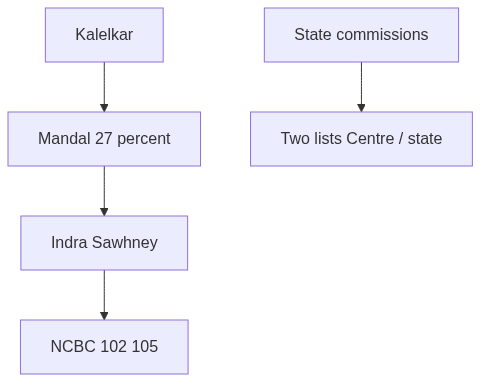
Kalelkar listed; Mandal implemented 27 percent with social-educational-economic tests. Indra Sawhney added creamy layer and a 50 percent ceiling. 102nd Amendment constitutionalised NCBC; 105th restored state lists after the Maratha judgment. Rohini tries to sub-categorise Central OBCs; Ram Singh required data for Jat inclusion. Centre and states maintain separate lists; method is gazette politics under judicial review.
Model answer
Copper italics in this answer — like this — are the key facts. Each one is unpacked in the Facts & figures rail.
Introduction
Other Backward Classes are not in the original caste-schedule sense of SC/ST. They are a developmental-political list of socially and educationally backward groups, built by commissions, gazettes and courts. History and method are one story.
Body
National history
Kaka Kalelkar Commission (1953) first listed backward classes for the Union; Nehru’s government did not implement a national quota from it, partly because the list looked like a caste census. Mandal Commission (1979, report 1980, implemented 1990) used social, educational and economic indicators, 1931 census proxies, and arrived at about 52 percent of the population as OBC, recommending 27 percent jobs. Indra Sawhney (1992) upheld 27 percent, barred reservation in promotions for OBCs (as then argued), imposed creamy layer, and set a 50 percent ceiling except in extraordinary situations.
NCBC began as a statutory body (1993) and became constitutional by the 102nd Amendment (2018). Jaishri Laxmanrao Patil (Maratha, 2021) read 102nd as giving the President (Union) the exclusive power to notify SEBCs for the purpose of Article 342A, unsettling state lists. The 105th Amendment (2021) restored states’ power to make their own OBC lists. Rohini Commission (sub-categorisation of Central OBCs) tried to split a lumped list so that a few dominant OBCs do not take most posts; its politics remain unfinished.
Janhit Abhiyan (2022) upheld EWS 10 percent, showing another backwardness track beside OBC.
State methods
States had backward-class commissions and lists before Mandal (Tamil Nadu’s long quota history, Karnataka, Bihar). Methods: public notification, representations, socio-economic surveys, public hearings, and a gazette. Some states use occupation plus caste; some notify Muslim occupational groups as OBC. Quantifiable data after Indra Sawhney and later Ram Singh (Jat, 2015) is the judicial test: a state cannot notify a dominant agrarian caste as OBC on assertion alone.
Inclusion and exclusion petitions go to the state commission, then to the government, then often to the High Court. Central list for Union jobs and UPSC is separate from the state list for state services. A community can be OBC in one and not the other.
What “method” means
It is not anthropometry. It is indicators, politics, gazette and judicial review. Anthropology’s caste ethnography (dominant caste, Sanskritisation) explains why some powerful jatis still reach the list. The honest method would be a caste census with deprivation scores and sub-quotas. India has pieces of that (Bihar survey, Rohini) without a settled national instrument.
Flow diagram
Conclusion
OBC lists grew from Kalelkar’s unused catalogue to Mandal’s 27 percent, Indra Sawhney’s rules, a constitutional NCBC, a shock after the 102nd Amendment, and restoration by the 105th. States and the Union keep separate gazettes. The method is commission plus data plus court, not a blood test.
Quick related
Students also ask
-
Digitisation of rural economy
Next question on this syllabus topic (2024 · Q1(a)). View answer →
-
Is OBC the same as Shudra varna?
No. The list is empirical and political. Some Shudra groups are dominant and fail the data test; some Muslim and Christian occupational groups are included in states.
-
Why two lists?
Federalism. Union jobs follow the Central list; state jobs follow the state list. A person may be OBC for one and not the other.
Same topic · past papers
UPSC has asked this before
These previous-year questions sit on the same topic. Open one to practise the earlier ask.
-
2022 · Q5(a) · Anthropology GS 2 · 10 marks
Regionalism as an opportunity and threat to national integration
More from this topic
Q6(a) · UPSC Mains 2026 · Anthropology GS 2 · 20 marks · Solution
Make a critical appraisal of the mesolithic culture of Ganga basin with reference to artifacts, faunal and human skeletal remains excavated from different sites
Evolution of the Indian Culture and Civilization
• Ganga basin Mesolithic sites like Sarai Nahar Rai, Mahadaha, and Damd
Q5(e) · UPSC Mains 2026 · Anthropology GS 2 · 10 marks · Solution
Contribution of L. K. Ananthakrishna Iyer in Anthropology.
Evolution of the Indian Culture and Civilization
L. K. Ananthakrishna Iyer is a pioneering figure in Indian anthropology, known for his monumental ethnographic surveys like The Cochin Tribes and Castes and The Mysore Tribes and Castes. Working during the colonial era, he bridged western anthropological methods with indigenous scholarship. His documentation of social stratification, material culture, and folklore laid the empirical foundation for Indian sociology and anthropology. Iyer also established the first department of anthropology in India at the University of Calcutta, shaping institutional teaching and research.
Q5(c) · UPSC Mains 2026 · Anthropology GS 2 · 10 marks · Solution
Article 371A of the Indian Constitution.
Evolution of the Indian Culture and Civilization
Article 371A of the Indian Constitution grants special autonomous status to Nagaland, protecting its traditional socio-religious practices, customary laws, and land ownership rights. Enacted via the 13th Constitutional Amendment Act, 1962, following the 16-point Agreement, it reflects the asymmetrical federal framework of India. The article places a special responsibility on the Governor regarding law and order and regional financial allocations. It balances tribal autonomy with national integration, though it faces implementation challenges in modern governance.