
Revision summary
The statement is from the Srinivas village-studies tradition: the village as a designed microcosm of Indian civilisation. Design includes caste ecology, agrarian rank, ritual calendar and factional politics. Values: hierarchy-with-interdependence, local dharma, jati marriage, sacred geography. Marriott, Dube and Bailey showed regional versions of the same idea. Land reform, migration, 73rd Amendment and PESA have rewritten the plan without erasing rank.
Model answer
Copper italics in this answer — like this — are the key facts. Each one is unpacked in the Facts & figures rail.
Introduction
The sentence that the Indian village was not merely a place where people lived, but a design that reflected the basic values of Indian civilisation, belongs to the village-studies school, and is taught in this paper as M. N. Srinivas’s claim. McKim Marriott, S. C. Dube, F. G. Bailey and Oscar Lewis worked in the same key: the village as a microcosm, not a random scatter of huts.
Body
Who said it
Srinivas, from Rampura and from his essays on the Indian village, argued against the idea of the village as a mere administrative unit or a Gandhi-romantic republic. He also argued against the opposite caricature — a shapeless mass. The village had a plan: caste streets, temple and mosque, tank, fields, cremation ground, the dominant caste’s houses near the centre, Dalit hamlets at the edge. That plan was social, not only architectural.
Marriott’s Kishan Garhi, Dube’s Shamirpet, and Bailey’s Bisipara showed regional variants of the same idea: civilisation is visible in settlement.
The design
- Caste ecology: who lives where, who takes water first, whose well is separate.
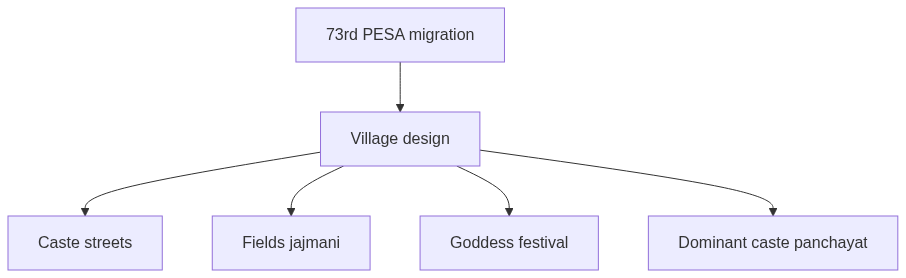
- Agrarian design: landlord, tenant, labour, jajmani or its local form, the harvest calendar as a moral year.
- Ritual design: village goddess, possession, festival that includes and ranks, Little Tradition nested in Great.
- Political design: dominant caste, factions, panchayat, later the statutory Gram Panchayat.
- Values said to be reflected: hierarchy with interdependence, dharma as local duty, joint family and jati marriage, sacred geography of fields and groves. Dumont would say purity; Srinivas would say dominance and flexibility.
Qualification
The design was never frozen. Land reform, Green Revolution, migration, panchayat reservation, Christianity and the party system cracked streets and jajmani. Béteille in Tanjore showed class splitting caste. Jan Breman showed footloose labour. The 73rd Amendment and PESA recoded the village as a constitutional Gram Sabha, which is a new design, not Srinivas’s Rampura.
- The civilisation-in-the-village thesis remains useful as a method: read settlement, rank and ritual together. It fails if it denies the factory, the slum and the ST hamlet outside the caste village. India’s values also live in the Constitution, which the village did not design.
Flow diagram
Conclusion
Srinivas and the village-studies school saw the village as a designed microcosm of hierarchy, duty and sacred geography. That insight still guides ethnography. Law, labour and reservation have redrawn the plan.
Quick related
Students also ask
-
Trace the history and describe the methods of formulating the lists of OBCs, both at the State and National levels
Next question on this syllabus topic (2025 · Q6(c)). View answer →
-
Did Srinivas think villages never changed?
No. He wrote on Sanskritisation and Westernisation. The “design” is a structure that can shift, not a stone temple.
-
Is the Indian city outside this civilisation?
No. The point was that civilisation was not only in texts and courts; it was also in village rank. Cities have their own designs.
Same topic · past papers
UPSC has asked this before
These previous-year questions sit on the same topic. Open one to practise the earlier ask.
-
2025 · Q8(b) · Anthropology GS 2 · 15 marks
Define minority. Elaborate the patterns of linguistic and religious minorities in India
More from this topic
Q6(a) · UPSC Mains 2026 · Anthropology GS 2 · 20 marks · Solution
Make a critical appraisal of the mesolithic culture of Ganga basin with reference to artifacts, faunal and human skeletal remains excavated from different sites
Evolution of the Indian Culture and Civilization
• Ganga basin Mesolithic sites like Sarai Nahar Rai, Mahadaha, and Damd
Q5(e) · UPSC Mains 2026 · Anthropology GS 2 · 10 marks · Solution
Contribution of L. K. Ananthakrishna Iyer in Anthropology.
Evolution of the Indian Culture and Civilization
L. K. Ananthakrishna Iyer is a pioneering figure in Indian anthropology, known for his monumental ethnographic surveys like The Cochin Tribes and Castes and The Mysore Tribes and Castes. Working during the colonial era, he bridged western anthropological methods with indigenous scholarship. His documentation of social stratification, material culture, and folklore laid the empirical foundation for Indian sociology and anthropology. Iyer also established the first department of anthropology in India at the University of Calcutta, shaping institutional teaching and research.
Q5(c) · UPSC Mains 2026 · Anthropology GS 2 · 10 marks · Solution
Article 371A of the Indian Constitution.
Evolution of the Indian Culture and Civilization
Article 371A of the Indian Constitution grants special autonomous status to Nagaland, protecting its traditional socio-religious practices, customary laws, and land ownership rights. Enacted via the 13th Constitutional Amendment Act, 1962, following the 16-point Agreement, it reflects the asymmetrical federal framework of India. The article places a special responsibility on the Governor regarding law and order and regional financial allocations. It balances tribal autonomy with national integration, though it faces implementation challenges in modern governance.