
Revision summary
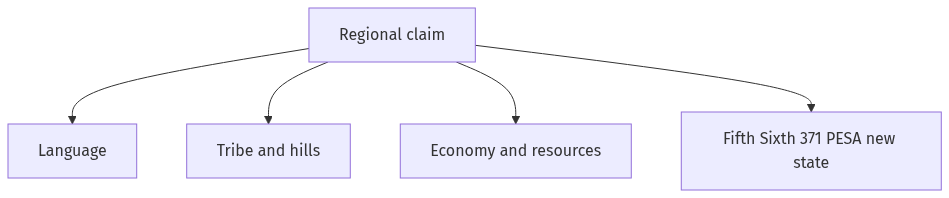
Regionalism politicises territory through language, tribe, history or economy. Autonomy is the constitutional reply: new states, Fifth and Sixth Schedules, PESA, Article 371, Inner Line. Bhuria and Xaxa named the gap between paper PESA and practice. Bommai, Sarkaria and Punchhi frame the Union–state balance. Examples include Telangana, Bodoland, Gorkhaland, Naga accords and resource belts under Samata and FRA.
Model answer
Copper italics in this answer — like this — are the key facts. Each one is unpacked in the Facts & figures rail.
Introduction
Regionalism is the political use of a territory’s language, history, tribe or economy against a larger centre. Autonomy is the legal space that the Constitution gives such a region so that it can stay inside the Union. Anthropology reads both as identity and as resource politics, not only as map-drawing.
Body
What regionalism is
It is not the same as secession. Most Indian regionalisms ask for a state, an autonomous council, a hill district, or special fiscal treatment. Linguistic reorganisation after the States Reorganisation Commission (Fazal Ali, 1955) and the creation of Andhra, then later Jharkhand, Chhattisgarh, Uttarakhand and Telangana, show the Union answering region with new states.
Tribal regionalism is older than language politics in the hills. Naga, Mizo, Bodo, Gorkha and Jharkhand movements mixed ethnicity, land and mission or mining history. F. G. Bailey and Sachchidananda already saw “tribe” becoming a regional political category.
Constitutional autonomy
- Article 3 lets Parliament form new states.
- Fifth Schedule and Tribes Advisory Councils, with the Governor’s regulations, are the plains-and-peninsula device. PESA, 1996, after the Bhuria Committee, tries to put Gram Sabha at the centre of land, minor forest produce and intoxicants in Fifth Schedule areas. Implementation is uneven, as the Xaxa Committee (2014) recorded.
- Sixth Schedule gives Autonomous District Councils in parts of Assam, Meghalaya, Tripura and Mizoram. Bodoland Territorial Region after the 2020 accord is a later, thicker council.
- Articles 371A to 371J special-status clauses protect Nagaland land and social practice, Sikkim, Mizoram, Manipur hills, Andhra–Telangana, Karnataka Hyderabad-Karnataka, and others.
- Inner Line under the Bengal Eastern Frontier Regulation, 1873, still structures Arunachal, Nagaland, Mizoram and now Manipur.
S. R. Bommai v. Union of India (1994) limited arbitrary central takeover of states. Punchhi and Sarkaria Commissions discussed federal balance. The Supreme Court in the NCT of Delhi cases and in Kerala/Centre fiscal disputes keeps returning to the same tension: region wants room, Union wants one market and one security policy.
Living examples
Telangana combined language pride with a claim that coastal Andhra took canal and job surplus. Gorkhaland remains an autonomous hill council rather than a state. In the North-East, ILP, AFSPA debates and peace accords (Naga Framework, Bodo, Bru resettlement) show autonomy as a peace technology. Resource regionalism — Odisha bauxite, Jharkhand coal, Ladakh Sixth Schedule demand after 2019 — ties identity to Samata (1997) and forest-rights litigation.
Autonomy fails when councils are captured by a single elite, when funds bypass Gram Sabha, or when a new inner minority (Bru in Mizoram, non-Bodo in BTR) is squeezed.
Flow diagram
Conclusion
Indian regionalism usually asks to rearrange the Union, not to leave it. Fifth and Sixth Schedules, PESA, Article 371 and new states are the toolkit. The test is whether autonomy protects land and language without creating a smaller domination inside the region.
Quick related
Students also ask
-
Impact of urbanization and industrialization on tribal communities of India.
Next question on this syllabus topic (2025 · Q5(a)). View answer →
-
Is every demand for a new state secession?
No. Article 3 is the ordinary Union method for creating states. Secession would deny the Constitution; regionalism usually uses it.
-
Why do hill movements ask for Sixth Schedule?
It offers a council with land and custom powers inside the state, short of full statehood, which is why Bodos, some Gorkhas and some Ladakhis use that language.
Same topic · past papers
UPSC has asked this before
These previous-year questions sit on the same topic. Open one to practise the earlier ask.
-
2016 · Q5(a) · Anthropology GS 2 · 10 marks
The role that regionalism plays in demand for autonomy among Indian tribes -
2022 · Q5(a) · Anthropology GS 2 · 10 marks
Regionalism as an opportunity and threat to national integration
More from this topic
Q8(b) · UPSC Mains 2026 · Anthropology GS 2 · 15 marks · Solution
What are the major challenges tribal communities are facing in contemporary India?
The concept of ethnicity
• Tribal communities face severe displacement from ancestral lands due to large-scale mining, dams, and industrial projects. • Protective laws like the CNT and SPT Acts often fail to prevent illegal land transfer to non-tribals and corporations. • Delays in implementing the Forest Rights Act (FRA) restrict access to minor forest produce and disrupt traditional livelihoods. • State restrictions and ecological pressures are forcing a decline in traditional Jhum (shifting cultivation) practices. • Mainstreaming pressures, market forces, and religious conversions are eroding indigenous languages, beliefs, and customary governance. • Remote tribal areas suffer from acute health deficits—like malnutrition and sickle cell anaemia—and high educational dropout rates. • Sustainable solutions require moving past paternalistic welfare toward self-determination and strictly enforcing PESA and FRA.
Q5(a) · UPSC Mains 2026 · Anthropology GS 2 · 10 marks · Solution
Buddhist tribes of India.
The concept of ethnicity
• Major Buddhist tribes include the Monpa, Sherdukpen, Khampti, Singpho, Chakma, and Bhutia. • They are geographically concentrated in the Himalayan belt and Northeast India, specifically across Arunachal Pradesh, Assam, Sikkim, Mizoram, Tripura, and West Bengal. • Their religious practice is a syncretism of canonical Buddhism (Mahayana, Theravada, or Tibetan) and indigenous animism or Bon beliefs. • Rituals frequently honor local mountain deities and spirits alongside formal monastic practices led by lamas or bhikthus. • Unlike rigid caste systems, their societies remain relatively egalitarian, guided by clan ties and customary village councils. • They primarily speak Tibeto-Burman or Tai dialects, maintaining oral traditions alongside written scriptures in Tibetan or Tai scripts. • Preserving their unique identity requires balancing modernization with constitutional protections under the Scheduled Tribes framework.
Q4(a) · UPSC Mains 2026 · Anthropology GS 2 · 20 marks · Solution
Write an account on the contribution of Verrier Elwin in developing policies for the tribal populations in post-independent India
The concept of ethnicity
Verrier Elwin played a foundational role in shaping post-independent India's tribal policy by advocating for cultural autonomy, protection of land rights, and cautious assimilation. Influenced by his anthropological work in Central India and NEFA, his ideas directly shaped Jawaharlal Nehru's Tribal Panchsheel. While critiqued for encouraging isolationism, his emphasis on tribal heritage ensured a distinct administrative framework under the Sixth Schedule.